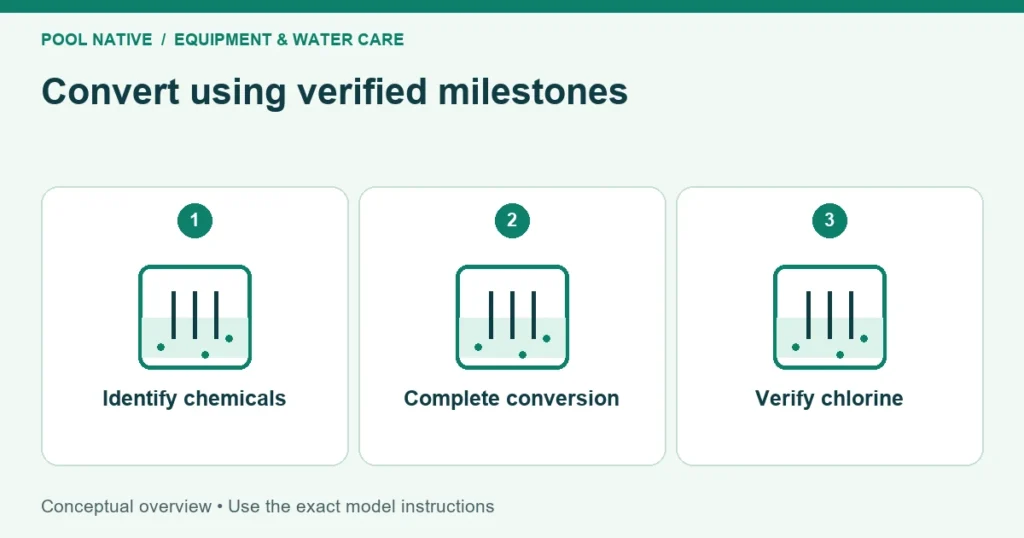
Converting a biguanide pool to chlorine requires removing or treating the old sanitizer system before establishing the new one. PHMB and its peroxide oxidizer must both be considered. Adding chlorine to an otherwise unchanged biguanide maintenance routine is not a complete conversion plan.
Choose a route with the product manufacturer or a pool professional familiar with biguanide. The two broad approaches are a suitable water replacement plan or a controlled chemical conversion. The exact chemicals and endpoints must match the products already in the pool.
Record what is actually in the water
Identify the biguanide sanitizer, peroxide oxidizer, and any support products. Include algaecides, metal treatments, clarifiers, and recent opening or closing chemicals. Keep the bottles or clear label photographs available.
Measure the sanitizer and oxidizer separately with suitable tests. Also obtain pH, alkalinity, hardness, and relevant metal results. Confirm the pool volume and filter type before estimating treatment or replacement water.
| Record | Why the conversion needs it |
|---|---|
| PHMB level | Establishes the remaining biguanide sanitizer |
| Peroxide or program oxidizer result | Identifies another part of the old treatment system |
| Recent additions and dates | Prevents an unexplained reaction or misleading test |
| Pool volume and surface | Informs dosing and whether water exchange is suitable |
| Filter type and condition | Determines cleaning or media work |
| Intended chlorine method | Plans the final routine after conversion |
An old strip reading or a clear appearance is not enough. If the existing program is uncertain, have the water assessed before adding anything. A test method intended only for chlorine will not identify the PHMB residual.
Understand why a simple switch can fail
The BAQUACIL sanitizer label states that it is incompatible with chlorine and bromine. Its peroxide oxidizer also serves a different chemical role from chlorine sanitizer. Remaining old products can complicate the change and consume newly added chlorine.
Do not add a chlorine tablet to a biguanide pool as a small trial. Do not turn on a newly installed salt cell to perform the conversion automatically. Both introduce chlorine before the old system has been dealt with under a suitable plan.
Non chlorine shock is not a universal conversion chemical. Products sold under that description can use different active ingredients. A recipe naming an old product cannot safely be transferred to a different modern bag solely because the category sounds the same.
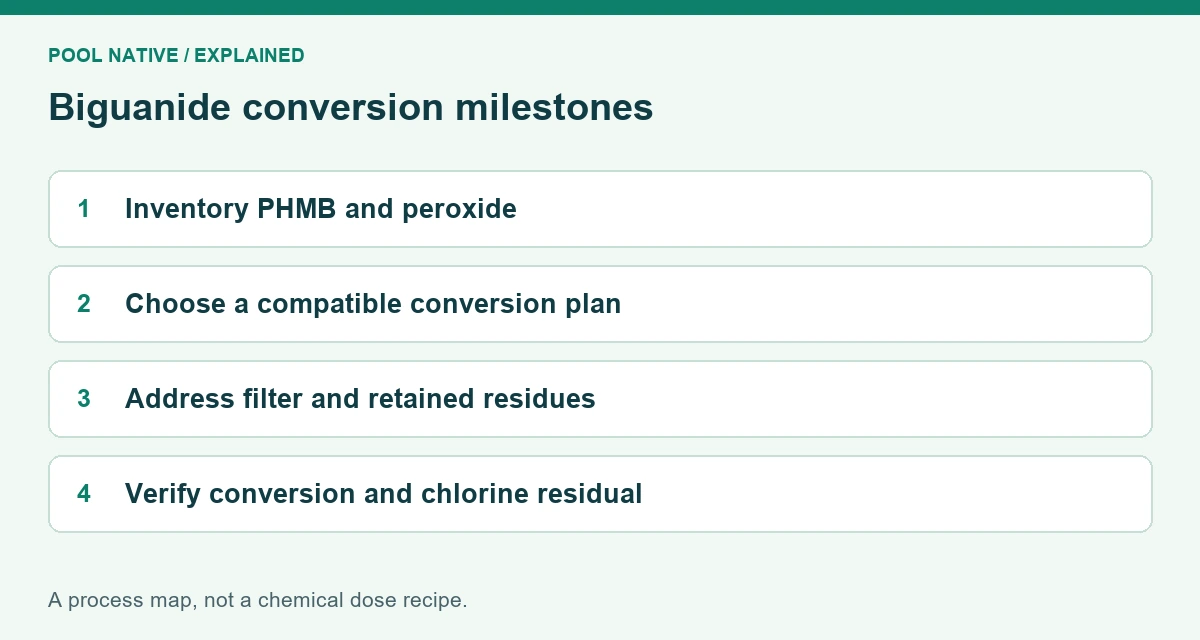
Choose a route appropriate for the pool
| Route | What must be planned | What it does not justify |
|---|---|---|
| Controlled water replacement | Structural suitability, groundwater, discharge, refill quality, and residual testing | Draining a pool completely without assessment |
| Product specific chemical conversion | Exact products, doses, testing intervals, filtration, and completion criteria | Combining several internet recipes |
Water replacement may reduce the quantity of old chemistry that needs treatment. Whether it is suitable depends on the pool structure, liner, ground conditions, and local discharge arrangements. Have the safe method and permitted water level established before starting.
A chemical route needs written instructions for the actual products and measured starting levels. Request the test method, next step, and stopping condition for each stage. The current BAQUACIL care guide’s instructions for converting into biguanide are not instructions for converting out of it.
Do not mistake dilution for removal
Replacing half the water does not remove all the sanitizer. With thorough mixing and replacement water containing none, 50 ppm becomes approximately 25 ppm after one 50 percent exchange. A second separate 50 percent exchange leaves approximately 12.5 ppm.
Those figures are an arithmetic example, not a recommended draining schedule. They assume each exchange removes half the mixed pool water before refill. Simultaneous filling and draining can behave differently and needs its own professional plan.
Peroxide and other dissolved ingredients also need verification afterward. Do not infer their final readings from the PHMB result alone. Test the actual water once circulation and mixing are complete.
Prepare filtration and allow for repeated attention
Ask which filter cleaning steps belong before, during, and after the chosen conversion. Record the clean starting pressure and the equipment’s cleaning trigger. Conversion work should not continue through a severely restricted filter.
Use cleaners compatible with the filter and the chemistry present at that stage. Ordinary backwashing or rinsing may not remove every retained deposit. Follow the approved cleaning procedure rather than combining chemicals in the filter tank.
Do not replace all filter media automatically without an assessment. The needed work differs between sand, cartridge, and diatomaceous earth filters and their condition. The plan should explain whether cleaning, recharge, or replacement is required and when.
Shut down and relieve pressure before opening equipment. Keep removed material out of the return plumbing. Reassemble and verify flow before continuing the next authorized treatment stage.
Keep a conversion log
Write down each measured result before adding the next product. Record its name, concentration, amount, application time, and the next scheduled test. This avoids repeating a dose because the water still looks unchanged.
Keep the pool closed during conversion and maintain the specified circulation and supervision. Do not abandon the old sanitizer program for weeks while the pool remains available for swimming. Schedule the transition for a period when testing and filter attention can be completed.
If an unexpected color, precipitate, or rapid pressure rise appears, record it and follow the plan’s response. Do not assume every color change is harmless or proof of progress. Contact the supervising professional or product support before adding another treatment to chase the appearance.
Use completion criteria before starting ordinary chlorination
The conversion plan should confirm that residual PHMB and oxidizer have reached its specified endpoints using the correct tests. Filtration and water clarity must be restored, and pH and other balance measurements must suit the new program. A single zero reading on an unsuitable strip does not establish completion.
Next establish and maintain the required free chlorine residual using the intended chlorine product and verified pool volume. Follow that product’s directions and the pool’s stabilizer conditions. Confirm the residual persists under the plan’s follow up testing rather than disappearing immediately.
CDC’s general guidance specifies at least 2 ppm chlorine in pools using cyanuric acid. This is not a complete target for every stabilizer concentration. Have the final operating range established for the actual water and sanitizer method.
Start the long term routine only after verification
If converting to saltwater, complete the chemical transition before commissioning the chlorine generator. Follow the salt conversion planning guide for compatibility, salinity, installation, and output. The cell should maintain an established program rather than serve as an uncontrolled conversion reactor.
Remove obsolete dosing instructions from the maintenance area and label the new program clearly. Retain the conversion record and update anyone who services the pool. If remaining on biguanide instead, use the biguanide maintenance guide and keep incompatible chlorine products out of that routine.


