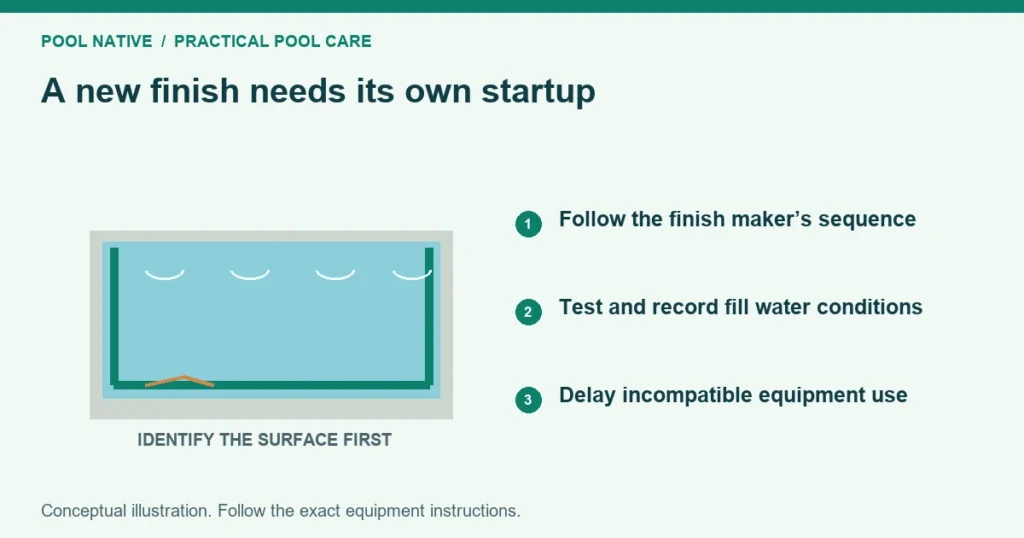
A new plaster startup needs a written plan before the pool begins filling. Confirm the exact finish, who controls water chemistry and who handles daily brushing and filtration. The installer should provide the filling release and product specific equipment restrictions.
A generic thirty day calendar cannot replace those instructions. Traditional plaster and proprietary aggregate finishes may use different startup procedures. Even one manufacturer may issue a separate plan for salt systems.
Before the installer leaves
Collect the finish brand, product name, color and application date. Ask whether any exposure, washing or other installation work remains before filling. Get a clear instruction for when the owner takes responsibility.
For example, PebbleTec describes a break in phase performed by the builder or authorized applicator before the owner startup. Its exact process depends on the finish. Do not interrupt that work because another pool was filled immediately after troweling.
Obtain the current startup sheet and contact details for problems during filling. Save warranty registration requirements. If the service company and installer provide conflicting instructions, have them resolve the difference together before dosing begins.
Test the actual fill source
Have the source water tested before filling. The National Plasterers Council specifically recommends this because municipal and well water can vary. Do not rely on an old report from another address or a different source.
Record pH, alkalinity, calcium hardness and relevant metals. Ask the startup professional whether the results require a modified plan. Water described as potable can still present scaling, staining or surface protection issues in a new pool.
Identify hose connections supplied through a household softener. PebbleTec directs owners not to use softened water for the initial fill. Tell the installer before connecting that hose rather than trying to correct the result afterward.
If delivery water is used, record its source and test information too. The final pool water may combine several sources. Everyone making chemical calculations needs to know that.
Assign the work explicitly
| Task | Person to name before filling | Record to keep |
|---|---|---|
| Release the finish for water | Installer or authorized applicator | Date, time and remaining restrictions |
| Supervise filling | Owner or appointed helper | Start, interruptions and completion |
| Start circulation safely | Builder or service professional | Operating setup and filter baseline |
| Test and adjust chemistry | One responsible startup operator | Results, additions and retest times |
| Brush the entire finish | Owner or contracted service | Areas completed and unusual residue |
| Approve equipment return | Responsible installer or service professional | Separate dates and conditions |
Do not let two people independently add chemicals from different instructions. Agree on one shared record. If the owner will be away, arrange the required work beforehand instead of assuming a weekly visit will cover it.
During filling
Follow the installer’s approved hose placement and target water level. Once the authorized continuous fill begins, avoid unnecessary interruptions. Pausing can leave a visible waterline mark on a fresh finish.
Keep people and pets out during filling. Protect the surface from dirt, irrigation runoff and objects dropped into the pool. Do not walk on the finish to move equipment without the installer’s direction.
If the water supply fails, contact the installer promptly and record the interruption. If a leak, structural concern or other hazard appears, report it immediately. Continuous filling instructions do not mean ignoring an emergency.
Do not start circulation before the pool and equipment are ready. A builder should confirm adequate water level, open flow routes and the correct operating setup. An empty pump or closed route creates an equipment problem unrelated to curing.
Make the first chemistry check a measured one
Once the pool is ready for circulation, follow the startup procedure using the actual volume and test results. Avoid a universal acid dose based only on pool size. The starting water chemistry determines what correction is required.
Fresh cementitious surfaces can change pH and calcium conditions during startup. That makes repeated testing necessary. Write down the result before an addition and the later result after the required circulation period.
Do not combine calcium hardness and alkalinity additions in one container or add incompatible chemicals together. Follow the product labels and the startup operator’s sequence. Concentrated chemicals must not remain against the finish.
Sanitizer timing and target ranges must come from the approved startup plan. Some procedures delay initial chlorination. Keep the pool closed to swimming until it is properly balanced, sanitized and otherwise ready for use.
Brush the whole surface with the specified tool
Use the exact finish’s recommended brush. PebbleTec’s general care page specifies nylon and a frequent initial schedule. Its public guidance describes three sessions daily for the first three days, then two daily for ten days.
That is a named manufacturer’s example, not a schedule for every plaster product. Get the requirement for your registered finish and system in writing. A contractor’s approved procedure may include additional instructions for that installation.
Cover walls, steps, benches and the floor with overlapping passes from safe access. Record areas you cannot reach so the service provider can address them. Brushing one visible section repeatedly does not complete the whole pool.
Observe the residue without grinding the surface. Report unusually heavy material loss, sharp areas or persistent changes. Some dust or limited aggregate release can occur initially, but a new defect still deserves assessment.
Keep filtration working through startup
Brushing loosens material; circulation and filtration remove it. Monitor the filter pressure and flow against the startup baseline. Follow the filter manual for cleaning and safe pressure release.
The PebbleTec general startup document requires continuous circulation for at least seven days or until the specified dust condition clears, whichever is longer. Other procedures can differ. Confirm the applicable duration instead of shortening it to a normal maintenance schedule.
A cleaner is not an automatic substitute for brushing. Some cleaners are restricted on fresh finishes. Do not put one in service until the exact model and finish combination is approved.
Give each piece of equipment its own release
Record separate approvals for heating, adding salt, enabling the salt generator and using an automatic cleaner. These are different actions. A pool can be ready for one and not the others.
PebbleTec’s general instructions delay heating for at least fourteen days and require the dust condition to be suitable. They delay wheeled cleaners for twenty eight days. Its salt system procedures require their own review; do not borrow a shorter date from a general article.
Have a professional arrange any heater bypass required by the startup plan. Do not close an unknown valve or alter plumbing by guesswork. Confirm normal routing again when equipment returns to service.
At the end of the startup period
Arrange a handoff review of water results, surface appearance, filter condition and equipment restrictions. Establish the ongoing testing and care schedule. The first month is an important development period, not a promise that cement chemistry stops on one date.
Photograph the finish in ordinary daylight and record unresolved concerns. New or worsening roughness should be assessed before abrasive treatment. For routine care afterward, use the plaster and aggregate maintenance guide.
Keep the completed checklist with the product record. It should show what happened, who handled it and what remains restricted. That is more useful than an unsigned instruction sheet found after a problem appears.


