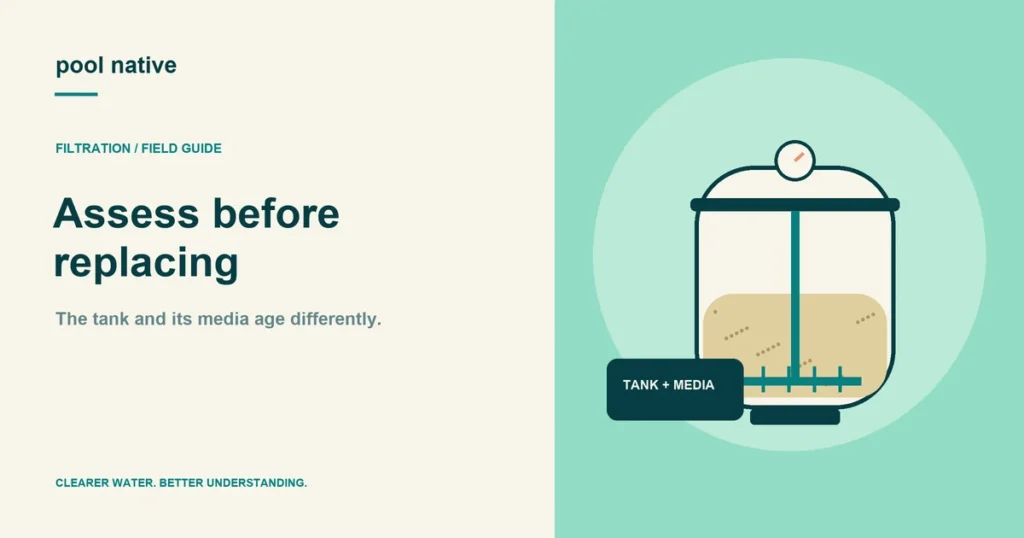
How long should a pool filter last? There isn’t one reliable replacement age for the complete assembly. A tank, valve, seal, and filter element can wear at different rates, so identify the failing part before replacing everything.
Published lifespan ranges often blur those parts together. A cartridge replacement after several seasons doesn’t mean the tank reached the end of its life. A cracked pressure vessel, however, isn’t made serviceable by adding fresh media.
Separate the filter assembly from its replaceable parts
| Part | What needs assessment | What its age doesn’t establish |
|---|---|---|
| Tank and closure | Structural condition, correct hardware, and safe sealing | That a vessel is safe because it is relatively new |
| Valve and plumbing connections | Leaks, operation, and internal bypass | That the whole tank needs replacement |
| Cartridges or DE elements | Fabric, end caps, support, fit, and cleaning response | That discoloration means failure |
| Sand or other approved granular media | Correct grade, quantity, condition, and filtration performance | That a calendar date alone requires new media |
| Gauge and air relief | Reliable operation and model compatibility | That an apparently normal reading proves the tank is depressurized |
The practical question is “What has deteriorated, and can it be restored safely?” That produces a better answer than choosing a number of years from an average.
When the tank needs professional assessment
Stop using equipment with a cracked or distorted tank, damaged closure, or leaking clamp. Don’t tighten it while pressurized. Follow the safe shutdown procedure and arrange qualified service.
A pool filter is a pressure vessel. Tape, sealant, or an improvised patch isn’t an acceptable repair for structural damage. Exterior weathering also needs proper assessment if you can’t distinguish it from damage.
Don’t assume a tank that survived last season is safe today. Freeze damage, impact, chemical exposure, and incorrect assembly can change its condition. Keep chemicals stored according to their labels, away from equipment they could damage.
Manufacturer guidance recommends professional filter servicing. The exact closure procedure matters because designs differ. An old filter with a missing label or mismatched hardware deserves identification before another operating season.
When replacing a component may be enough
A sound tank may need a compatible seal, valve component, cartridge set, or other approved part. Ask the technician to identify the defect and show the corresponding replacement in the parts diagram.
For cartridge media, inspect the fabric, end caps, and support structure. Check whether proper cleaning restores performance under the same operating conditions. See the cartridge replacement decision guide for those checks.
For sand, persistent trouble can involve the valve or internal piping rather than worn media. Fresh sand won’t repair a broken lateral. The sand replacement timing guide separates those causes.
A worn gauge is another distinct issue. Replacing the tank because one gauge reads strangely would skip diagnosis. Equally, trusting a stuck gauge can make service dangerous.
Use the service history to judge the next repair
Gather the installation date if known, previous repair invoices, and the current model label. Note whether the same fault keeps returning. Record what each repair changed.
Two repairs on unrelated consumables don’t necessarily suggest a failing assembly. Repeated leakage at the same damaged sealing surface is a different concern. Ask why the proposed repair should resolve the cause this time.
Also compare operation before and after cleaning. A changed pump program can make the gauge reading look worse without proving that the filter aged suddenly. Our equipment log keeps the settings attached to the readings.
Compare repair and replacement quotes on the same basis
Ask for two clear scopes when both options are reasonable. A repair quote should name the defective part and required labor. A replacement quote should include the tank, valve if needed, media, plumbing alterations, and commissioning.
- Are the tank and closure confirmed serviceable?
- Are approved parts available for the exact model and revision?
- Does the current filter meet the system’s operating requirements?
- Will the repair address the cause, or only the latest symptom?
- What access, disposal, and plumbing work does replacement require?
- What warranty applies to the actual work and parts being supplied?
A cheap element replacement isn’t good value if the tank is unsafe. A complete replacement isn’t automatically good value when a sound assembly needs one supported part. Avoid a fixed repair percentage that ignores condition and installation work.
Consider changes to the pool since installation
The original filter may have been adequate for a system that no longer exists. A different pump, additional water feature, or changed operating mode can alter flow. Recheck the match if equipment has changed.
Use the filter sizing checks when replacement becomes necessary. Buying the closest looking tank isn’t a sizing method. Neither is automatically choosing the largest model.
If the filter still performs normally, has sound components, and remains supported, age alone is a weak reason to discard it. Keep inspecting and servicing it as directed. If structural condition is uncertain, resolve that uncertainty before operating it.