
A UV pool sanitizer treats water as it passes through a chamber containing an ultraviolet lamp. It provides supplemental treatment within that chamber, not a lasting sanitizer residual throughout the pool. Continue the required chlorine or other approved sanitizer program and routine testing.
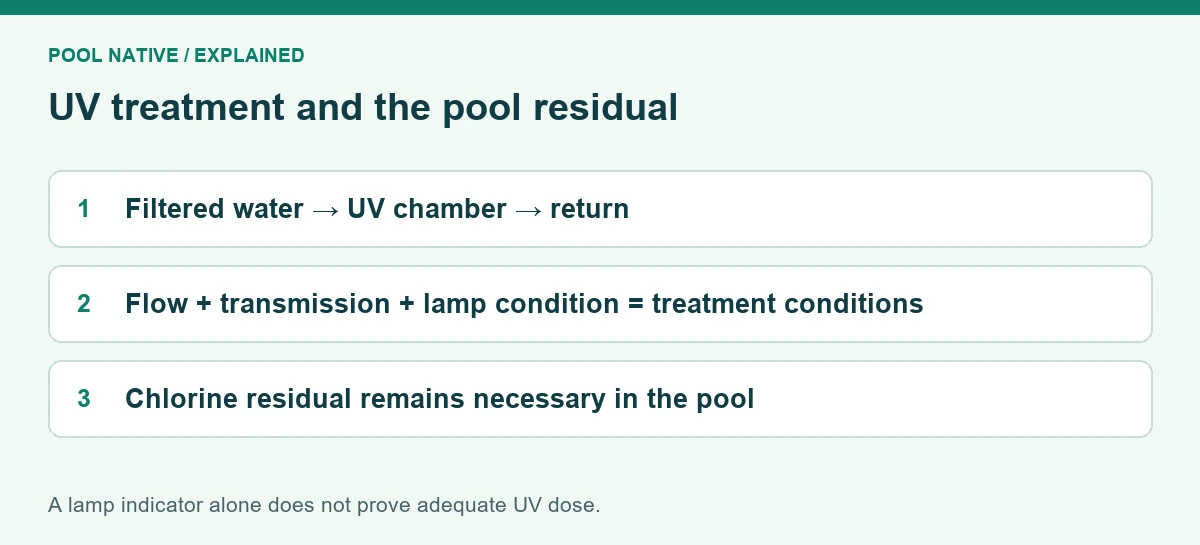
The useful question is whether a correctly sized and maintained UV system solves a defined water treatment need. A lit indicator alone does not prove that the water receives the required UV dose. Flow, lamp output, water transmission, and sleeve condition all matter.
What UV treatment can add
UV can inactivate susceptible microorganisms when the water receives a sufficient dose. Suitable systems can also help manage chloramines. CDC identifies UV and ozone among the options for breaking down chloramines in pool water.
Those capabilities belong to the specified equipment and operating conditions. Do not assume every small residential device provides the same treatment as a validated commercial installation. Ask what the selected model is designed and tested to achieve.
UV does not remove leaves, replace filtration, or brush attached material from walls. It also does not leave a protective chemical residual after water returns to the pool. Material introduced elsewhere must still be managed by the complete sanitation and maintenance program.
| Expectation | What to verify |
|---|---|
| Additional microorganism treatment | Model’s documented performance and operating envelope |
| Chloramine management | Suitability for that purpose and a way to assess results |
| Less routine chlorine work | Actual measured demand, without lowering required residuals |
| Clearer water | Filtration and chemistry problems addressed independently |
| Low maintenance | Lamp, sleeve, seal, and winterizing requirements included |
Why chlorine remains necessary
The pool contains water and surfaces outside the UV chamber. UV energy is not stored in that returned water as an ongoing disinfectant. Swimmer contamination and other demand can arise between passes through the equipment.
Maintain the sanitizer level required by the product program and pool conditions. CDC’s general home pool guidance specifies at least 2 ppm chlorine when cyanuric acid is used. A UV installation does not make a lower number from another system automatically suitable.
Do not judge sanitizer adequacy by appearance or odor. Test free chlorine and pH using suitable methods, and interpret combined chlorine separately when needed. A UV status light cannot replace those measurements.
Claims of a fixed percentage reduction in chlorine use should not be treated as a budgeting guarantee. Demand changes with weather, bathers, water chemistry, and operation. Compare actual records under similar conditions while maintaining the required residual.
Match treatment flow to the installation
Ask the installer to identify the flow through the UV chamber during every operating mode. A pump can use different speeds for filtration, heating, cleaning, or water features. The unit needs to remain within its documented treatment conditions across the intended modes.
Distinguish a housing’s maximum flow capacity from a validated treatment claim at a stated dose. Water passing through an intact vessel is not the same as receiving sufficient UV exposure. Obtain the model’s applicable performance information rather than choosing solely by pool gallon rating.
Check whether a bypass or parallel return sends part of the flow elsewhere. That arrangement must fit the installation instructions and treatment plan. Do not assume all circulating water passes through the lamp chamber merely because the unit is connected to the equipment pad.
Have the installer resolve any inconsistent units or ratings in sales literature before commissioning. Do not convert an ambiguous specification into an operating target by guesswork. Keep the confirmed setting and source document in the equipment record.
Check the installation and service access
Follow the exact plumbing order, mounting orientation, electrical protection, and flow interlock instructions. The cited DEL UV model is installed after filtration, with its own placement guidance for other equipment. Another model may require a different arrangement.
Allow the space needed to remove lamps and quartz sleeves later. A unit squeezed beneath fixed piping can turn routine service into a larger job. Confirm isolation and drainage arrangements when equipment sits below the pool’s water level.
Use a qualified installer for permanent electrical and plumbing work. Never defeat a cover interlock or expose an operating UV lamp to check brightness. UV exposure can injure eyes and skin even when a lamp does not look unusually bright.
Keep the quartz sleeve clean
The quartz sleeve separates the lamp from water while allowing UV energy through. Deposits on it reduce transmission. The system can remain powered while a dirty sleeve limits treatment.
Follow the prescribed inspection and cleaning interval, shortening attention when actual conditions require it. The cited DEL UV manual specifies six month sleeve inspection and cleaning as necessary. Use its approved cleaning method and compatible seals.
Disconnect power, allow lamps to cool, and isolate and depressurize the chamber before the relevant service steps. Do not handle lamp glass with bare hands or force a fragile sleeve. Have damaged glass or uncertain reassembly handled by a qualified technician.
After service, verify sealing and normal operation under the manufacturer’s startup procedure. A clean sleeve with a damaged seal is not a completed repair. Record what was cleaned or replaced and when.
Replace lamps on schedule, not only when dark
UV output can decline before a lamp stops visibly operating. Follow the model’s calendar or operating hour interval. The cited DEL UV instructions specify lamp replacement every 18 months; that is an example, not a universal schedule.
Use the exact approved lamp, sleeve, and electrical components. A bulb that fits physically may not provide the specified treatment output. Record the replacement date or hours rather than relying on memory.
Handle spent lamps according to the product’s disposal instructions, including mercury requirements where applicable. Do not break them or put an unidentified lamp into ordinary recycling. Confirm any lamp timer reset only after the actual replacement has been completed.
Diagnose an apparent lack of benefit
If the indicator is off, check the displayed operating state and whether circulation is supposed to be active. Leave electrical testing and internal faults to service personnel. Do not bypass a flow or cover safety device to make the light come on.
If it is on but water quality is poor, review sanitizer, filtration, flow, sleeve service, and lamp age separately. A green pool is not proof that the UV unit alone has failed. Nor does a lit lamp prove that the complete sanitation program is adequate.
For example, restoring a scaled sleeve may improve transmission, but it cannot correct a chlorine feeder that has stopped dosing. Investigating both prevents one repaired component from concealing another fault. Use the chlorine feeder guide if delivery is the missing part of the routine.
Decide whether the added equipment fits
Compare the complete installed quote with ongoing lamps, seals, cleaning, electricity, and service access. Require a clear reason for the addition and a way to assess its operation. A documented treatment need is a stronger basis than a promise of chemical free water.
If comparing UV with ozone, the ozone system guide explains gas production, injection, and maintenance. Both still belong within a complete pool care program. Keep the model’s operating record alongside the water test log so performance and maintenance can be assessed together.


