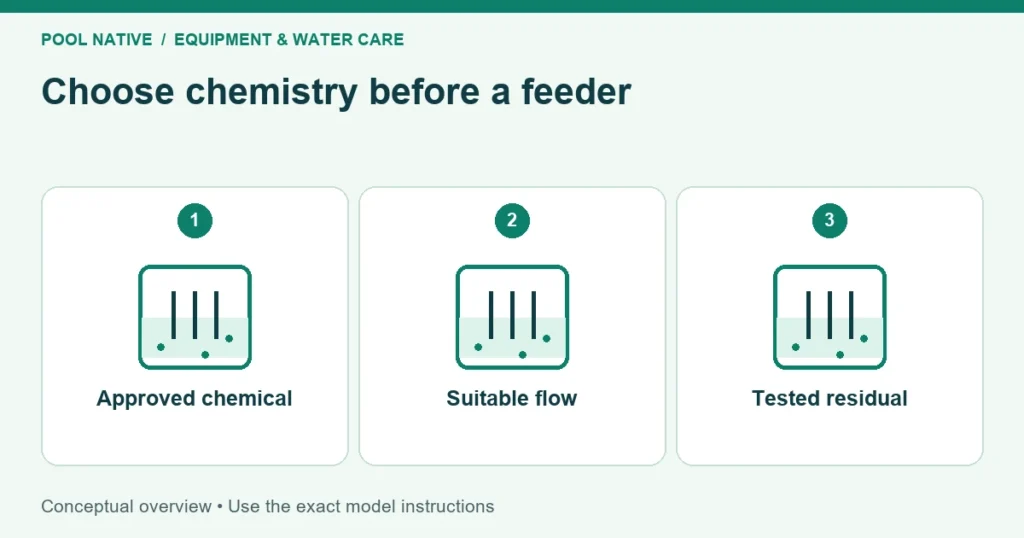
A pool chlorinator feeder delivers sanitizer at a controlled rate, but it doesn’t automatically prove the water contains enough chlorine. The common tablet models dissolve an approved chemical as water moves through them. Their settings must be adjusted using pool water tests.
Choose the chemical program before choosing the feeder. Trichlor tablets, calcium hypochlorite products, liquid chlorine, and salt generation require different equipment. Similar containers or the word “chlorine” on two labels do not make the products interchangeable.
Match the feeder to the chemical
| Equipment type | What it does | Main ownership issue |
|---|---|---|
| Inline tablet feeder | Sits in the return plumbing and meters water through approved tablets | Plumbing layout and effective flow |
| Offline tablet feeder | Uses separate connections to move water through a nearby chamber | Pressure difference, tubing, and check valves |
| Liquid dosing pump | Pumps a specified liquid from a dedicated supply | Chemical compatibility, tubing, injection, and controls |
| Salt chlorine generator | Produces chlorine from dissolved salt | Cell condition, salinity, and generating time |
| Floating dispenser | Releases an approved tablet product through adjustable openings | Placement, surface contact, and regular testing |
For a comparison of the two plumbed tablet arrangements, see inline versus offline chlorinators. For salt equipment, use choosing a saltwater system. These devices solve related tasks through different mechanisms.
A chemical controller adds another layer. It can command feed equipment from sensors or programmed settings, depending on the system. That doesn’t eliminate independent water testing or make one chemical pump suitable for every chemical.
Tablet compatibility is a firm limit
Read the feeder label and manual for the exact allowed product. Hayward CL series instructions specify slow dissolving trichlor tablets. Pentair Rainbow instructions identify approved trichlor or bromine use, with an explicit prohibition on mixing them.
Never put calcium hypochlorite into a trichlor feeder, including one that appears empty. Residues can react dangerously. Don’t use granular shock, liquid chlorine, acid, or miscellaneous treatment products to make tablets dissolve faster.
If you inherit a feeder with an unknown chemical history, identify and service it before loading anything. Don’t guess from the color of remaining material. Have a qualified pool professional determine the appropriate cleaning or replacement route.
Use dedicated clean handling equipment and keep chemicals in their labeled containers. Follow the chemical’s protective equipment and storage instructions. Never crush tablets to increase feed rate.
Understand what the dial controls
On a tablet feeder, the dial generally changes water movement through the chemical chamber. Its number isn’t a chlorine ppm setting. The actual delivery also depends on circulation, tablet exposure, water conditions, and operating time.
A setting that maintained chlorine in mild weather may be insufficient during heavy use. A higher pump speed can also change feed behavior. Adjust from measured free chlorine rather than copying a neighbor’s dial number.
Don’t use tablet disappearance as the only performance test. Tablets can dissolve while the pool consumes chlorine faster than it arrives. Conversely, slow dissolution may be appropriate when demand is low and the required residual is maintained.
Plan installation around the whole circulation system
Follow the exact installation diagram, including the chemical outlet location and required backflow protection. Concentrated sanitizer must not migrate into vulnerable upstream equipment. The correct check valve location and materials depend on the system.
Offline feeders need the specified pressure difference between their connections. Moving both tubes to convenient nearby points can leave little effective flow. Inline feeders also need a layout that supplies their internal feed path correctly.
Evaluate the pump’s normal speed schedule, not just its highest setting. A feeder that works only during a short high speed period may deliver much less sanitizer than expected. Ask the installer to verify operation under the actual daily program.
Leave access for refilling, seals, tubing, and future replacement. Installation below water level requires the model’s specific service arrangements. Don’t improvise isolation valves that trap concentrated chemicals or gas.
Establish the initial setting by testing
Begin with water that is already properly balanced and sanitized. A routine erosion feeder shouldn’t be expected to quickly recover an algae filled pool. Resolve high demand conditions using an appropriate treatment plan first.
Record the starting water tests, pump schedule, approved tablet load, and feeder setting. Check free chlorine frequently while establishing the routine. Follow the label and applicable water care targets rather than treating an older manual’s example as universal.
Change the setting gradually and note the result. If the pool remains low while the feeder appears active, investigate demand as well as delivery. If tablets barely change and chlorine falls, use inline chlorinator not feeding for the flow diagnosis.
Account for what the sanitizer adds
Trichlor adds stabilizer as it supplies chlorine and can influence pH. Continued use can raise cyanuric acid over time. Include stabilizer testing in the maintenance plan rather than checking chlorine alone.
Calcium hypochlorite products add calcium and require equipment designed for them. Liquid chlorine avoids adding stabilizer, but it has its own handling and storage requirements. None of these differences authorize mixing products inside a feeder.
If the water no longer suits the current tablet program, reassess the sanitizer approach. Changing to a different chemical may require different feed equipment. It is not a matter of emptying one container and filling it with something else.
Refill using the exact model’s procedure
A feeder can contain pressure, concentrated chemical solution, and fumes. The shutdown, draining, and cap removal sequence differs between models and installation heights. Read that sequence before touching the lid.
Prevent automatic starts where the procedure calls for isolation, and keep your face away from the opening. Wear the specified protection and never inhale fumes to judge chemical strength. Do not open an unfamiliar feeder merely to see whether water flows through it.
Inspect the cap seal and sealing surfaces during approved service. Use only the specified lubricant; petroleum products can be unsuitable and hazardous around concentrated sanitizer. A cracked body or damaged cap needs proper repair or replacement, not extra tightening.
Maintain the small parts that control delivery
Check tubing for kinks, brittleness, leaks, and unsupported strain. Inspect accessible screens and check valves according to the manual. Use compatible replacement parts rather than generic hose chosen only by diameter.
Keep debris out of the chamber and follow the model’s instructions during vacuuming, backwashing, and winterization. Those operations can change flow or leave concentrated solution where it shouldn’t remain. A feeder is part of the circulation system even when its chamber looks simple.
Save a short record of refills, settings, tests, and maintenance. It helps distinguish rising chlorine demand from reduced feed. The endpoint is reliable sanitation with compatible equipment and chemicals, not simply a full canister.


