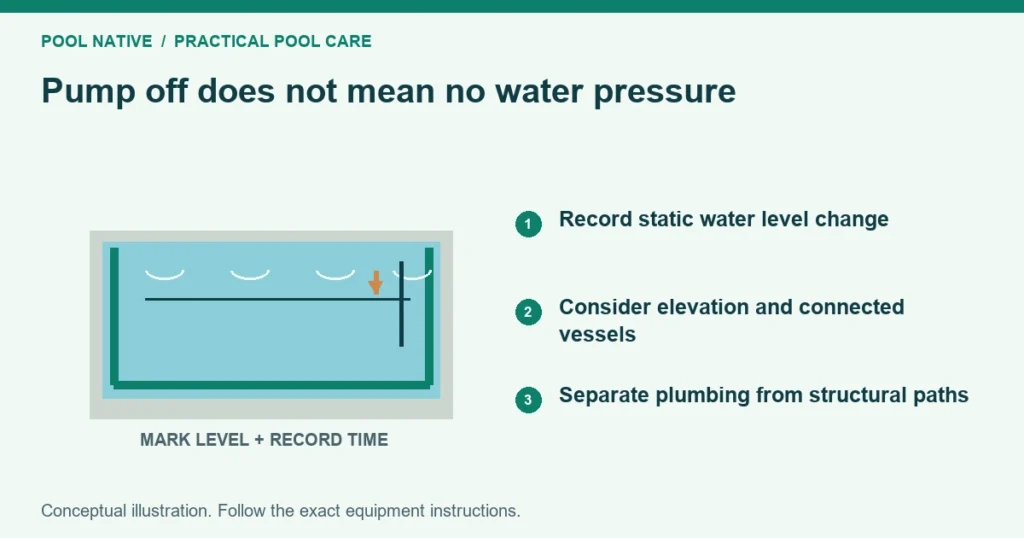
A pool can leak with the pump off because the water itself still exerts pressure on submerged openings and connected plumbing. Shutdown loss does not prove that the shell is leaking. Suction lines, return lines, fittings and transfers between pool and spa can remain relevant.
Confirm actual loss with a controlled observation before changing valves or applying sealant. Record the water level in every connected vessel. A falling spa and rising pool may indicate redistribution rather than water leaving the whole system.
Make sure stopped really means stopped
Check the controller, pump and any separate feature or booster pump. A schedule, freeze protection or another command can start equipment during an observation. Record the operating mode rather than relying on a quiet moment at the pad.
Do not disable necessary freeze protection to obtain a test. Ask the service technician to choose suitable conditions when weather makes a long shutdown unsafe. Sanitation and equipment requirements also matter.
Keep the water at a safe operating level. If the pump loses prime or a skimmer begins drawing air, stop and address that condition. Do not let the pool empty itself while waiting for a diagnostic plateau.
Compare loss with evaporation
Use the bucket test as a reference under suitable, comparable conditions. Record the pool and bucket changes, start and finish times, weather and cover position. Disable automatic top up when safe and account for any water you add.
Exclude swimming, backwashing and other discharges during the observation. Rain or an overflow can invalidate the comparison. A small uncertain difference should be repeated rather than treated as a confirmed leak rate.
Compare running and stopped periods of similar duration and conditions. A windy heated daytime test and a cool calm overnight test are not equivalent. The observation should answer whether the rate changes, not simply whether the level ever falls.
Why water can escape without pump pressure
A submerged opening can have water above it pushing outward. The pressure depends on the relative water levels and the connected route. Turning off the motor does not remove that water or automatically isolate the plumbing.
A suction line may draw air during operation but lose water at rest under some arrangements. A return line can also leak under static conditions. The words suction and return describe their operating roles, not a guarantee about shutdown behavior.
Equipment below pool level may remain under water pressure after shutdown. Do not open a lid or union assuming that a stopped pump makes it safe. Isolation and pressure release require the equipment’s proper procedure.
Check connected pool and spa levels
Mark the pool and raised spa separately at shutdown. Record the immediate change and later readings. Note whether the spa drops while the pool rises, and whether the change eventually slows or stops.
Raised spa drainback can involve a check valve, diverter valve or another connecting route. The same visible symptom does not identify which component failed. A plumbing map and observed operating states help localize it.
A transfer and an external leak can occur together. Do not dismiss measured overall loss just because some spa water moved into the pool. The whole system’s water balance still needs checking.
Inspect accessible candidate locations
Look at skimmer throats, visible cracks, liner fittings and accessible pipe connections. Photograph a suspected defect without dismantling it. A visible gap deserves testing, but it is not proof that it is the active water route.
Local dye testing can help at a specific accessible point in still water. It does not test an entire buried line. No visible dye movement at one fitting cannot clear every connected pipe.
Leave lights, drain covers and submerged electrical components assembled. A wet niche pool light is not designed to keep all pool water out of its niche. The fixture lens gasket is not a universal seal between the pool and surrounding ground.
A technician can assess niche, conduit and fitting leaks using the appropriate equipment. Do not pull a light or seal an electrical conduit as a casual leak test.
Treat a stopping level as a clue
If an observed loss rate slows near the skimmer, record the exact height and equipment behavior. A level that stops near the skimmer has several possible explanations. It does not prove the leak is at the visible waterline.
Changing water depth can reduce pressure at a leak. A connected pipe route, groundwater or a loss of pump flow can also affect the pattern. A rate too small to notice is not necessarily zero.
Do not deliberately drain farther to improve the clue. Keep the pool within its safe level requirements and arrange testing. A qualified detector can isolate routes without using uncontrolled water loss as the method.
What professional isolation should establish
Provide a log of running and stopped observations, pool and spa levels, recent work and visible wet areas. Ask which lines and fittings will be tested. The report should identify confirmed failures separately from untested suspects.
Anderson Manufacturing’s workflow uses information gathering, plumbing pressure tests and local leak location as different steps. That separation prevents a symptom from becoming an excavation instruction. The test arrangement itself must also be checked.
Do not plug suction openings, move unknown valves or inject compressed air as an owner experiment. Incorrect isolation can leave an unsafe configuration for the next scheduled start. Use a qualified service for line testing.
Repeat the baseline after repair
Restore the intended valve and controller settings, then repeat the original observation under comparable conditions. Record both vessels if a spa is connected. Confirm that the repaired system retains water while still performing its normal functions.
If loss continues, share the new measurements rather than adding a second sealant blindly. Multiple leaks are possible. The main leak guide provides the broader process for continuing the investigation.


