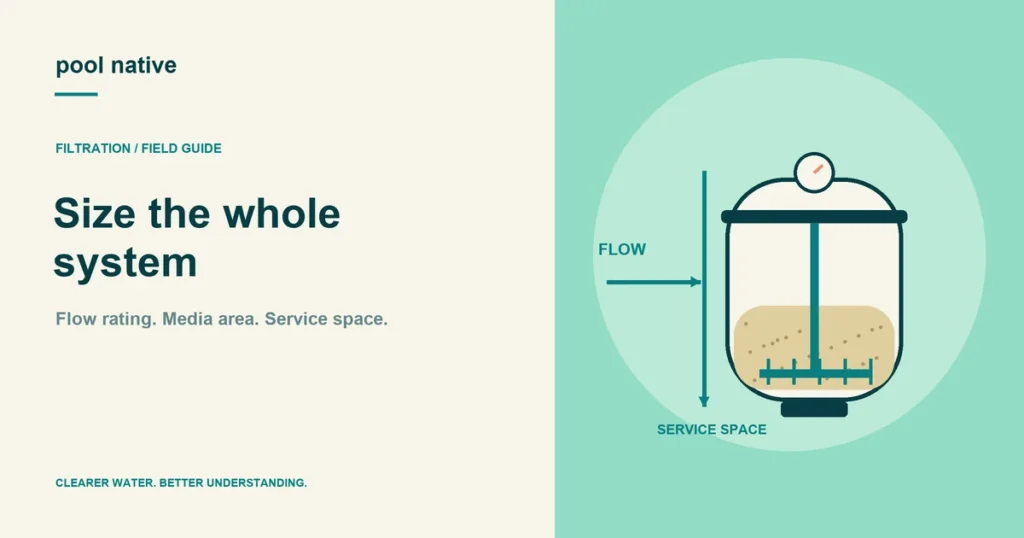
To work out what size pool filter you need, start with the flow your system will send through it. Then check the exact filter’s rated flow, media area, and service clearance. Pool gallons alone can’t make that decision.
A filter sized only for a low everyday pump setting may be a poor match for a faster cleaning program. Conversely, more square feet of media doesn’t always mean a higher allowed flow. You need both numbers.
What size pool filter do I need: the information to collect
| Input | Where to get it | Why it matters |
|---|---|---|
| Pool water volume | Reliable dimensions or construction records | Provides context for circulation planning |
| Pump model and programs | Label, manual, and controller | Shows which operating conditions need checking |
| Flow through the filter | Appropriate measurement or a professional hydraulic assessment | Must stay within the selected equipment’s limits |
| Other equipment limits | Heater, sanitizer, cleaner, and plumbing documentation | May constrain the usable operating range |
| Filter rating and area | Exact model data sheet | Separates allowed flow from media capacity |
| Service space | Measurements and installation drawing | Determines whether the filter can be maintained |
If nobody can tell you the system flow, don’t substitute the pump’s horsepower. Ask the installer to document the expected flow at the relevant operating conditions. A pump curve needs the system’s resistance, not just its motor label.
Read filter area and rated flow as separate specifications
Media area describes the available filtering surface. The rated flow describes the water throughput the manufacturer permits under its specification. Different filter technologies use very different amounts of area.
Don’t compare a sand filter’s area directly with a cartridge filter’s area as though the larger number wins. Compare models within the appropriate design and operating limits. Our filter type comparison explains the maintenance differences.
One verified example makes the distinction clear. Jandy’s CL460 and CL580 have 460 and 580 square feet of media respectively. Both are listed with a maximum flow of 150 gallons per minute in specification sheet 94314_SL.
The larger area therefore doesn’t authorize more than 150 GPM. Nor does that maximum become a recommended everyday flow. It’s a limit to respect while choosing the system’s actual operating conditions.
Check every mode that sends water through the filter
List normal circulation, cleaning overrides, heating, spa operation, and water features where they share the filter. Not every feature uses the same pump or flow path. Confirm the plumbing arrangement rather than assuming.
A variable speed system can have a quiet low setting and a much faster temporary program. Both matter. A flow controlled pump can also change speed as system resistance changes.
Don’t rely on an undocumented speed cap as the only protection against an unsuitable equipment match. Ask the installer how commissioning settings and maximum programmed operation are controlled. Replacement parts and later schedule changes should preserve that design.
A worked selection example
This example uses invented equipment ratings to illustrate the process. It is not a recommendation for a particular pool or brand.
| System requirement | Candidate A | Candidate B |
|---|---|---|
| Verified highest filter flow: 70 GPM | Rated maximum: 60 GPM | Rated maximum: 90 GPM |
| Basic flow check | Fails at the required setting | Passes this check |
| Cartridge removal clearance: 60 inches available | Not evaluated further | Requires 68 inches, so fails the space check |
Neither candidate is a complete fit. Candidate B passing the flow check doesn’t solve its access problem. The next step is another suitable model or an approved layout change, not ignoring the service drawing.
After those checks, compare media capacity, cleaning work, and available parts. That order prevents a large marketing number from distracting you from a basic incompatibility.
Use volume calculations for context, not automatic approval
Dividing pool gallons by operating minutes gives a simple volume throughput figure. For example, 20,000 gallons divided by 600 minutes is about 33.3 GPM. That arithmetic alone doesn’t establish the required runtime or select the filter.
Water mixes as it circulates. Pumping a volume equal to the pool’s capacity doesn’t mean every drop has passed through the filter once. Sanitation, circulation distribution, debris capture, and equipment needs still require attention.
Use the volume estimate in a wider design discussion. If you’re also selecting the pump, follow the pump flow and head sizing process. It addresses the supply side of the same equipment match.
Allow room for maintenance and dirt loading
A filter that technically meets a flow limit may still be inconvenient to maintain. Consider the debris your pool receives and the cleaning work you can manage. More approved media area can be useful, but it doesn’t remove the need for inspections.
Check the manufacturer’s vertical clearance, not just the tank height. Include access to the closure and room to remove internal parts. Leave the gauge and air relief visible and reachable as intended.
For a sand or DE filter, verify the waste route and the backwash requirements. A system that filters acceptably at low flow may still need a different flow for cleaning. Don’t assume the ordinary circulation program will backwash correctly.
Ask for a commissioning record
Before accepting the installation, request the exact model, media specification, programmed operating limits, and normal valve modes. Have the installer demonstrate the service process and safe shutdown. Save the manual revision used.
Record the initial clean pressure with its matching pump setting. Use that reference for future cleaning decisions. It is more useful than a generic “normal psi” range.
If a quote specifies only “large filter for a 20,000 gallon pool,” ask for the missing model and flow details. You should be able to explain why the filter fits before it arrives at the pad.