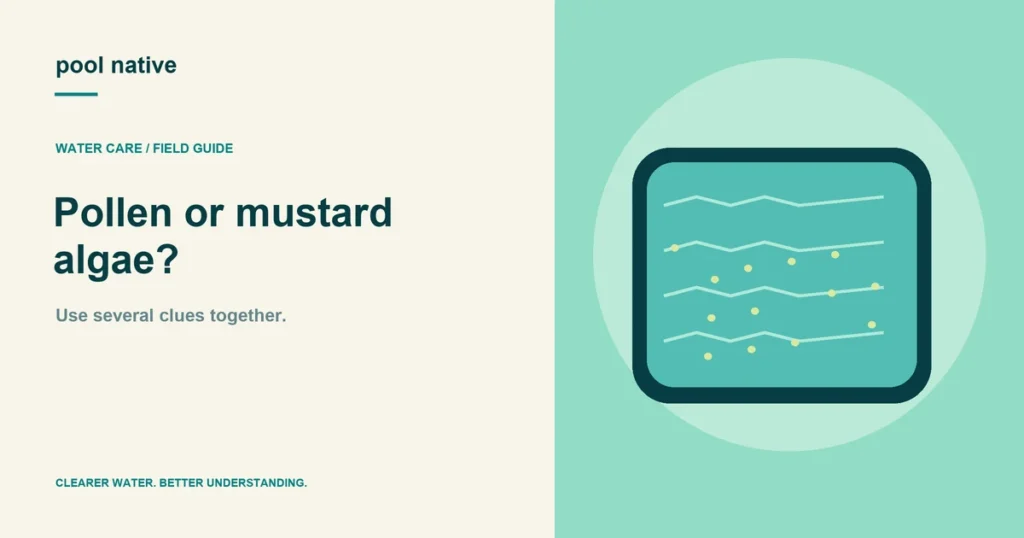
Yellow pool deposits can be mustard algae, pollen, or ordinary sediment. A puff of dust when brushed does not distinguish them reliably. Use the timing, location, recurrence, surrounding environment, and water tests together before choosing a treatment.
Pollen can arrive repeatedly from the air even after thorough cleaning. Suspected algae raises a different question about sanitation and attached growth. Both may exist in the same pool.
Compare the clues
| Clue | What it may suggest | Why it isn’t proof |
|---|---|---|
| Similar yellow dust on cars, furniture, and water | Active pollen deposition | Algae can coexist with pollen |
| Recurring material on shaded walls or steps | Growth or an inadequately cleaned area | Circulation can also deposit sediment repeatedly |
| Dust settles in the same low point | A collection point for particles | The location doesn’t identify the particles |
| Inadequate sanitizer or other growth | A sanitation problem needing correction | Not every yellow particle is therefore algae |
Observe before treating
Photograph the deposit and note where it collects. Compare the pool with nearby surfaces during the same period. Record recent wind, landscaping, storms, and seasonal pollen activity.
Brush a small area with a finish compatible tool and observe what happens during normal circulation. Don’t interpret a dust cloud as a definitive algae test. Avoid inhaling or handling unknown material unnecessarily.
Test free chlorine, pH, and CYA as appropriate. A properly obtained overnight chlorine comparison can contribute context in a suitable management program, but one small change doesn’t identify every deposit. Don’t turn a single measurement into a species diagnosis.
If pollen is the likely main source
Remove floating material with a suitable fine collection tool and vacuum settled debris as the system permits. Check baskets and filter condition more often during heavy deposition. New material may keep arriving while the environmental source remains active.
Don’t add improvised filter socks or restrictive accessories without confirming compatibility. They can obstruct flow or damage a basket when loaded. Empty approved collection devices before they become a circulation problem.
If algae is supported by the evidence
Use the algae treatment route and a product labeled for the actual problem. Include compatible surface cleaning and any accessory cleaning the instructions require. Correct the sanitizer or circulation issue that allowed persistence.
Don’t use a stronger metal brush on a liner just because a yellow patch returns. Use brush compatibility guidance. A damaged finish creates a separate problem that chemicals won’t repair.
Reassess a deposit that won’t stay gone
Record how soon it returns and whether it remains attached or simply settles again. Continued pollen arrival, filter media escape, and an uneven floor can all produce recurring deposits. Filter diagnosis may be appropriate when material emerges from returns.
If the evidence remains mixed, get a qualified inspection before escalating chemicals. The aim is to identify the cause, not to win an argument between two labels for yellow dust.