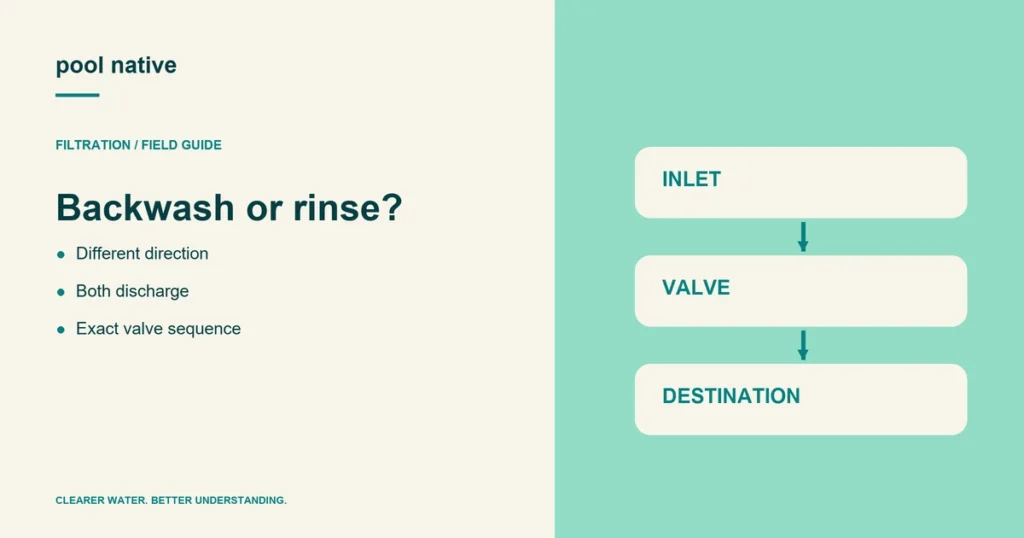
Pool backwash vs rinse is a difference in flow direction and purpose. Backwash reverses flow through a compatible filter to remove accumulated material. Rinse sends water in the normal filtering direction but discharges it to waste instead of the pool.
Where the manual specifies both, Rinse follows Backwash before normal filtration resumes. Stop the pump between valve changes. Don’t add a rinse step to equipment that doesn’t have one.
Pool backwash vs rinse at a glance
| Setting | Through the media | Destination | Main job |
|---|---|---|---|
| Backwash | Reverse direction | Waste | Flush accumulated dirt and, on DE systems, spent coating. |
| Rinse | Normal direction | Waste | Clear residual dirty water before returning to the pool. |
| Filter | Normal direction | Pool | Resume normal filtration. |
Why rinse isn’t another backwash
Both modes can send dirty water down the same hose, which makes them easy to confuse. The internal route is different. On a sand system, the rinse step helps clear residual material after the bed has been disturbed.
Skipping a prescribed rinse can send leftover dirty water toward the pool when Filter mode resumes. Repeating rinse instead of backwashing doesn’t reproduce the reversed cleaning flow. Follow the full procedure for your filter and valve.
Not every valve uses the same sequence
The Hayward ProGrid manual illustrates the distinction well. Its six position valve includes Rinse, while its four position and slide valve procedures differ. A sequence from another handle design may not apply.
Identify the valve and its marked functions before starting. Use the stated timing and observation requirements in its manual. “Run until clear” isn’t a reason to ignore a prescribed sequence or equipment limit.
For DE filters, also follow the coating instruction after cleaning. Rinse doesn’t supply new DE. Use the correct recharge amount for the model and task.
What the sight glass does and doesn’t show
A sight glass lets you observe water passing through its part of the discharge route. Clearing water helps assess progress when the manual calls for that observation. It doesn’t establish that every internal surface is clean or undamaged.
If pressure stays abnormal after the proper sequence, investigate the filter and operating state. Don’t keep cycling indefinitely to chase a particular gauge number. Compare the reading at the same pump speed as your clean baseline.
Finish with the route restored
Both Backwash and Rinse remove pool water. Watch the level and ensure the discharge destination is approved. Stop if the route overflows or circulation loses its water supply.
With the pump stopped, return the valve to the prescribed normal position. Restart as directed and check pressure, return flow, and the waste line. Continuing discharge during Filter mode needs a valve diagnosis.