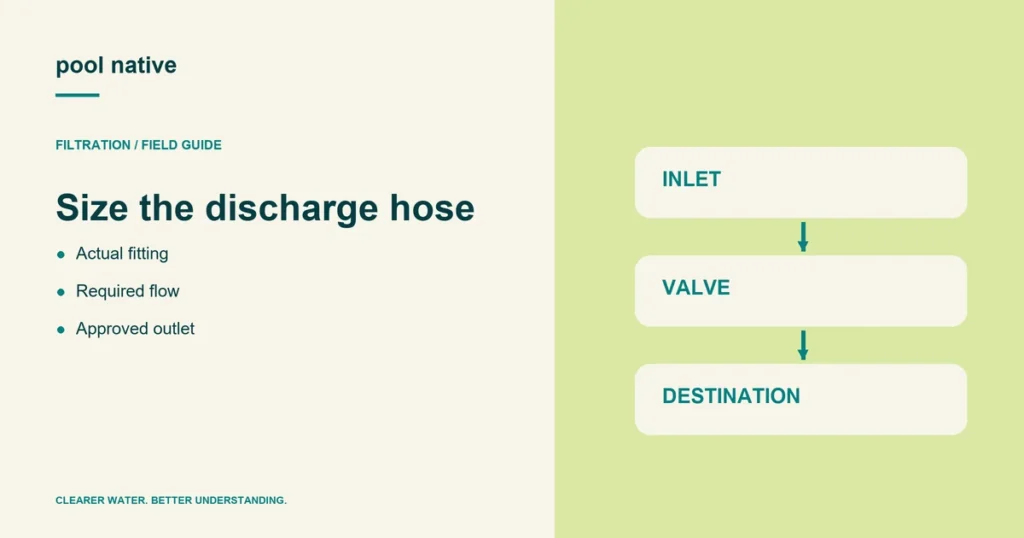
Pool backwash hose size must match the valve’s discharge connection and the required cleaning flow. Measure the actual hose connection and check the valve manual. Don’t choose a diameter from pool gallons alone.
Length matters too. Buy enough hose to reach the approved destination without stretching, sharp bends, or unnecessary excess.
Find the right pool backwash hose size
Identify whether the valve has a hose adapter, threaded outlet, or another connection. A nominal pipe size doesn’t always equal the outside measurement where a hose attaches. Match the hose’s stated inside diameter to the intended adapter.
| Check | What to confirm |
|---|---|
| Valve outlet | Exact connection type and manufacturer size |
| Adapter | Correct thread or fitting, with a suitable hose attachment surface |
| Hose | Intended for discharge service at the required size and conditions |
| Length | Actual route to an approved destination, including gentle bends |
| Clamp | Correct fit for the adapter and hose without damaging either |
Match the adapter in two separate places
Suppose a valve has a nominal 1.5 inch female pipe thread and its approved adapter ends in a 1.5 inch hose barb. The threaded end must match that valve; the hose must match the barb’s stated hose size. Measuring the outside of the threaded end does not identify the hose inside diameter.
That is an illustrative connection, not a statement that your valve uses those dimensions. Some outlets accept a union or another fitting instead. Record both sides of the actual adapter before ordering the hose.
If the supplier lists only a flat hose width, ask for its nominal open diameter. A collapsed lay flat hose does not measure like a rigid pipe. Do not force the apparent width over a fitting.
Don’t solve a mismatch by reducing the outlet
A smaller hose can restrict the discharge path. Backwashing depends on the specified flow through the filter, so an arbitrary reducer can undermine cleaning. Ask the installer to verify the route rather than matching the cheapest hose.
Likewise, a wider hose doesn’t correct an unsuitable adapter or authorize more flow into a household drain. The receiving destination has its own limits. Confirm backwash disposal requirements separately.
Plan the whole route
Measure along the path the hose will actually follow. Account for obstacles and avoid places where vehicles or people will crush it. Lay flat hose needs room to open when water enters.
Long runs and large downhill drops can require additional installation measures. Pentair’s Triton manual explicitly addresses extended and downhill backwash lines. Those are system design questions, not simply reasons to buy a longer roll.
Keep the outlet secure and observable. Don’t direct water where it can erode soil, cross neighboring property, or enter an unauthorized drain. Stop immediately if the receiving area cannot accept the flow.
Connect and verify without forcing parts
Install the connection with the pump off and follow the adapter’s instructions. Don’t stretch a hose over an incompatible outlet or tighten a clamp until plastic deforms. Check for cracks, tears, and a loose attachment before use.
Start the prescribed backwash sequence and observe the hose. Stop if it kinks, leaks, detaches, or produces an unexpected restriction. Never adjust a stressed connection while it is discharging.
Remember that Rinse may also discharge through the hose. Keep the route ready until the cleaning sequence is complete. Then restore the normal valve position before packing away equipment.
Drain and store the hose according to its instructions. Record the confirmed diameter and adapter so a future replacement matches. Inspect it again before the next cleaning cycle.