Pool plumbing carries water from the pool to the equipment and back again. Start by separating the suction paths before the pump from the return paths after it. That simple map makes valve labels, leaks, and weak circulation much easier to interpret.
Your installation may also serve a spa, cleaner, heater, water feature, or bypass. Those branches change the route in different operating modes. A diagram from another pool is useful for orientation, but not a set of valve instructions for yours.
Follow one complete water circuit
In a common circulation arrangement, water leaves through skimmers and permitted submerged suction fittings. It travels to the pump, then through filtration and any equipment installed along the return path. Return fittings send it back into the pool.
Think of each device as doing a different job. The pump moves water; the filter removes particles; treatment equipment serves its specified function. None makes every other part unnecessary.
The exact order and bypass arrangement must follow the installed equipment’s requirements. Do not rearrange a heater, chlorinator, or check valve from a simplified illustration. This guide explains how to read the system you have.
Identify the suction sources
The skimmer collects water near the surface and traps larger debris in a basket. A submerged suction outlet is a different component. A fitting casually called a main drain often belongs to circulation rather than an open drain to waste.
Some pools have separate pipes from each source to the equipment area. Others combine lines underground or route a connection through a skimmer. Two visible holes in a skimmer do not reveal every buried connection.
Keep protective covers and screens in place. Do not test suction by covering a fitting with a hand, foot, or object. A damaged or missing suction cover requires the pool to remain out of use until properly resolved.
Use the two hole skimmer explanation when that layout is unclear. Label a buried destination unknown until records or a qualified professional establish it. A confident guess can create an unsafe valve decision later.
Read the equipment area without opening it
Find the pump inlet and outlet from the model diagram and visible pipe route. Follow the outlet toward the filter. Note branches, valves, and arrows on components rather than assuming every pipe follows the shortest route.
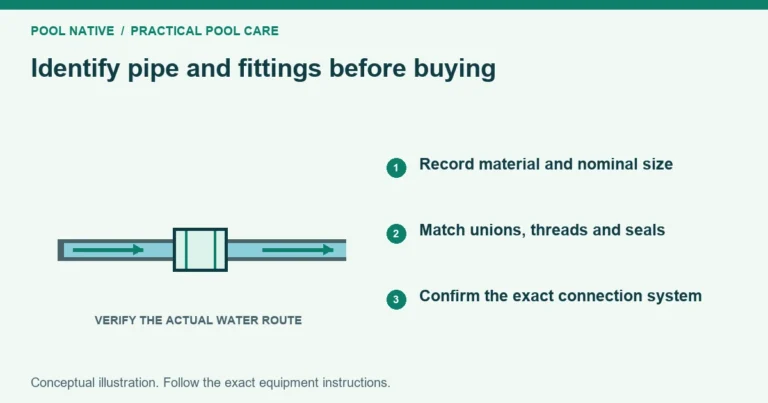
Record filter type and the location of any heater or sanitizer. Identify unions as service connections and elbows or tees as routing fittings. Their presence does not mean they should be loosened or adjusted.
Photograph the normal operating arrangement with labels visible. Keep hands off hot equipment and electrical compartments. Shut down, prevent automatic restart, and follow pressure relief instructions before any service requiring a connection to open.
Separate valve function from valve position
A diverter can select or divide a flow path. A check valve responds to flow direction without an ordinary operating handle. A filter’s multiport valve can send water through entirely different internal routes.
Use valve identification and position markings before turning an unfamiliar handle. Handle direction alone is not a universal open or closed code. Preserve stops and identify every connected branch.
Pool and spa modes can change both suction and return routing. The controller’s label should agree with the actual water destination. If a spa level changes unexpectedly, document the mode and behavior rather than repeatedly trying random valve positions.
Understand pressure without calling it flow
Pressure is not a direct reading of gallons moving through the system. The same gauge value can occur under different pump speeds or restrictions. Compare readings with a known clean baseline under the same operating conditions.
A restriction can change both flow and pressure, but its location matters. Air on the suction side, a dirty filter, and a restricted return branch are different faults. A single gauge number cannot distinguish all of them.
Keep the pump speed, valve mode, filter condition, and visible return behavior with each reading. Those details turn an isolated number into useful evidence. A flow measurement, where installed and appropriate, supplies different information from the pressure gauge.
Use the symptom to choose the next investigation
| Observed problem | Useful route |
|---|---|
| Air collecting in the pump basket | Check the suction and priming conditions before blaming the return jets. |
| All returns weaker than usual | Compare operating speed and shared equipment conditions. |
| One skimmer underperforming | Compare that local branch with the other skimmer under the same schedule. |
| Leaves miss a skimmer despite water movement | Investigate surface capture rather than assuming no suction. |
| Water appears at a fitting | Locate the first wet point and identify the component before selecting a repair. |
Follow weak return flow checks for a circulation change. Use surface debris capture checks when the water is moving but leaves stay behind. Those problems overlap in appearance but do not always share a cause.
Make a useful owner diagram
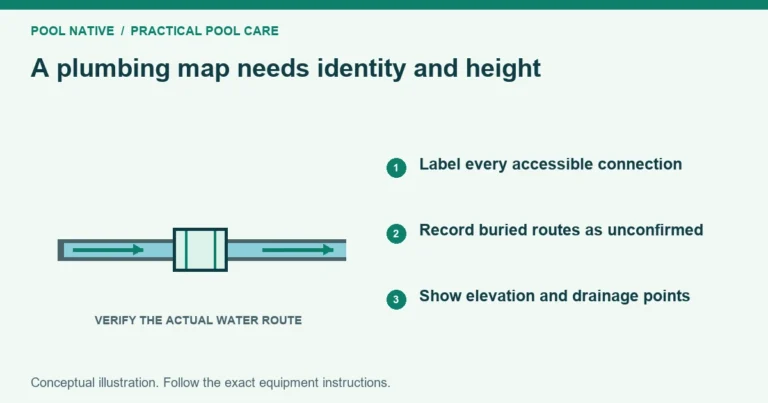
Draw the pool, equipment, and any spa or feature as simple boxes. Add arrows only where you have confirmed the direction. Mark hidden or uncertain branches explicitly.
Label normal operating modes and record the date. Ask the installer to confirm the drawing during service, especially any suction branch or chemical equipment bypass. Save the corrected version beside the equipment manuals.
This map is for identification and communication. New plumbing, pressure testing, suction alterations, and electrical changes require appropriate professional design and work. Knowing where uncertainty remains is part of understanding the system.