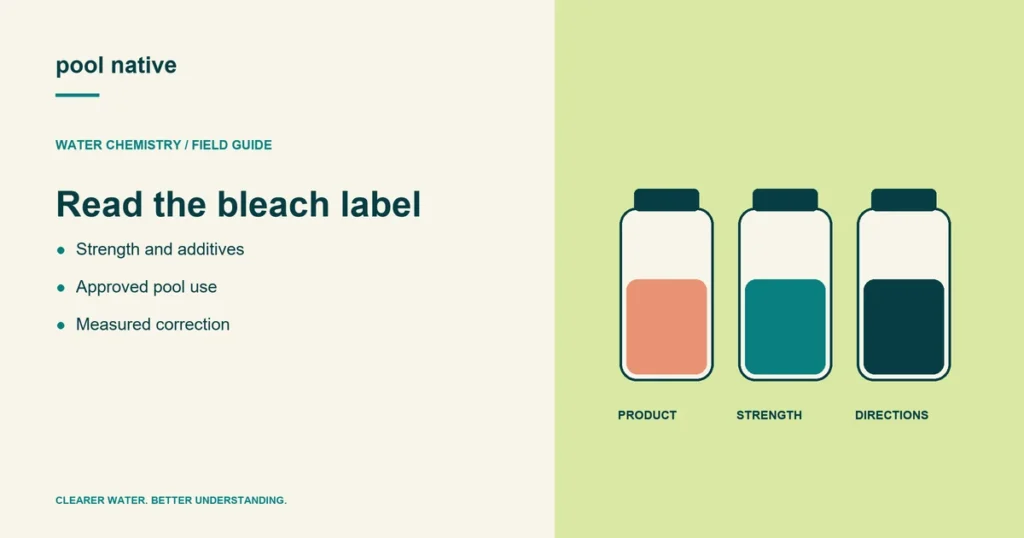
Some household bleach formulations can supply chlorine to a maintained swimming pool. That does not make every bottle suitable. Check the manufacturer’s pool use instructions, ingredients, and actual strength before treating bleach as a substitute for liquid pool chlorine.
If the bottle’s suitability is unclear, choose a product labeled for pool chlorination. A familiar brand name or the word “disinfecting” alone does not answer the question.
Start with the kind of pool
This decision concerns pools with appropriate filtration and an ongoing treatment routine. Small plastic or inflatable kiddie pools without filtration need a different approach. CDC advises against adding disinfectants to their water and recommends emptying them at least daily.
Don’t scale down a swimming pool recipe for a small unfiltered splash pool. Cleaning an emptied pool surface with a bleach solution is also a separate task. Follow the relevant cleaning instructions for that use.
Read beyond the active ingredient
Liquid pool chlorine and many household chlorine bleaches contain sodium hypochlorite. It supplies chlorine without adding cyanuric acid or calcium through that ingredient. Other ingredients and the intended application still matter.
| What the bottle says | What to check next |
|---|---|
| Sodium hypochlorite | Find the concentration and manufacturer guidance for pool use |
| Scented, thickened, or splash reducing formula | Do not assume it is pool suitable; choose an approved formulation |
| Color safe or oxygen bleach | It is not a sodium hypochlorite replacement |
| Disinfects household surfaces | That claim does not establish swimming pool suitability |
| No readable label | Do not use an unidentified product |
Clorox specifically says its No Splash formula should not be used in pools because it contains thickeners and fragrance. A product can disinfect a household surface and still be unsuitable here. Avoid relying on old claims that all splash reducing products are simply “not disinfectants.”
Check the exact product, including its country and formulation. Brand families contain multiple products. A recommendation for one bottle does not approve everything sharing its logo.
Strength changes the amount required
Household bleach and pool chlorinating liquid are sold at different concentrations. Do not transfer the dose from one bottle to another. Use the concentration printed on the product you actually have.
Also distinguish sodium hypochlorite percentage from available chlorine percentage. Clorox gives an example of 7.5% sodium hypochlorite providing approximately 7.1% available chlorine by weight. Those numbers describe the same example product using different conventions.
A calculator must request the same concentration basis you enter. If its instructions don’t make that clear, use the product’s pool dosing directions or ask its manufacturer. Apparent precision cannot fix the wrong input.
Age and storage conditions can reduce liquid chlorine strength. Keep the original container and follow its storage instructions. A bottle left in prolonged heat should not be assumed to retain its original strength.
Gather the information needed for a dose
Have a credible pool volume estimate, a fresh free chlorine result, and the appropriate treatment target. Check pH and CYA as part of that decision. Then use directions for the approved formulation and intended treatment.
There is no useful universal answer in cups per pool. Pool size, starting residual, product strength, and treatment purpose all change the amount. Don’t dose from color or chlorine odor.
If you have been using stabilized tablets, switching to sodium hypochlorite stops that particular CYA input. It does not remove the stabilizer already in the water. Keep that reading in your treatment plan.
Apply it through the approved route
Follow the product’s instructions for circulation, addition location, protective equipment, and swimming restrictions. Keep concentrated bleach away from acids and other pool chemicals. Never pour it into a tablet feeder or combine it with another concentrate.
Use the original labeled container for storage. Do not reuse a different chemical’s container or measuring equipment. Keep spills and incompatible products apart as explained in the chemical compatibility guide.
After the required mixing period, test the water again. A calculated addition predicts an input; it does not prove the residual that remains. If chlorine continues falling unusually fast, investigate chlorine demand and losses before repeatedly adding more.
Compare value only after confirming suitability
Compare the cost of the amount required for the same approved treatment. Include the actual container size and concentration, using the same strength convention. A cheaper bottle can contain less usable chlorine.
For a purchase decision, record the product name, concentration, pool use directions, and storage history if known. If any essential detail is missing, the comparison is unfinished. A clearly labeled pool chlorinating liquid avoids much of that uncertainty.