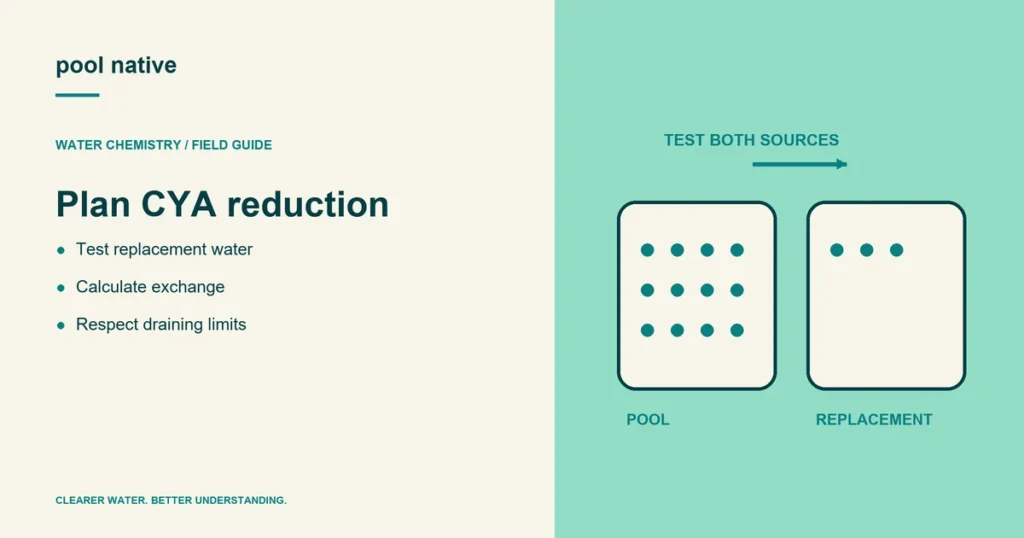
Lowering cyanuric acid usually involves replacing some pool water with water containing less CYA. Confirm the starting reading before calculating that exchange. A test that stops at 100 ppm may be reporting its limit, not your pool’s actual concentration.
Stop unnecessary stabilizer additions while you investigate. Changing sanitizer can prevent further buildup, but it won’t immediately remove the CYA already present.
Get a usable starting measurement
Repeat the CYA test exactly as its manufacturer directs, including sample temperature and viewing conditions. If the result reaches the upper limit, use its approved dilution procedure. Don’t estimate an unmarked result below the bottom line of a viewing tube.
For its relevant visual tests, Taylor describes mixing equal parts pool water and CYA free water. Test that mixture and multiply the result by two. Follow your own kit’s instructions if they differ.
As a hypothetical example, a diluted result of 90 ppm would indicate about 180 ppm in the original sample. Treating that pool as exactly 100 ppm would substantially underestimate the needed correction. Confirm uncertain results before committing to a large water exchange.
Choose the destination before calculating the difference
Use the CYA guidance for your sanitizer system and pool, alongside applicable operating requirements. There is no single target that should replace every equipment manual. The CYA interpretation guide explains how to make that decision.
Review every source of stabilizer: standalone conditioner, dichlor treatments, and trichlor tablets. A pool can receive CYA without anyone adding a product labeled “stabilizer.” Check ingredients rather than package descriptions.
Consider an appropriate unstabilized chlorine option when further CYA input is unwanted. Keep feeder compatibility and calcium effects in that decision. Never change concentrated chemicals inside a feeder without manufacturer approval.
Estimate the replacement fraction
For one removal and refill, use this relationship:
Fraction to replace = (starting CYA − target CYA) ÷ (starting CYA − replacement water CYA).
Use ppm for all three readings. The calculation assumes uniform starting water, a measured removal, and thorough mixing after refilling. It also assumes no additional CYA input or other significant change.
In a hypothetical 15,000 gallon pool, reducing CYA from 120 to 60 ppm with CYA free water requires a 50% exchange. That is about 7,500 gallons, or 28,390 liters. These are planning figures, not permission to lower the pool that far.
If the replacement water instead contains 20 ppm CYA, the fraction becomes 60 ÷ 100, or 60%. You would need more replacement water. If its CYA equals or exceeds your target, dilution with that source cannot reach a lower target through a partial exchange.
Repeated smaller exchanges don’t simply add up
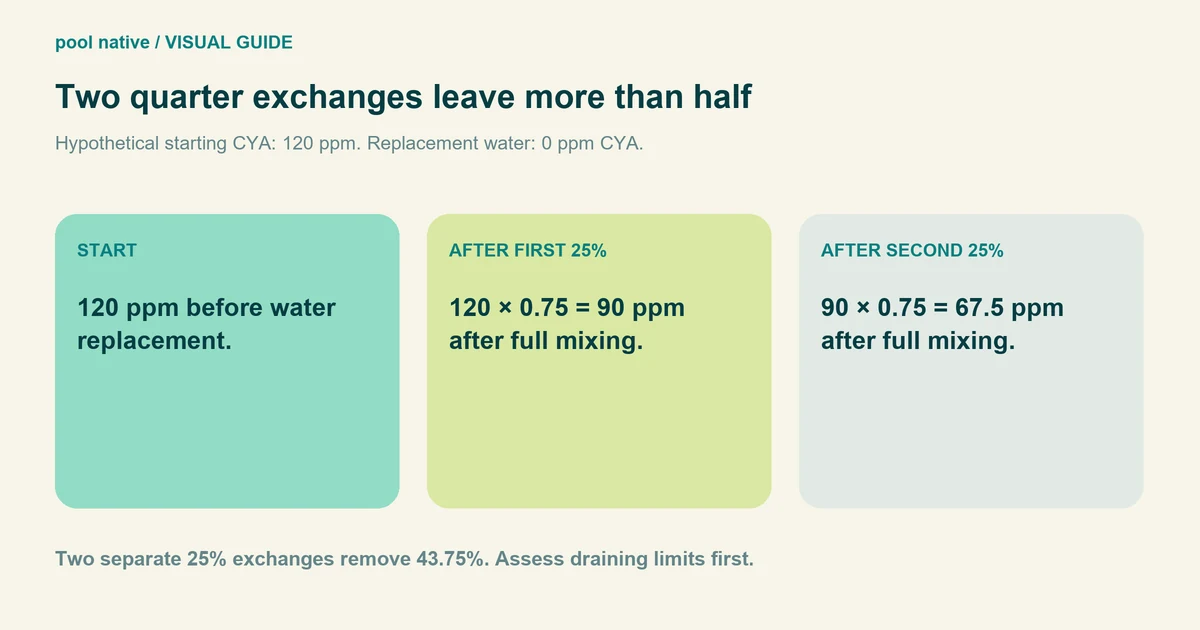
Each refill dilutes the water that the next removal will take out. Two 25% exchanges therefore remove less original CYA than one 50% exchange. Some newly added water leaves during the second cycle.
For a calculated example starting at 120 ppm with CYA free replacement water, one 25% exchange leaves about 90 ppm. A second leaves about 67.5 ppm. That is a 43.75% reduction overall.
Recheck after each properly mixed exchange instead of relying solely on a predicted endpoint. Simultaneous filling and draining introduces different mixing behavior. Don’t apply the single exchange formula to that process as though the waters stayed perfectly separated.
Have the water exchange method checked for your pool
Removing supporting water can damage a pool. Groundwater, shell construction, liner condition, and the manufacturer’s restrictions affect what is appropriate. Even a partial drain is not automatically safe.
Leisure Pools, for example, warns owners against lowering its fiberglass pools below the skimmer without qualified involvement. Ask your builder or a qualified pool professional to establish the method and allowable level. Also confirm local discharge and water use requirements before moving water.
Protect the circulation equipment from running without its required water supply. Don’t leave a low pool unattended or improvise a draining procedure from the calculated percentage. The chemistry calculation and the physical operation are separate decisions.
Compare alternatives when replacement is difficult
A suitable mobile membrane service can reduce CYA while returning treated water to the pool. Ask for the expected endpoint, water loss, makeup water requirement, and effects on salt and calcium. Membrane treatment still produces a concentrated waste stream.
Commercial biological reducers also exist, but their operating conditions matter. BioActive specifies limits involving temperature, pH, and total chlorine. Manufacturer claims do not establish a guaranteed reduction in your particular pool.
Before choosing a reducer, request the current instructions and a credible plan for verifying results. Keep the sanitizer requirements in view throughout treatment. Don’t intentionally leave the pool inadequately sanitized to satisfy a product’s preferred conditions.
Ordinary filtration, acid addition, and a larger chlorine dose are not substitutes for a verified CYA reduction plan. Evaporation followed by topping up does not perform the same exchange as removing pool water. Avoid buying a treatment solely because its name includes “balance” or “clarifier.”
Rebuild the maintenance baseline afterward
Once the water is mixed, retest CYA, free chlorine, pH, alkalinity, and calcium hardness. Check salt if applicable. Replacement water can alter several readings at once.
Adjust the routine to the new results and record the amount of water replaced. Continue checking chlorine while the delivery setting is being established. Keep tracking CYA inputs so the same problem does not quietly return.