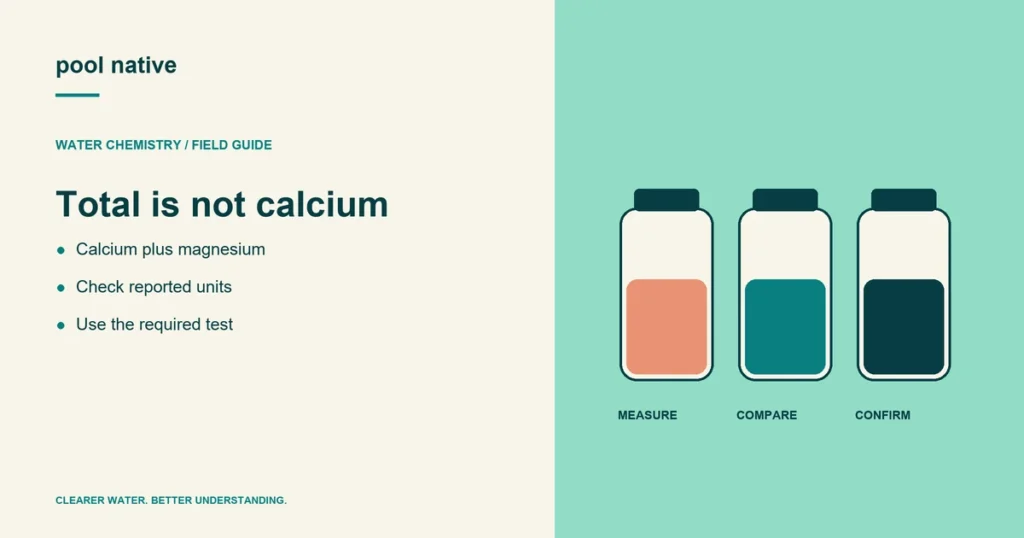
Total hardness and calcium hardness can give different results for the same pool without either test being wrong. Total hardness includes calcium and magnesium; calcium hardness measures the calcium contribution. Use the value requested by the equipment instructions or water balance calculation.
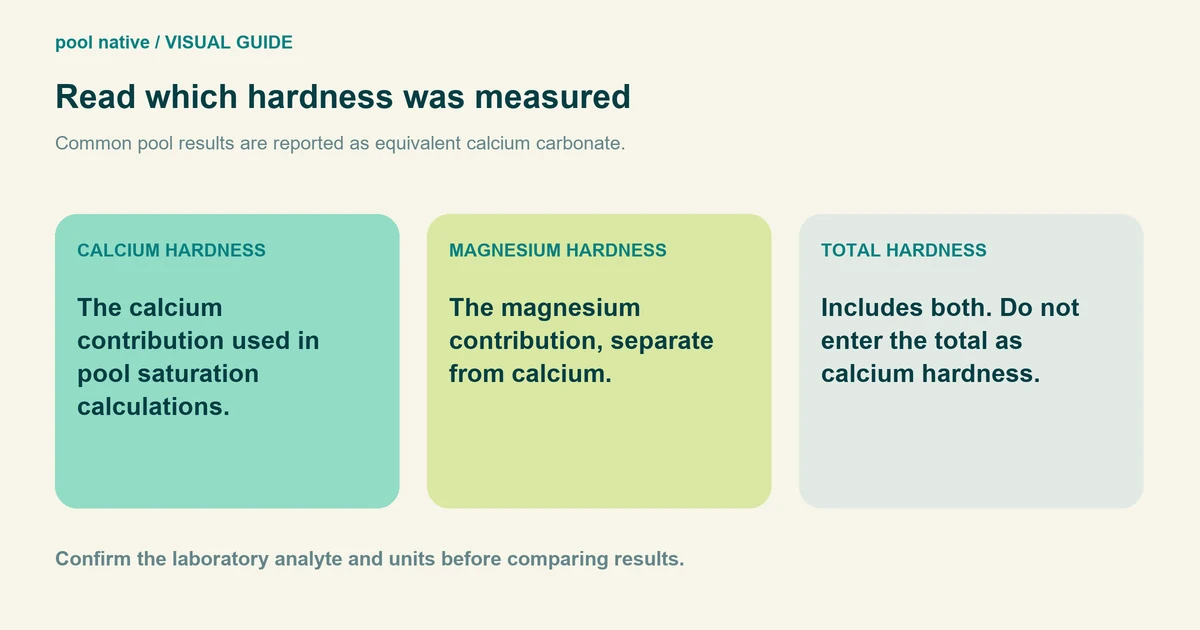
The word “hardness” on its own is not enough information. Check the full test name and reporting units before deciding that two results disagree.
Compare what each test includes
| Reported value | What it describes | Can it replace calcium hardness? |
|---|---|---|
| Calcium hardness, as CaCO3 | The calcium contribution on a calcium carbonate equivalent basis | Yes, when this is the requested measurement |
| Total hardness, as CaCO3 | Primarily the combined calcium and magnesium contributions | No, unless the calcium contribution is separately established |
| Calcium, as Ca | Elemental calcium concentration | Only after the appropriate unit conversion |
| Total alkalinity, as CaCO3 | Acid neutralizing capacity | No; matching units do not make it the same measurement |
The “as CaCO3” notation provides a common reporting basis. It does not mean the test found that amount of solid limestone. Two different measurements can share this notation and still describe different properties.
A difference that makes sense
Consider hypothetical water with 200 ppm calcium hardness and 150 ppm magnesium hardness, both expressed as CaCO3. Its total hardness would be about 350 ppm. A total hardness result near 350 and a calcium result near 200 would therefore be compatible.
You cannot reverse that example using total hardness alone. A 350 ppm total result does not reveal how much is calcium. The calcium to magnesium proportion varies with the water source and treatment history.
Do not multiply total hardness by a fixed percentage to invent a calcium reading. Obtain a calcium specific test when the decision requires one. Use the calcium interpretation guide after establishing that value.
Read the strip’s actual specification
Many pool strips measure total hardness. AquaChek Select Connect, for example, explicitly lists total hardness among its tests. Its result should not be entered as calcium hardness simply because both relate to hard water.
Check the particular product rather than assuming every strip measures the same thing. Also look at the scale’s intervals. A broad color block provides less detail than a result divided into smaller steps.
The issue is not only whether strips or drops are “better.” First ask whether they measure the same substance. Then assess range, resolution, technique, and known interferences.
Use calcium hardness in a calcium saturation calculation
A calcium carbonate saturation calculation needs the calcium contribution. Substituting total hardness can overstate that input when magnesium is significant. It can make the water appear more saturated than the correct inputs indicate.
Use the required pH, temperature, alkalinity, and dissolved solids inputs as well. Apply CYA and other buffer corrections as the calculator instructions specify. A correct hardness value cannot compensate for another incorrect field.
For finish or equipment requirements, preserve the measurement named in the manual. If a document says only “hardness,” ask its manufacturer which definition it uses. Don’t silently substitute your preferred interpretation.
Check water reports before comparing them with the pool
A municipal or well report may list calcium in mg/L as Ca. Your pool kit may report hardness in ppm as CaCO3. Those results require a reporting basis conversion before comparison.
Ask the laboratory for calcium hardness expressed as CaCO3 if the report is unclear. Do not convert a number already reported as CaCO3 a second time. Keep the original units in your maintenance record.
Source water also isn’t necessarily identical to water that has spent months in the pool. Calcium additions, evaporation, replacement, and precipitation can change the pool’s reading. Compare recent samples when investigating the difference.
Convert elemental calcium only once
To convert calcium reported in mg/L as Ca, multiply by approximately 2.497 to obtain calcium hardness as CaCO3. For example, 80 mg/L as Ca becomes about 200 mg/L as CaCO3. This changes the reporting basis; it does not add magnesium.
A report already showing 200 mg/L calcium hardness as CaCO3 needs no further multiplication. Applying the factor again would produce about 499 and create a false discrepancy. Keep the original heading and units beside the converted value.
If comparable results still disagree
Collect representative samples under the test manufacturer’s instructions. Confirm that reagents are usable and the correct sample volume was used. Apply the multiplication factor for that volume.
For a titration, follow the specified endpoint rather than stopping at an intermediate shade. If it fades or remains purple, investigate calcium test interference. Repeat with the approved procedure before adding treatment chemicals.
Under comparable conditions, calcium hardness should not substantially exceed total hardness on the same reporting basis. Such a result calls for checking units, methods, sampling, and uncertainty. It does not establish a negative magnesium concentration.
Keep treatment on hold until the needed measurement is credible. Then decide whether calcium actually needs adjustment for your system. The purpose of comparing tests is to reach the right decision, not force unlike numbers to match.