Freeze protection can keep a pool pump running after its normal schedule ends. That is expected while the controller still detects cold conditions. If it keeps running in warm weather, compare the controller’s air reading, its release temperature, and the command actually running the pump.
Don’t disconnect a sensor or disable protection just to stop the noise. First establish whether the system is responding correctly to cold air or acting on a bad reading. Warm pool water does not establish the temperature around exposed equipment.
Read the status before changing settings
Record the exact message on the main controller and the pump display. Note the air temperature, water temperature, time, and active operating mode. A screenshot helps preserve the evidence if the message disappears later.
A pump running continuously does not prove freeze protection is responsible. A schedule, manual command, heating request, or another controller can also be involved. Look for the active reason instead of replacing a sensor based on runtime alone.
If the app and local display disagree, record both and check whether the app has refreshed. Use the equipment’s current local status when reporting the fault. Do not assume an old app message describes what the pump is doing now.
Compare air readings in the same conditions
Check an independent thermometer near the air sensor, following the thermometer’s placement instructions. Let the reading settle. A weather app for the nearest airport is useful context, but it isn’t a measurement at the equipment pad.
Identify the sensor location from the installation record or manual. From outside the enclosure, look for visible damage or an unsuitable location near a heat source. Leave wiring inspection and electrical enclosure access to a qualified technician.
An implausible, missing, or changing reading needs diagnosis. Different controls interpret disconnected or failed sensors differently. There is no universal displayed number that proves a specific wire fault.
Check the release temperature, not just activation
Some controls use separate activation and release points to avoid rapid switching. The Jandy AquaLink PDA manual, for example, specifies release two degrees Fahrenheit above its activation setting. With activation set to 38°F, that model would need an air reading of 40°F to release.
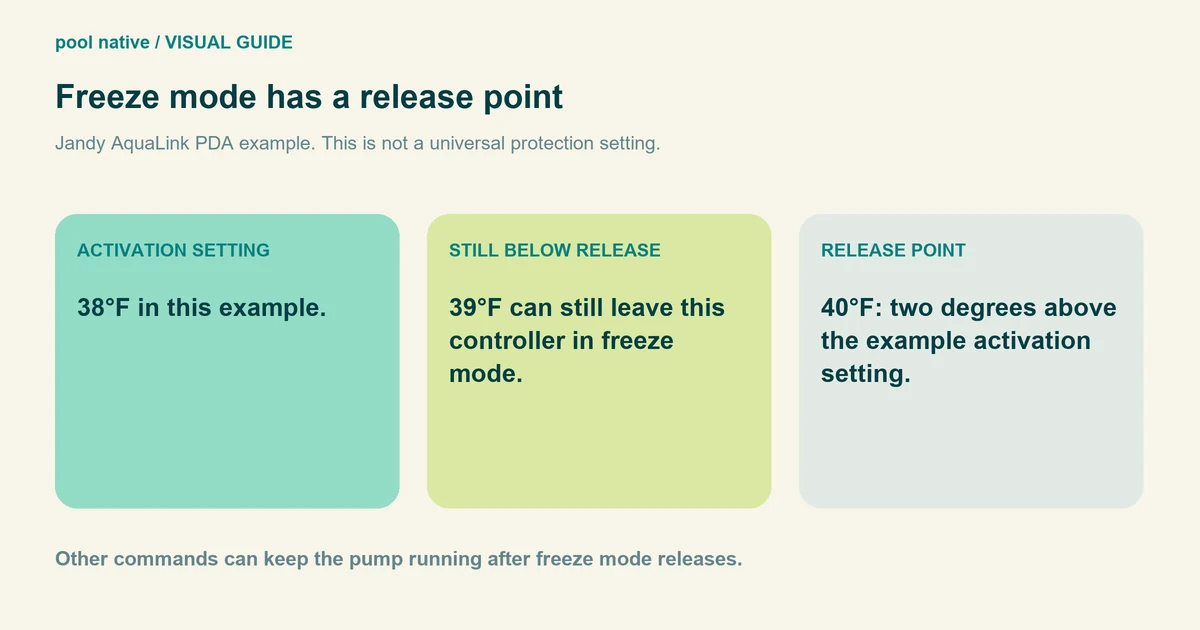
That example is not a setting recommendation for every pool. Find the rule for the installed controller and its current configuration. A temperature just above the activation point may still be within normal operation.
Do not lower the activation setting to compensate for a faulty sensor. Repair the reading problem. Also avoid assuming an “Air Temp” display option calibrates the sensor; on some Jandy controls it only hides or shows the reading.
Separate the controller from the pump’s own protection
A pump may have its own temperature protection in addition to the pool automation. Its sensor, schedule, and operating rules may differ. The installer should confirm which device controls operation in this configuration.
Record any recent pump replacement, software change, or scheduling adjustment. Those details help explain behavior that began suddenly. Don’t copy another owner’s speed or firmware fix without matching the equipment and diagnosis.
| What you observe | What to check next |
|---|---|
| Accurate cold air reading and active freeze message | Model’s release point and expected operating behavior |
| Warm conditions but an implausibly cold display | Sensor location, sensor fault, or connection diagnosis by a technician |
| Normal air reading and no freeze message | Other schedules, heating demands, and manual commands |
| Controller says off but pump continues | Pump’s own control mode and the connection between devices |
| Pump runs but water does not circulate normally | Flow problem requiring prompt attention, not a successful protection cycle |
Confirm which plumbing is protected
Running the main pump does not prove water moves through every feature or isolated branch. Review equipment assignments and valve behavior with the installer. A separate waterfall line can remain vulnerable even while the pool returns are flowing.
Freeze protection also depends on power and functioning equipment. It cannot guarantee protection through prolonged freezing. If the forecast exceeds the system’s intended use, arrange a suitable winterization plan.
If water may already have frozen inside stopped equipment, do not start it as a test. Follow the frozen equipment response. Restoring circulation is a different task once ice may obstruct the system.
Verify the repair through a normal cycle
After service, confirm the displayed air reading is plausible and the protection settings remain appropriate. Observe whether freeze mode releases under the manual’s conditions. Then check that the normal schedule resumes.
Keep the diagnosis and final settings with the equipment record. A disappearing warning alone is not proof that protection still works. Ask the technician how its operation was verified without disabling safeguards.


