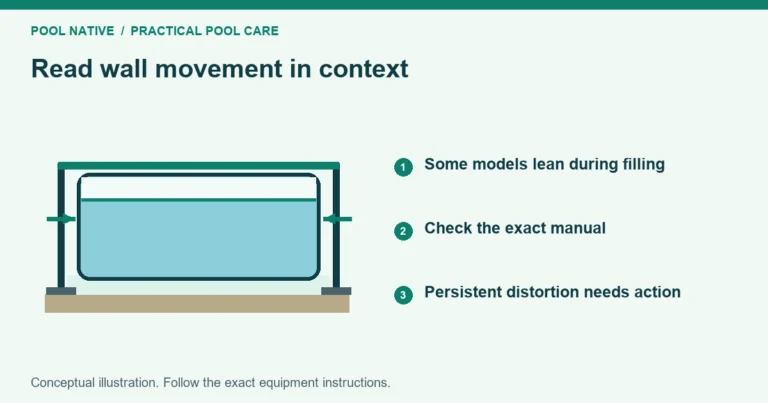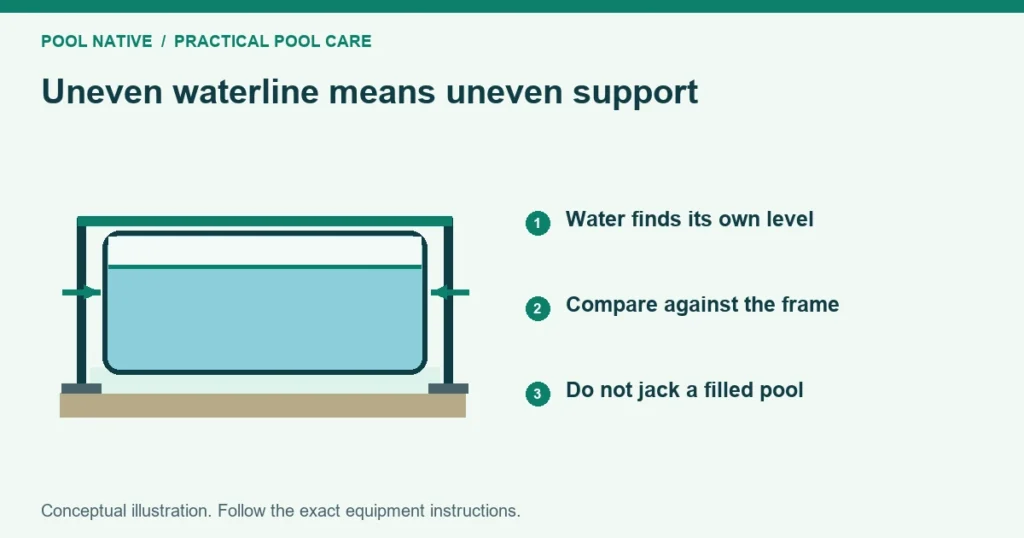
If your above ground pool is unlevel after filling, stop using it and identify whether the site slopes or supports have settled. Do not lift the loaded frame or add blocks beneath it. Correcting the foundation requires an appropriate unloading and reset plan.
There is no universal “safe number of inches” for every pool. The model, construction, foundation and condition all matter. Another owner’s pool surviving a season does not establish the safety of yours.
Confirm what is uneven
Water provides a horizontal reference when it is still. Compare its distance from corresponding fixed points on the pool structure. Do not rely only on the liner’s printed tile pattern, which can be misaligned or stretched.
Stop swimming and allow movement to settle before observing. Take measurements from safe positions outside the pool. Do not lean over an unstable wall or climb onto a support.
Use the same structural reference around the pool. On a suitable frame, that may be the corresponding beam location specified by the manufacturer. If the frame itself is distorted, the measurement describes that condition too.
A hypothetical waterline comparison
Suppose the still water sits 5 inches below a corresponding rim point on one side. It sits 3 inches below the equivalent point opposite. The observed difference is 2 inches, about 51 mm.
That is a record of the difference, not an acceptable tolerance. It also does not identify the cause by itself. A sloped base, settled supports or frame deformation can affect the comparison.
Photograph the measuring locations and write down the readings. Use the same points if the manufacturer requests another check. Do not keep filling while collecting evidence of a developing problem.
Separate whole site slope from local settlement
| Pattern | Likely investigation |
|---|---|
| A gradual change across the whole pool | Foundation elevation across the footprint |
| One low corner or short section | Local soil settlement or support movement |
| One leg lower than adjacent legs | Individual pad and bearing condition |
| Uneven frame but no clear waterline pattern | Assembly, damaged parts and expected model geometry |
| A new change after rain or overflow | Drainage and softened ground |
Look for changes since the original fill. If the pool started level and later tilted, something moved or changed. Fresh mud around a support is useful evidence, but it is not the only possible cause.
Use the sinking leg assessment for a local support problem. If you are judging inward frame lean rather than elevation, see bowing during filling. Those conditions should not be diagnosed from the same visual shortcut.
Why topping up or jacking is not a correction
Adding water reduces the space beneath the low rim first. It does not level the base. Do not overfill to make the higher side look right.
Removing water can reduce load, but it does not repair the foundation either. A partly drained pool may still carry substantial force. Do not assume a chosen percentage makes a leg safe to lift.
Jacking, wedging and digging beneath loaded supports can change the load suddenly. They can also stress neighboring joints and the liner. Use the manufacturer’s correction plan rather than a demonstration for an unidentified pool.
Intex requires level, firm and stable ground. Its Rectangular Ultra Frame manual directs draining and leveling when the initial water check exposes an uneven site. That is a reset instruction, not permission to tolerate an unspecified amount of tilt.
Arrange the right reset for the construction
For a portable pool, the plan may involve draining, dismantling and preparing the site again. Confirm the exact sequence with the manufacturer. Follow controlled draining and dismantling guidance once a safe discharge route is established.
A permanent steel wall pool needs its installer involved. Emptying it can affect the liner and structure. Do not apply portable pool teardown instructions to a permanent installation.
If access to equipment is unsafe, keep clear and obtain help. Do not stand beside a moving wall to operate a drain. Plan the water route so it cannot undermine the pool or damage nearby property.
Before refilling, check the complete footprint rather than only the lowest spot. Use recorded ground leveling measurements. Investigate soft fill, buried organic material, tilted pads and runoff.
Inspect the unloaded frame, liner and connections for damage. Correct pad elevation according to the model. Replace damaged components rather than hiding deformation with a different support height.
Refill with an acceptance plan
Write down what must be checked before water returns: foundation, support arrangement, frame assembly and liner condition. Photograph those areas while they are visible. Keep the instructions used for the repair.
Pause at the manual’s initial shallow fill checkpoint. Look for uneven coverage and early support movement. Continue only when the installation meets the prescribed checks.
Observe the same locations as the water rises. Recheck after the first use and significant rain. A repair that looks level while empty still needs to remain supported under load.
If settlement returns, stop use and investigate the ground more thoroughly. Repeatedly adding blocks treats the visible symptom. The durable correction addresses why that part of the foundation cannot hold its required elevation.
Sources
- Intex: Slope and stability requirements
- Intex: Rectangular Ultra Frame manual 119IO, July 16, 2014 historical edition.