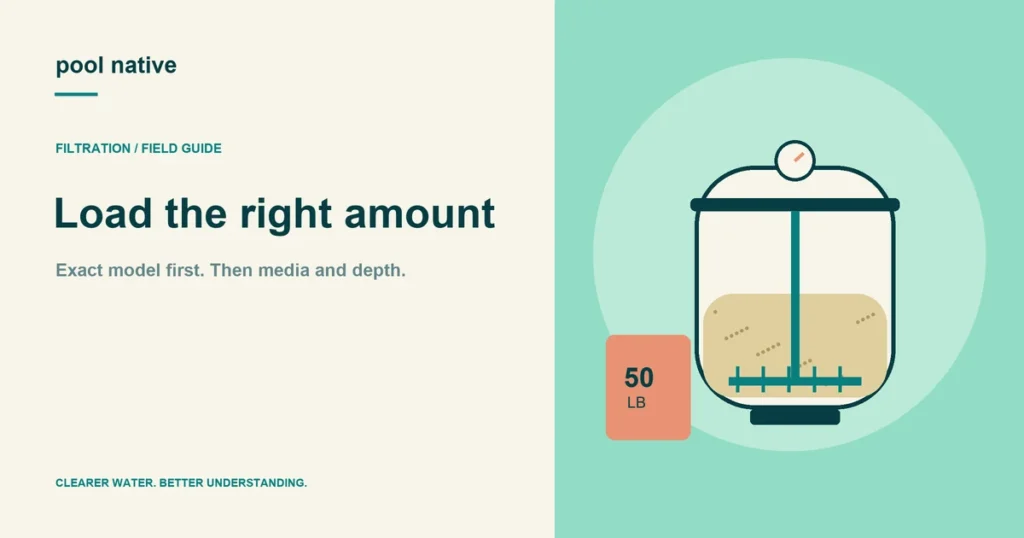
How much sand your pool filter needs depends on the exact model and the approved media configuration. Use its label and matching manual. A tank diameter chart can’t reliably substitute for either.
Also separate the amount you buy from the amount you load. Four 50 pound bags provide 200 pounds, but a filter requiring 175 pounds should not receive all four bags. The spare material stays out of the tank.
How much sand for a pool filter: verified model examples
These tables identify the source configuration rather than treating every similar tank as interchangeable. Check your own label and applicable manual before loading. Where they disagree, have the manufacturer resolve the difference.
Pentair Triton examples from the current linked guide
The linked Triton guide lists these sand loads and freeboard dimensions in Table 2 on printed page 3. It specifies No. 20 silica sand. It also says freeboard is the controlling variable because media density can vary.
| Model in Table 2 | Listed sand load | Listed freeboard | 50 pound bags to have available |
|---|---|---|---|
| TR40 | 175 lb | 8.25 inches | 4, with material left over |
| TR60 / TR60 ClearPro | 325 lb | 10.5 inches | 7, with material left over |
| TR100 / TR100C-3 | 600 lb | 11.25 inches | 12 |
| TR140 / TR140C-3 | 925 lb | 13.5 inches | 19, with material left over |
These are the sand configuration figures from that document. Do not combine them with gravel quantities from another specification. Older documents and alternative configurations can explain why another source shows a different sand weight.
Hayward examples from manual IS210T-06 Rev. A
The following historical manual covers the four exact models shown. Its table specifies No. 20 silica sand in the 0.45 to 0.55 millimeter range. Confirm that this manual applies to your installed unit and revision.
| Model | Listed sand load | 50 pound bags to have available |
|---|---|---|
| S180T | 150 lb | 3 |
| S210T | 200 lb | 4 |
| S220T | 250 lb | 5 |
| S244T | 300 lb | 6 |
The manual is linked in Sources as a manufacturer document hosted by a distributor. Don’t extend its values to suffixes, larger models, or other series that aren’t listed. The bag calculations assume bags labeled 50 pounds, not 20 or 25 kilograms.
Find the exact model before buying media
Photograph the tank’s model and serial labels. Include every suffix and any manufacturing date. The number on the pump or multiport valve may identify that separate component, not the filter tank.
Look up the manufacturer’s manual for the tank. Find its media loading table, grain specification, and any freeboard drawing. Save the document so you can check the instructions during the job.
If the label is missing, don’t settle on the closest online photograph. Send the manufacturer or qualified service provider pictures of the tank, base, ports, closure, and remaining labels. Get the identity confirmed before loading.
Keep sand, gravel, glass, and other media specifications separate
Some approved configurations use more than one material. A sand amount in that configuration isn’t necessarily the total weight in the tank. Read each layer’s quantity and the installation sequence together.
Glass, zeolite, and fiber media don’t share one universal weight conversion from silica sand. Density and the approved operating method can differ. Use the filter manufacturer’s approval and the media supplier’s instructions together.
Don’t replace the specified grade with play sand or general construction sand. Don’t pour DE powder into a system because an unrelated guide promises finer filtration. Only use media and additives expressly supported for the equipment.
Calculate bags without rounding up the tank load
Divide the specified load by the bag weight, then round up only the purchase quantity. For 175 pounds in 50 pound bags, the calculation is 3.5 bags. Buy four, then measure the remaining partial bag as needed.
A bathroom scale may not suit every handling method or load. Use an appropriate accurate scale where weighing is required. Keep bags and measurements dry unless the instructions specify otherwise.
If your document uses kilograms, stay in kilograms while measuring. If conversion is necessary, 1 kilogram is about 2.205 pounds. Don’t mistake a 25 kilogram bag for a 50 pound bag.
Why freeboard matters as much as the shopping total
The space above the bed allows it to behave as designed during cleaning. Filling the tank to the neck removes that space. “More sand must filter better” is not a valid loading rule.
Measure freeboard from the reference point shown in the manual. Different drawings can use different reference locations. Don’t borrow another model’s dimension or measure from an arbitrary lid edge.
If the prescribed weight produces an unexpected level, stop before adding more. Recheck the media type, model, configuration, and measurement point. A discrepancy needs an explanation, not an improvised average.
Before you open the filter
Confirm that replacement is actually needed with the sand condition guide. A cleaning or valve issue may be the real cause. Fresh media can’t repair a broken collector.
Then use the sand replacement workflow alongside your exact manual. It covers preparation, protecting internals, and the checks needed before restarting.
If sand is already entering the pool, follow the return debris checks first. Save a sample and the recent service details. Those clues can prevent another refill with the same unresolved fault.