Pool flow rate is the volume of water passing a particular point over time. For many US pool systems, the useful unit is gallons per minute, or GPM. The location matters: total filter flow can be different from flow through a heater branch.
The most direct practical approach is a correctly selected and installed flow meter. A pump curve can provide an estimate when suitable measurements and the correct curve are available. Jet strength, pump horsepower and filter pressure alone do not establish GPM.
Decide which flow you need to know
Sketch the route from the pump through the filter and back to the pool. Mark bypasses, solar branches, spa returns and water features. Identify the pipe whose flow answers your question.
| Question | Useful measurement location | Common mistake |
|---|---|---|
| How much water passes through the filter? | A suitable common pipe carrying that filter’s flow | Measuring only a feature branch |
| Does the heater receive its required flow? | The heater branch or an approved equivalent method | Treating bypass flow as heater flow |
| How much water reaches a solar array? | The collector supply route | Reading total circulation before the split |
| How does a pump program affect circulation? | The same relevant location in each program | Comparing readings from different modes |
| Why is one return weak? | Branch or outlet evaluation suited to the system | Dividing total flow equally among all returns |
In a hypothetical steady split, 60 GPM could divide into 35 GPM through a heater and 25 GPM through its bypass. A meter before the split would read the combined amount. It would not prove that the heater receives 60 GPM.
Use the heater bypass guide for that routing question. The same distinction applies whenever water has more than one path. Mark the meter location on the record beside its reading.
Choose a meter for the actual installation
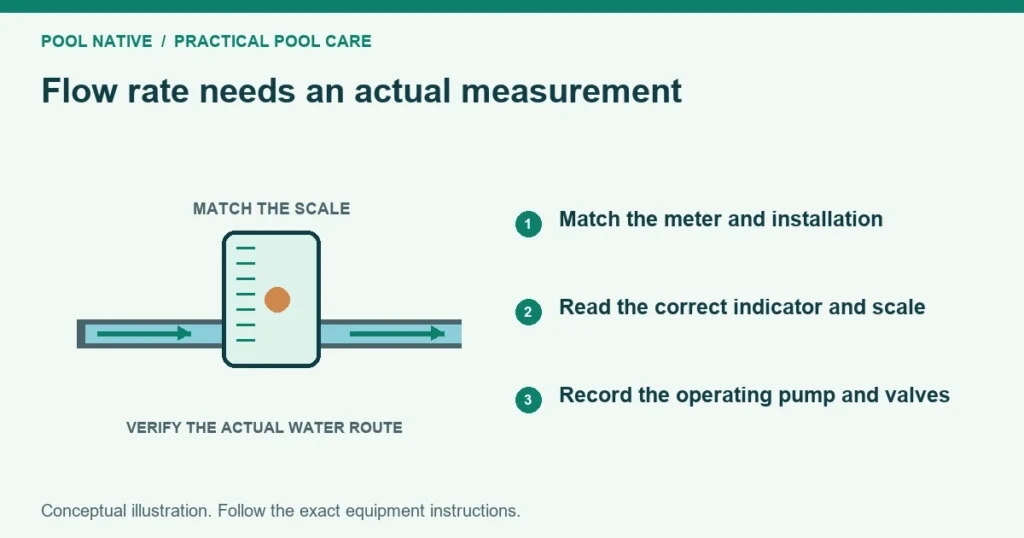
Match the exact meter model to the pipe size, pipe material and schedule or wall specification. Its measuring range must cover the flows you intend to check. A display below its calibrated range should not be treated as an accurate small flow reading.
Confirm the permitted direction, orientation and surrounding pipe layout. Some meters require a straight run before and after them. Other models allow shorter runs, but those permissions are specific to the model and its accuracy conditions.
For example, Blue-White specifies five nominal pipe diameters before and two after its horizontal F-300 installation. It also requires the horizontal version to sit at the top of a full horizontal pipe. A two inch nominal pipe therefore needs ten inches before and four after under that stated rule.
FlowVis uses different installation requirements across its range. Its current manual permits no straight run for certain smaller models, while larger models have specified upstream lengths. Do not transfer a small model’s allowance to a larger one.
Meter installation can involve cutting, drilling or opening pressurized plumbing. The equipment must be shut down, secured, depressurized and isolated as required. Have a qualified installer handle it if the route, material or installation method is uncertain.
Read the correct scale and indicator
Confirm the scale’s units before recording a number. Gallons per minute, liters per minute and feet per second describe different things. Velocity is not volume flow unless the relevant internal area is also known.
Use the exact indicator reference specified by the manufacturer. A float’s top, center and bottom are not interchangeable reading points. FlowVis instructs the reader to view the indicator squarely to avoid an angle dependent error.
Let the system reach stable ordinary operation before recording the reading. Note whether the meter remains steady, oscillates or appears stuck. A pipe containing substantial air or a dirty moving element can invalidate an otherwise plausible number.
Do not remove a meter cap or cover while the system is pressurized. Follow its service instructions if the indicator does not respond normally. A stationary indicator is not proof that the pump produces the same flow at every speed.
Make a mode log instead of one universal RPM rule
Measure the relevant operating programs separately. A low circulation program, heating program and water feature program can use different flow routes. The same pump speed does not guarantee the same GPM after a valve changes position.
Use this record format:
| Field | What to record |
|---|---|
| Mode | Pool circulation, heating, spa or named feature |
| Pump setting | Actual speed or selected flow setting |
| Meter | Model, pipe location and scale units |
| Reading | Stable value and any visible fluctuation |
| System condition | Filter condition, valve route and active branches |
| Requirement | Applicable equipment flow range and its source |
Recheck when equipment, plumbing or operating routes change. Also investigate a substantial departure from a comparable baseline. Do not raise pump speed to compensate for a new restriction without finding its cause.
If the purpose is choosing runtime, use the pool pump runtime guide after obtaining a useful flow reading. Runtime also has to support the actual pool and equipment needs. A single number cannot establish every operating requirement.
Can a pump display replace a separate meter?
Some pumps display or control an estimated flow rate. Others show only speed and power. Read the manual for the exact pump to determine what its displayed value represents and any stated limitations.
A flow setpoint is the requested value, which may differ from what the system can achieve. A displayed total flow also cannot isolate a downstream branch by itself. Confirm both the meaning and the location represented by the number.
Use an appropriate independent measurement when commissioning equipment that requires verified flow. If the two readings disagree, compare their definitions and installation conditions first. Do not assume either instrument is correct simply because its display looks precise.
Estimating from the pump curve
A pump performance curve relates flow to the head the pump develops at a specified speed. Head expresses pressure energy as an equivalent height of water. You need the curve for the actual pump and impeller, not merely the motor’s horsepower label.
A technician can use suitable suction and discharge measurements to estimate the pump’s operating head. The measurement locations, gauge units, elevation difference and velocity effects must be handled correctly. Then the operating head is matched to the correct speed curve to estimate flow.
The filter pressure gauge alone leaves out important information. It is also located downstream of part of the system. Treating its PSI reading as the pump’s complete head can produce a misleading estimate.
Do not remove pump plugs or add gauges to unidentified ports while troubleshooting casually. The gauges must suit the pressure, fluid and connection. Ask for the measured inputs, curve and assumptions with any estimate supplied by a technician.
Shortcuts that change the question
Collecting water in a container can measure a simple open discharge when volume and time are known. Redirecting a pool return through a hose and blocking other outlets changes the system’s resistance. The result may not represent ordinary pool circulation.
Likewise, dividing total GPM by the number of returns assumes equal flow. Real branches can have different pipe lengths, fittings and openings. Use the return eyeball guide to understand why a forceful stream can still mislead.
Do not calculate flow solely from RPM. Another pool with the same pump can have a different operating flow because its plumbing and equipment differ. A measurement record belongs to a particular system configuration.
Convert flow into a useful volume estimate
At a steady measured 40 GPM for three hours, the volume passing that point is 40 × 60 × 3, or 7,200 gallons. This is a calculation example, not a recommended schedule. If the flow changes, calculate each operating period separately and add the volumes.
For unit conversion, one US gallon is approximately 3.785 liters. A reading of 40 US GPM is therefore about 151 liters per minute. Check that the source uses US gallons before applying that conversion.
Volume passed is not proof that every parcel of pool water was filtered once. Water mixes and recirculates. Keep that limitation in mind when interpreting a turnover calculation.
What a reliable result looks like
A useful flow result includes a number, units, location and operating condition. It also identifies the meter or estimation method. Those details let you compare future readings without guessing what changed.
If the result is close to an equipment limit, account for measurement uncertainty and changing conditions. Have the installer establish a suitable operating setting within the manufacturer’s requirements. Do not balance the system on an unverified display value exactly at a stated minimum.