Nonchlorine shock usually supplies an oxidizer called potassium monopersulfate, or MPS. It does not replace the sanitizer your pool needs. Chlorine products can supply sanitizer as well as oxidation, but their ingredients and application requirements differ.
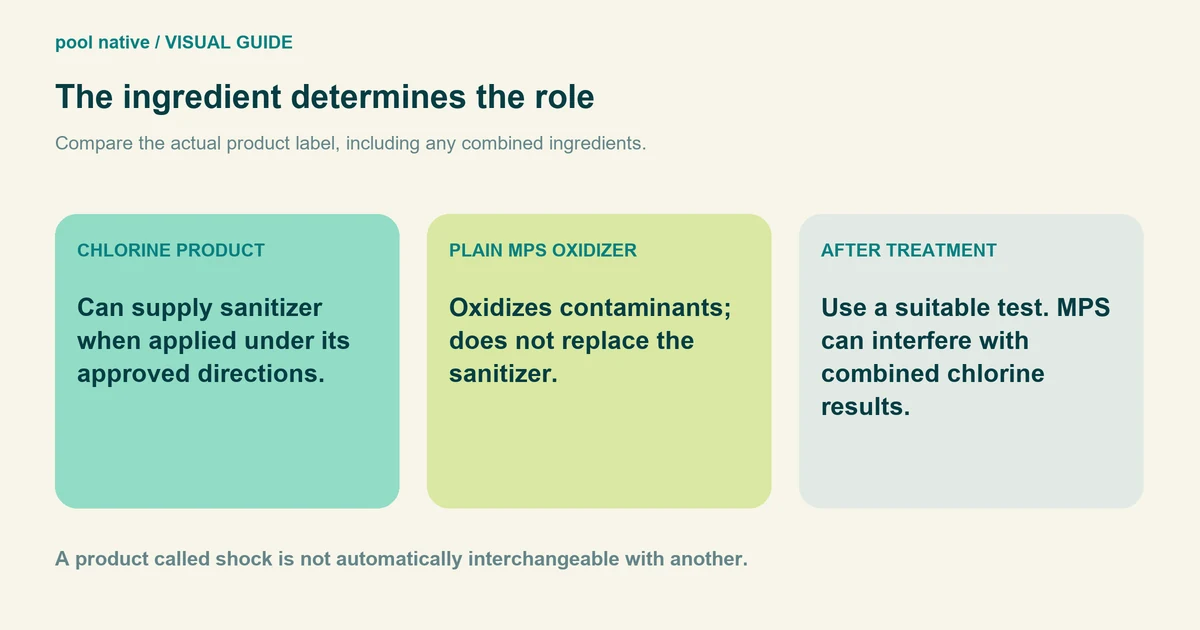
Choose by the job and the ingredient label. The word “shock” on the front of a bag does not tell you whether it adds chlorine, stabilizer, or calcium.
Start with the problem you need to solve
If free chlorine is inadequate, restore it with an appropriate chlorine product or functioning chlorination system. MPS is not a substitute for that correction. A clear appearance does not establish adequate sanitation.
For a pool with adequate sanitizer, an approved nonchlorine oxidizer may fit a specific oxidation need. Check the product and system instructions. It is not automatically necessary because the pool is small or uses a salt generator.
Active algae requires an appropriate treatment plan, including sanitizer management and physical cleaning. Do not choose MPS alone because it promises an earlier swim. A product’s application interval cannot override unresolved water quality problems.
Compare actual formulations
| Ingredient | Supplies chlorine? | Other consideration |
|---|---|---|
| Potassium monopersulfate | No | Oxidation aid; can interfere with chlorine testing |
| Sodium hypochlorite | Yes | Liquid chlorine without added CYA or calcium |
| Calcium hypochlorite | Yes | Adds calcium |
| Dichlor | Yes | Adds CYA |
The table describes the named ingredients, not every blended package. Read all active ingredients and restrictions. A product combining an oxidizer with a chlorinating ingredient is not equivalent to plain MPS.
For chlorine selection, compare cal hypo and liquid chlorine against current hardness. Check stabilized chlorine against CYA and equipment requirements. Do not mix products to construct your own blend.
Account for what remains after repeated additions
Dichlor contributes roughly 9 ppm CYA for each 10 ppm of chlorine it supplies. Cal hypo contributes roughly 8 ppm calcium hardness per 10 ppm chlorine. Those additions can matter when either measurement is already high.
MPS itself supplies neither CYA nor calcium. Repeated use can reduce pH and alkalinity, however. “Chlorine free” does not mean it has no effect on water balance.
Review the treatment history before changing products. Switching away from dichlor prevents that continuing CYA input; it does not remove existing CYA. Similarly, choosing another chlorine source does not immediately lower accumulated calcium.
Test before applying MPS
Record free chlorine, combined chlorine, and pH before treatment. Residual MPS can register as combined chlorine in DPD and FAS-DPD testing. That can make the result after treatment misleading.
Use the test manufacturer’s approved interference procedure or an appropriate unaffected method. Do not assume one overnight wait guarantees the interference has disappeared. Our total versus free chlorine guide explains the investigation.
A high reading after a blended product still needs its actual ingredients checked. Don’t automatically dismiss it as interference or turn down a salt generator without a reliable free chlorine result. Record the product name when seeking help with the test.
Keep application and swimming decisions separate
Follow the exact dose, circulation instructions, protective measures, and reentry conditions on the label. There is no universal fifteen minute clearance for every nonchlorine product. Do not improvise bucket mixing when the label specifies another method.
Never combine concentrates, leftover packages, or measuring tools contaminated by another chemical. Keep the product in its original container. Review chemical storage before adding another oxidizer to your supplies.
Also check metal and mineral system restrictions; oxidation can contribute to staining when metals are present. Biguanide systems require their manufacturer’s specific compatibility guidance. Advice for a chlorine pool is not an automatic treatment plan for another sanitizer.
Choose by the correction, not by the bag price
Compare labeled treatment amounts for the same pool volume and purpose. Include any resulting balance adjustments and testing requirements. A cheaper package cannot be a better sanitizer purchase if it supplies no sanitizer.
After treatment, verify the intended result with suitable tests and normal filtration. If clarity or odor problems persist, investigate their cause. Repeating an oxidizer without reliable measurements can obscure the next useful decision.