If your pool heater keeps shutting off, record what changes at the moment it stops. The time, water temperature, heat request and pump state are more useful than the shutdown alone. Several very different faults can end with a quiet heater.
A heater reaching its setpoint should stop adding heat. A heater stopping below the requested temperature needs a closer look, but it may still be following a delay or external control. First establish which event actually occurred.
What stopped: heat, the fan or the whole system?
Read the normal operating display without removing covers. A gas heater’s blower can continue after the burner stops. A heat pump’s fan can run while its compressor is off.
Likewise, the circulation pump may continue after heating ends. That can be part of a cooling sequence. Do not defeat the sequence by cutting pump power or closing the heater’s water path.
Write down four states: heater display, heating indicator, circulation pump and automation heat request. If you can see a valve actuator from a safe position, record whether it moved. A photograph or short video of the displays can preserve details that disappear quickly.
When a pause can be normal
If the controlling sensor reaches the requested temperature, the controller can end the heat request. The pool may then cool slightly before another cycle begins. The exact restart behavior depends on the heater and controller.
Compare the displayed temperature with the correct pool or spa setpoint. Also check which device owns that setpoint. A local thermostat can impose a different limit from the temperature requested in an app.
Heat pumps may pause for compressor protection or defrost. On the AquaCal systems covered by the cited guide, passive defrost can stop the compressor while the fan continues. That state should be assessed against the model’s displayed status and operating conditions.
A delay that follows the manual and resolves normally is different from repeated fault lockouts. Heavy ice, repeated breaker trips or a persistent fault requires service. Do not keep resetting the equipment to shorten the waiting period.
Use two clocks to distinguish the pattern
Record both the clock time and the elapsed time since heating began. “Stops at 3 p.m.” suggests a different investigation from “stops three minutes after every start.” Neither pattern identifies a failed part, but each narrows the next check.
| Pattern | Useful next observation | What the pattern cannot prove |
|---|---|---|
| Same clock time each day | Schedule end, pump speed change or another circuit starting | That the heater’s internal timer failed |
| During a switch between pool and spa | Valve travel, pump transition and selected water body | That an actuator or pressure switch must be replaced |
| Shortly after an ignition attempt | First fault, startup sounds and whether heat was established | That the igniter alone is responsible |
| After several minutes of heating | Displayed temperature change, flow condition and safety message | That a temperature limit is defective |
| Only during cold weather | Heat pump status, operating range and icing | That a longer schedule will overcome a safety limit |
| At the same displayed temperature | Local and remote setpoints, sensor agreement | That the pool has reached that temperature everywhere |
Don’t deliberately repeat a dangerous shutdown to fill in the table. Existing observations and one normal operating attempt are enough to start the service discussion. Gas odor, soot, steam, banging or burning smells require stopping and seeking help.
Check what happened to the heat request
Look at the outdoor controller as well as the app. If the controller ended its heat request, investigate the schedule, mode, setpoint and selected body first. A phone can show an outdated state when connectivity is interrupted.
If the controller still requests heat but the heater has stopped, capture the heater’s own message. The command has reached a different stage of the process. Follow the corresponding model diagnostic route rather than adding another schedule.
An automation change can alter both controls and hydraulics. For example, a hypothetical filtration program might reduce pump speed at 4 p.m. If a flow warning appears at that same transition, report both events together.
That observation does not establish the correct replacement speed. The installer must confirm flow within all equipment limits. The automation heating guide explains how to compare local and remote operation without changing several conditions at once.
Check flow against a comparable baseline
Confirm normal pool level, clean accessible baskets and stable pump prime. Compare filter pressure with its clean baseline at the same speed and valve arrangement. A reading from spa mode is not a direct comparison with yesterday’s pool mode reading.
A heater bypass or feature branch can reduce heater flow while other returns remain strong. If a documented valve setting changed recently, include that in the record. Do not guess at unlabeled handles or force a stiff valve.
Too little flow can cause a real temperature limit event. An internal bypass, regulator or obstructed exchanger can also require investigation. Replacing a limit switch without establishing why it opened can leave the cause untouched.
Have flow measured when pressure readings and pump speed do not resolve the question. A pressure switch is a safety input, not a direct gallons per minute display. Never bridge its contacts or adjust it simply to keep the burner running.
Treat a rapid temperature jump differently from a slow pool
If the heater display rises quickly while the main pool remains cool, record both readings. The heater sensor observes water at the equipment, not the average temperature of the entire pool. Poor circulation, routing or a sensor issue can require different repairs.
Leave sensor calibration and internal checks to the correct service procedure. Raising the setpoint can conceal the symptom without restoring proper heat removal. Stop operation if overheating messages recur.
A heater that runs steadily but cannot overcome heat losses belongs to a different diagnosis. Use the no heat decision guide for demand and net heat gain. This page addresses interrupted operation, not normal heating that is simply slower than expected.
Save the first fault before resetting
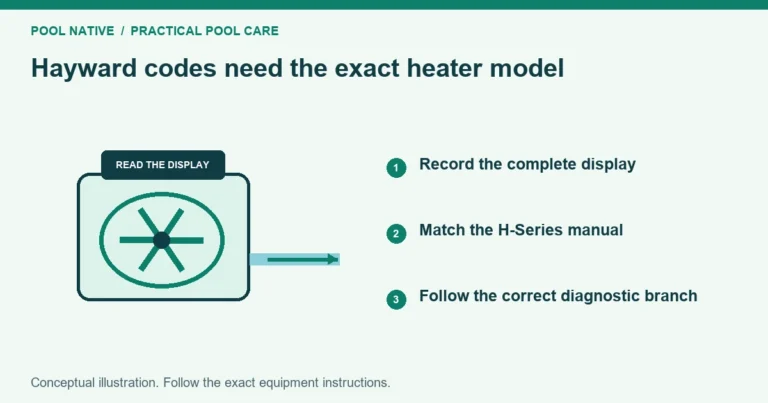
Read the code in the manual for the exact model and control revision. The Hayward code index and Pentair code router help identify the correct branch. Similar lettering does not guarantee the same meaning across technologies.
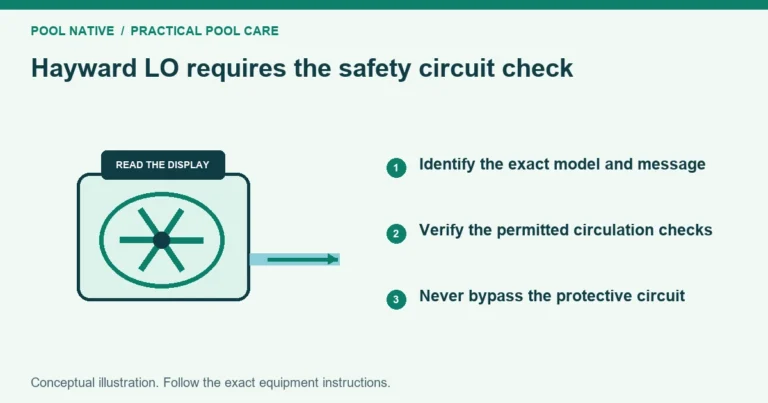
As one model specific example, Hayward’s cited RevE table gives IF an automatic reset period of 60 minutes. It gives LO a different restart condition after the limit circuit closes. These are descriptions of control behavior, not advice to keep retrying an unresolved fault.
After a shutdown, a later pressure warning may simply coincide with the pump turning off. Tell the technician which message appeared first. A list of codes without their order loses useful evidence.
A service note that helps reproduce the fault
Record the model and serial number, selected water body, requested temperature and displayed temperature. Add the elapsed heating time, clock time, pump program and first message. Include any recent filter service, fuel work, storm, power interruption or settings change.
Explain whether the system resumes by itself, stays locked out or only appears to recover after a reset. Do not repeat resets to test that last point. The technician can use the recorded sequence to choose the correct controlled tests.
The goal is stable operation under the intended heating conditions. A heater that completes one cycle after an unexplained adjustment is not yet proof that the underlying issue is resolved.
Sources
- Hayward: Universal H-Series owner manual, 51300004201 RevE
- Pentair: MasterTemp installation and user guide
- AquaCal: Issues and Resolutions, LTM1041 Rev A (archived manual)