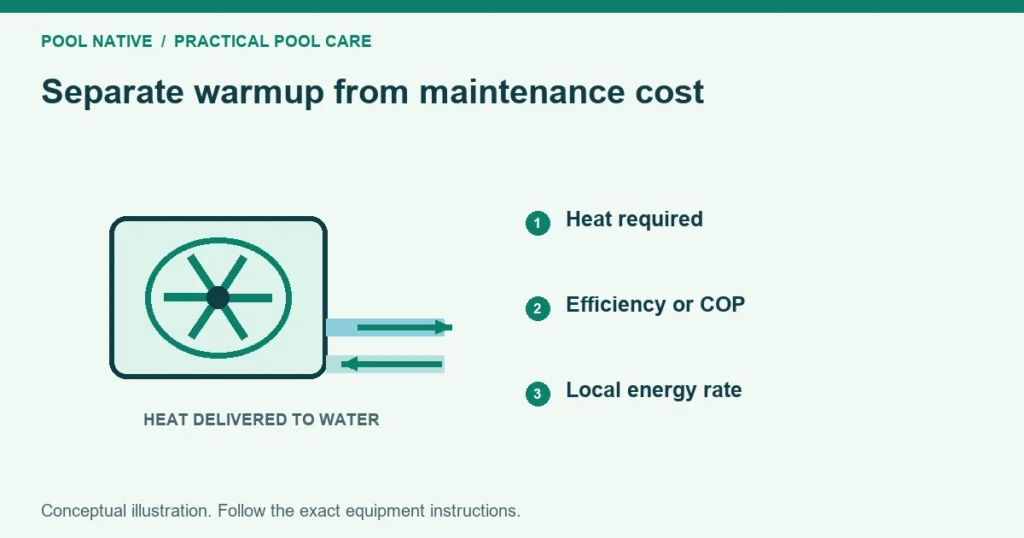
Pool heater running cost depends on how much heat the water needs, how efficiently the heater supplies it and your energy price. A monthly dollar figure without those inputs describes someone else’s situation. Separate the first warmup from the cost of keeping the water warm.
The calculator below prices a specified temperature increase. It also offers an optional daily heat replacement estimate based on a temperature loss you enter. It does not automatically predict local weather, evaporation or your next utility bill.
Calculate heating energy cost
Enter your own energy rate in dollars per displayed unit. The examples are illustrative rates, not current national averages. Compare fuels only after confirming the units on your bill or supplier quote.
The initial heating result excludes heat lost during that warmup. The optional maintenance result estimates replacing the daily temperature loss you enter. Keep the two figures separate unless both apply to your actual heating plan.
Choose the correct energy and efficiency inputs
| Heating method | Rate unit | Performance input |
|---|---|---|
| Heat pump | Dollars per kWh of electricity | COP at relevant operating conditions |
| Electric resistance | Dollars per kWh of electricity | Calculator assumes essentially all element energy becomes heat |
| Natural gas | Dollars per therm | Heater thermal efficiency as a percentage |
| Propane | Dollars per US gallon | Heater thermal efficiency as a percentage |
COP is the ratio of heat delivered to electrical energy consumed. A COP of four means four units of heat per unit of electricity at that operating point. It is not a promise that the heater holds that performance throughout the season.
Gas efficiency is a percentage of fuel energy delivered as useful heat. Enter 84 for an 84% example, not 0.84. Use your unit’s actual specification rather than copying the example value.
Resistance heating has no heat pump multiplier. The tool treats its conversion as one unit of heat per unit of electricity. Heat escaping from the pool still creates additional demand.
Read your energy bill carefully
For electricity, use the relevant cost per kWh, including variable delivery charges where applicable. A bill total divided by usage may include fixed charges that do not increase with heater use. Time dependent tariffs may require separate estimates for different operating periods.
Natural gas may be billed in therms, CCF or another unit. Use the utility’s stated conversion when your bill does not use therms. Do not treat one CCF as exactly one therm without checking its heat content factor.
For propane, enter the delivered price per US gallon applicable to your supply. Tank rental, minimum delivery charges and other fixed costs belong in a separate budget. The calculator does not assume a tank size or delivery schedule.
The equations behind the result
The starting heat requirement is approximately US gallons × 8.34 × the Fahrenheit temperature increase, in BTU. In metric units, use cubic meters × 1.163 × the Celsius increase, in kWh of heat. The temperature increase compares current water with target water, not target water with air.
The tool uses about 3,412 BTU per kWh, 100,000 BTU per therm and 91,452 BTU per US gallon of propane. These are planning conversions based on EIA energy units. Your utility’s billed gas heat content can differ.
- Heat pump electricity equals required thermal kWh divided by COP.
- Resistance electricity equals required thermal kWh under the tool’s conversion assumption.
- Gas therms equal required BTU divided by efficiency as a fraction, then divided by 100,000.
- Propane gallons equal required BTU divided by efficiency as a fraction, then divided by 91,452.
- Energy cost equals the resulting fuel or electricity quantity multiplied by your unit price.
For maintenance, the same water heating calculation uses your daily temperature loss instead of the initial temperature increase. Multiplying by the chosen number of days gives a simple period estimate. It assumes that daily load and efficiency remain constant.

Worked example: one temperature increase
Consider 15,000 US gallons going from 70°F to 80°F. The required heat is approximately 1,251,000 BTU, or 366.6 kWh. This example excludes ongoing losses during warmup.
| Method and illustrative rate | Energy needed | Approximate cost |
|---|---|---|
| Heat pump, COP 4, electricity $0.20 per kWh | 91.7 kWh | $18.33 |
| Resistance, electricity $0.20 per kWh | 366.6 kWh | $73.33 |
| Gas, 84% efficiency, $1.50 per therm | 14.89 therms | $22.34 |
| Propane, 84% efficiency, $3.00 per gallon | 16.28 gallons | $48.85 |
These figures compare equal heat delivered. They do not establish equal heating speed or a universal cheapest fuel. At another electricity rate, gas rate or heat pump COP, the order can change.
The gas versus heat pump comparison explains that tradeoff. Use the heating time calculator separately with delivered output to estimate recovery time. A cheaper unit of heat may arrive more slowly.
Estimate the cost of maintaining temperature
Suppose the same pool would lose 2°F over a representative day without heating. Replacing that loss requires about 250,200 BTU, or 73.3 kWh of heat. At COP four and $0.20 per kWh, that is roughly $3.67 per day.
Over 30 identical days, the simplified maintenance estimate is about $110. It excludes a separate initial warmup and other electricity use. Real days will not all have the same loss or COP.
Use a measured or professionally estimated daily loss appropriate to your pool. Record the starting temperature, weather and cover use with any observation. Sunlight or fresh water can make one day’s net temperature change unrepresentative.
Do not multiply a nighttime drop by two and assume it describes a full day. Daytime solar gains and different air temperatures affect the result. Run several plausible scenarios when you do not have enough observations.
A second way to check operating cost
If you know actual electrical input and runtime, electricity use is input kW × hours. For example, an average 5 kW draw over eight hours is 40 kWh. At $0.20 per kWh, that costs $8 for that period.
For gas, divide fuel input BTU per hour by 100,000 to get therms per firing hour. A 300,000 BTU per hour input heater uses about three therms per hour at full input. Forty five such hours at $1.60 per therm cost about $216.
Use actual firing or operating hours rather than the whole timer window. Modulating equipment can change its input during operation. Metered data is more useful than assuming maximum input for every scheduled hour.
Budget for costs outside the result
Additional circulation time, controls, gas heater electrical use and fixed utility fees are excluded. Installation, maintenance and repairs are also separate. The heater installation cost guide helps evaluate the upfront work.
A suitable cover and a lower desired water temperature can reduce the load, but no single savings percentage fits every pool. Compare your own covered and uncovered observations where safe and practical. Follow the cover’s handling and safety instructions.
Save the assumptions with each estimate so you can revise them after a few heating sessions. A result with traceable inputs is more useful than a precise looking monthly promise. Recheck rates and performance assumptions when the season changes.