A pool heat pump often suits steady heating in favorable weather. A gas heater can suit faster recovery when sufficient fuel input is available. The better choice depends on your swimming schedule, local energy prices and installation, not a universal winner.
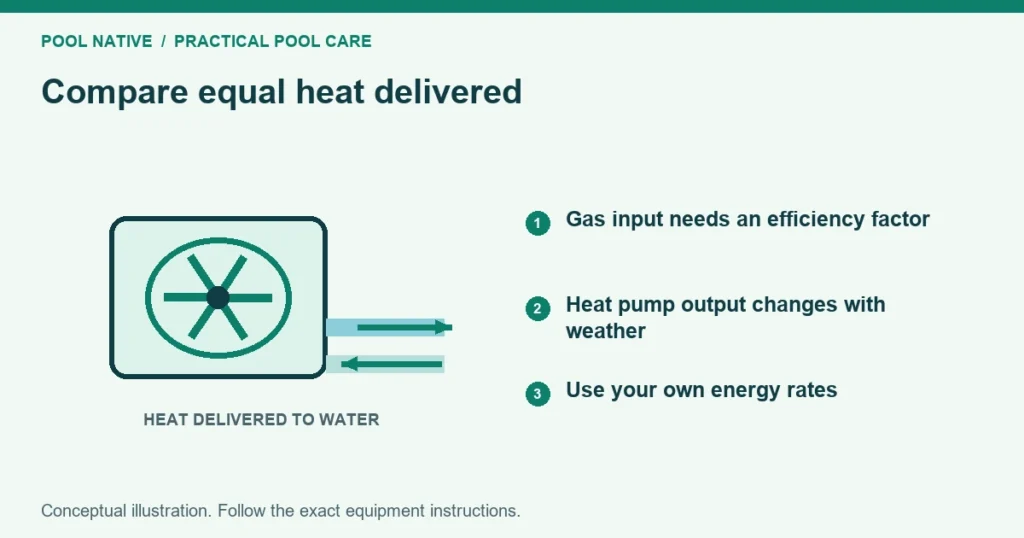
Compare delivered heat first, then operating cost and installed cost. A gas input rating and a heat pump output rating are different quantities. Treating them as equivalent can distort both speed and value.
What changes between the two
| Question | Heat pump | Gas heater |
|---|---|---|
| Where heat comes from | Transfers heat from surrounding air using electricity | Burns natural gas or propane |
| Important performance measure | Output and COP at stated conditions | Fuel input and thermal efficiency |
| Weather effect | Air and water conditions change capacity and COP | Pool losses still change; equipment has operating limits |
| Installation focus | Electrical supply, airflow and condensate drainage | Fuel supply, combustion clearances and venting |
| Common use pattern | Longer scheduled maintenance runs | Recovery for a chosen event or combined pool and spa use |
These are tendencies, not fixed speed rules. A sufficiently large heat pump can outheat a small gas heater at some conditions. Compare actual output during the conditions you care about.
Match the swimming schedule
For frequent swimming, maintaining temperature may be more convenient than repeatedly starting cold. A heat pump can work over longer periods when its output exceeds the pool’s losses. Consistent cover use supports that plan.
For an occasional weekend, recovery time can matter more. Gas equipment may provide substantial output without depending on warm air as its heat source. Check the time needed rather than assuming any gas heater warms the pool in an hour.
Cold season use needs a full assessment whichever method you choose. Gas does not make the rest of the pool immune to freezing. A heat pump’s minimum operating temperature does not guarantee adequate output there.
Compare the cost of equal delivered heat
Use your marginal energy rates, including usage based delivery charges. Keep fixed monthly fees separate unless the heating choice creates them. Natural gas may be billed in therms, while electricity is billed in kilowatt hours.
For one million Btu delivered, a heat pump uses about 293.1 divided by COP kilowatt hours. A gas heater uses 10 divided by thermal efficiency therms. Multiply each result by the appropriate rate.
Hypothetical example: electricity costs $0.20 per kWh, gas costs $1.50 per therm, and gas efficiency is 84%. At COP 4, the heat pump’s energy cost is about $14.65 per million Btu delivered. Gas costs about $17.86 for the same delivered heat.
If COP falls to 2.5 with the same rates, the heat pump cost rises to about $23.45. Gas is cheaper in that example. These are calculations with invented rates and assumed performance, not local price forecasts.
Find the COP where their energy costs match
For electricity priced per kWh and gas priced per therm, use this comparison:
Break even COP = 29.31 × electricity rate × gas efficiency ÷ gas rate.
With the example rates, the threshold is about 3.28. A heat pump above that COP has lower energy cost per delivered heat unit under those assumptions. Below it, gas has lower energy cost.
The formula excludes additional circulation, maintenance, installation and fixed charges. It also says nothing about whether the heat pump has enough output to meet the schedule. Check capacity and cost separately.
Use the running cost calculator for your own values. Propane needs a different fuel conversion from natural gas therms. Do not compare their displayed prices directly.
Account for changing heat pump performance
Look at capacity and COP near the intended air and water temperatures. A high warm weather COP is not a seasonal guarantee. Humidity, airflow and defrost behavior can also affect operation.
A heat pump running longer during cooler weather is not automatically faulty. It may be delivering less output while the pool loses more heat. Use cold weather checks to assess that pattern.
Do not assume an inverter’s maximum efficiency occurs at maximum output. Ask for the performance point used in each claim. A quiet maintenance mode and rapid recovery mode may have different input and output.
Compare installed cost fairly
A gas line already at the equipment pad may be inadequate for the new input. A nearby outlet may be unsuitable for a heat pump. Have both utility requirements assessed before choosing on equipment price.
Include clearances, pad work, plumbing, controls, electrical work and any venting or fuel tank requirements. Ask whether removal and commissioning are included. The installation cost guide provides a scope checklist.
Simple payback is extra installed cost divided by annual savings, but those savings need realistic usage. A rarely heated pool may never recover a large price difference. Do not use a full season heating assumption for a few weekends of use.
When a combined system makes sense
A heat pump can handle routine demand while gas provides occasional faster recovery or backup within the designed system. A hybrid appliance or coordinated installation can manage those roles. Extra cost and complexity must be justified by actual use.
Compare a combined quote with a properly sized single option. Ask how the controls choose a heat source and what rates or settings they use. Two heaters running together are not automatically the cheapest operating mode.
Make the final decision with site evidence
Bring your swim schedule, target temperature, local rates and cover routine to the installer. Ask for output at relevant conditions and an itemized installed price. Check local service support and the maintenance requirements for each exact model.
Choose the option that can meet the thermal job at an acceptable total cost. Keep sizing assumptions with the quote. They matter more than a broad statement that one technology is always faster or cheaper.