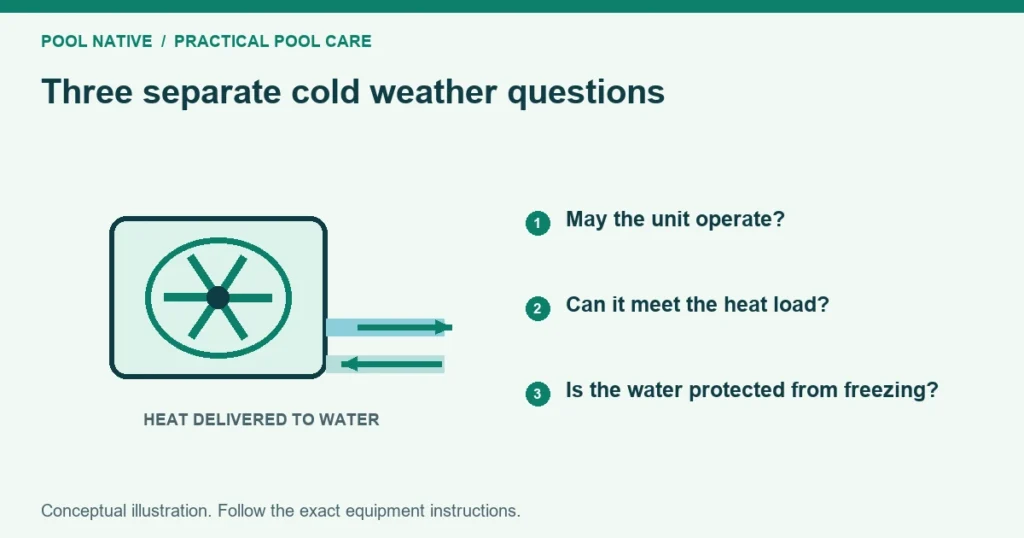
A pool heat pump can run in cool weather if its model permits it. That does not mean it can maintain your target temperature. You need to check operating limits, available heating output and protection against freezing separately.
A minimum air temperature on a sales page answers only part of the question. Ask how much heat the unit delivers at your expected air and water temperatures. Then compare that output with the heat your pool loses.
Three cold weather questions with different answers
| Question | Evidence to find | What it does not establish |
|---|---|---|
| May this heater operate today? | Exact model manual and any air or water temperature restrictions | Enough capacity to warm the pool |
| Can it reach the temperature I want? | Output at relevant conditions, available hours and estimated pool heat loss | Protection during a power outage |
| Can water safely remain inside it? | Manufacturer freeze and winterization instructions for your installation | Permission to ignore a failed circulation pump |
Keep these checks together when buying or troubleshooting. A heater that operates below your usual nighttime temperature might still need most of the day to recover. A unit with automatic defrost can still suffer water circuit freeze damage.
Compare the cool weather rating
Use the same model and operating mode when comparing performance points. Air temperature, water temperature and relative humidity belong with every output figure. A favorable warm weather rating should not stand in for a cool morning rating.
For example, Raypak’s May 2025 Crosswind manual lists the 65-I at 57,650 BTU per hour with 80°F air. Its 50°F air rating is 24,500 BTU per hour. Both use 80°F water and 63% relative humidity.
Those figures illustrate a substantial capacity change within one model. They do not predict every installation or establish a universal cutoff. Check the current manual matching the unit you actually own.
A capacity example you can apply
Suppose your pool needs 600,000 BTU to reach its target temperature. Assume the heater delivers 30,000 BTU per hour under those conditions. With no losses, that is 20 operating hours.
Now assume an average heat loss of 10,000 BTU per hour during heating. Only 20,000 BTU per hour remains to raise the water temperature. The estimate becomes 30 operating hours.
If loss reaches 30,000 BTU per hour, that heater cannot raise the temperature under those assumptions. More runtime does not solve a zero net heating rate. Use the pool heating time calculator to explore your own inputs.
These are illustrative loads, not measured losses for your pool. Wind, cover use and the difference between water and air temperature can change the result. A local installer can assess the load for the season you want to swim.
Understand frost and defrost
The outdoor coil can become colder than the surrounding air. Moisture can therefore freeze on it even when the weather report is above freezing. A light frost pattern is different from a coil enclosed in persistent heavy ice.
Defrost methods vary. Some heaters pause the compressor while the fan helps thaw the coil. Others use an active defrost cycle, which can produce visible vapor as ice melts.
Read the display description for your exact model. Do not assume every pause means a failed compressor. Record whether heating resumes after the prescribed cycle and whether the ice clears.
Do not chip ice, pour hot water on the coil or bypass a protective control. Persistent heavy ice, a fan striking ice or repeated faults need service. Photograph the condition from outside the cabinet and record the displayed message.
Check the operating setup before blaming the weather
- Confirm heating mode, the correct pool or spa selection and a setpoint above the measured water temperature.
- Check whether an external controller controls the heater and whether its schedule allows heating.
- Confirm the circulation system provides the heater’s required flow during those hours.
- Look for blocked air intake or discharge, including leaves, snow and nearby stored items.
- Compare pool temperatures using the same thermometer and similar measurement conditions.
A pump schedule that ends early can remove several useful heating hours. A reduced pump speed may also fall outside the heater’s flow range. Do not defeat a flow switch or guess at valve settings to force operation.
Use the warm part of the day deliberately
Warmer daytime air may improve output and efficiency. However, a short daytime window may not supply enough total heat for the next swim. Compare available heating hours with the calculated recovery requirement.
Keep an appropriate cover on when the pool is unused, following its safety and chemical instructions. Remove it completely before swimming. The solar cover guide explains practical handling and heat retention.
For a weekend swim, check the forecast and start temperature early enough to allow recovery. Avoid setting an unnecessarily high temperature as a shortcut. A higher setpoint does not guarantee faster heating below the original target.
Freeze protection needs an outage plan
Defrost protects the air coil’s operation; winterization protects water containing equipment during shutdown. Do not treat the two as interchangeable. Built in freeze circulation may depend on power, working sensors and control of the pool pump.
Ask your installer what happens if the pump stops overnight. Identify who can safely drain the heater before freezing conditions arrive. Follow the heater winterization guide and the exact equipment procedure when closing the system.
Never restart equipment you suspect contains frozen water. Have it inspected after thawing according to the manufacturer’s instructions. A cover over the cabinet does not remove water trapped inside the exchanger.
When another heating approach deserves consideration
If your main need is occasional rapid recovery during cold weather, compare suitable alternatives with an installer. Evaluate actual output, installation needs and local energy prices together. The heat pump versus gas heater comparison provides that framework.
Keep a short record of weather, start and finish temperatures, heating hours and cover use. Several comparable sessions are more useful than one disappointing afternoon. That record can separate a capacity mismatch from a change that needs service.