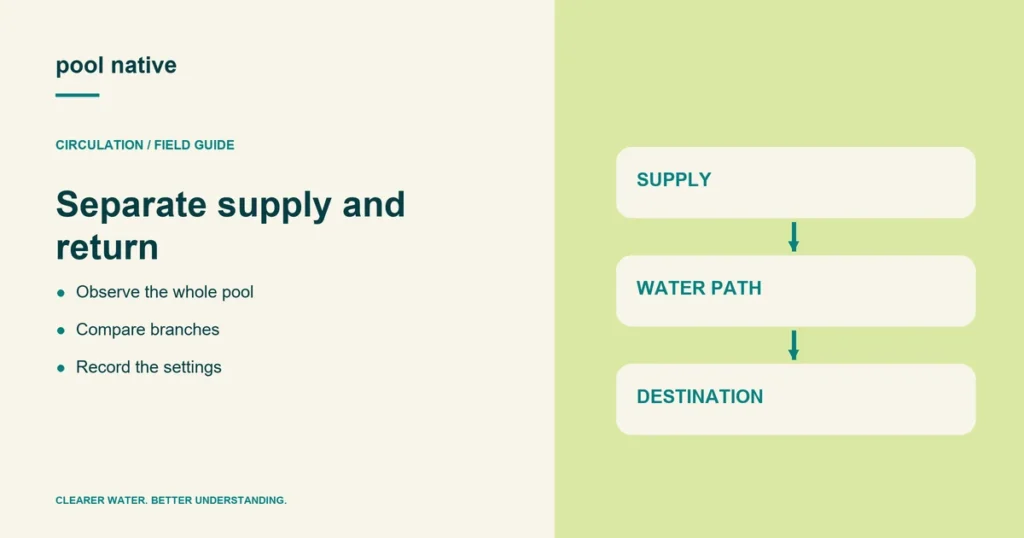
Pool return jets send circulated water back into the pool. Many use an adjustable eyeball to direct that stream, while others have a fixed or specialized outlet. Their direction and distribution matter, but a forceful jet is not proof that the whole pool circulates well.
First confirm that the fitting is a return. An unfamiliar wall opening could belong to suction, a cleaner, or another system. Do not test its identity by covering it with a hand or removing a protective cover.
Know which part you are looking at
In a common eyeball arrangement, a retaining ring holds a directional insert inside the return fitting. The opening in that insert shapes the outgoing stream. The wall connection behind it is a separate part of the assembly.
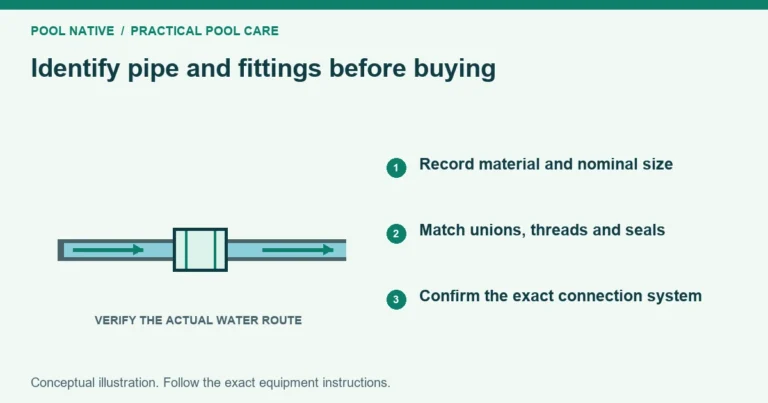
Not every fitting uses the same threads, seals, or removal method. A return in a vinyl liner also has sealing components that should not be disturbed as a routine adjustment. Identify the model before loosening anything.
| Detail to record | Why it helps |
|---|---|
| Location and count | Shows which areas the return system serves |
| Fixed or adjustable outlet | Determines whether directional adjustment is available |
| Insert and retaining arrangement | Helps identify correct replacement parts |
| Known branch or operating mode | Explains when the outlet should receive water |
| Recent change | Separates a longstanding pattern from a developing fault |
Separate stream speed from total flow
A narrow outlet can produce a concentrated stream. A wider outlet can feel less forceful while still passing substantial water. Changing the opening also changes resistance, so the system’s actual flow may change.
That is why comparing jets by hand is not a reliable gallons per minute measurement. Fitting shape and direction complicate the comparison. Use an appropriate installed flow measurement when a precise rate is needed.
Don’t reduce every opening just to make the pool look more active. Equipment limits and the whole return network matter. A pool professional can assess distribution and resistance if the system needs balancing.
Aim for useful movement in your pool
Observe where floating debris travels and where it stalls. Note skimmer locations, steps, corners, and the prevailing wind. A single circular pattern shown online may not suit those features.
Use the return direction guide for a controlled adjustment process. Change only a permitted adjustable insert with circulation safely off. Keep the original position recorded so you can compare results.
A cleaner hose can also be pushed by a return stream. Pentair’s Rebel instructions specifically address that interaction. Follow the cleaner’s instructions rather than sacrificing coverage to a jet pattern chosen only for appearance.
Read the symptoms before replacing a fitting
If all returns weaken together, examine the shared circulation conditions. If one changes, compare its branch and fitting with the others. Neither pattern automatically identifies a failed pump or blocked underground pipe.
The weak return flow checks explain that split. Use the same pump program and operating mode for comparisons. Different speeds can make an unchanged system look faulty.
Persistent bubbles, loss of prime, or an unusual pressure change deserve investigation. Don’t treat them as a reason to keep increasing speed. Stop the system if it loses its water supply or behaves abnormally.
Maintain the correct assembly
Check visible fittings for missing inserts, cracks, and parts that no longer hold their intended position. Use the exact model’s compatible replacements. Do not force a stuck fitting or loosen the wall body to adjust its insert.
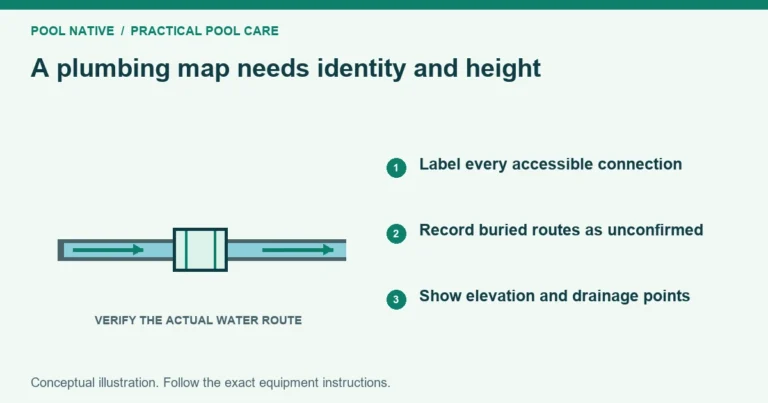
Keep the return locations and known branches on your pool plumbing map. That record makes future flow changes easier to discuss with a service professional. It also prevents an unfamiliar wall fitting from becoming a guessing game.