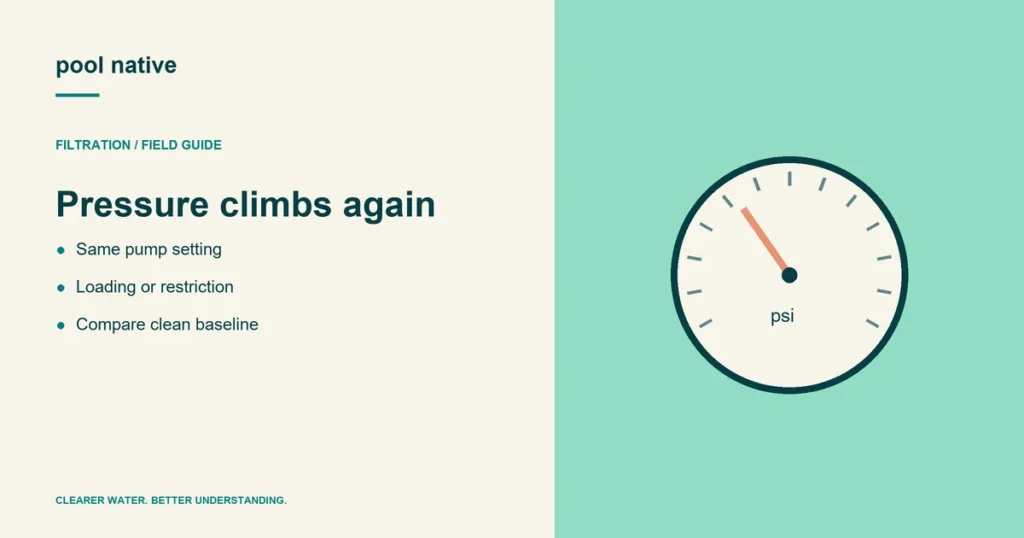
If pool filter pressure rises quickly after cleaning, first confirm that it actually returned to the clean baseline. A filter that starts high has a different problem from one that starts normally and loads again. Record both readings at the same pump speed and valve positions.
That distinction saves unnecessary repeat cleaning. It also helps separate heavy debris collection from an unresolved restriction.
When pool filter pressure rises quickly, compare like with like
A variable speed pump can produce different pressure readings during priming, normal filtration, heating, or cleaning. Do not compare a low speed morning reading with a higher speed afternoon reading. Note which program was active.
Let normal operation stabilize before recording a baseline. Include RPM, gauge pressure, return flow observations, and valve mode. Use the filter manual’s cleaning trigger rather than a universal pressure number.
| Pattern | What to investigate |
|---|---|
| High immediately after cleaning | Incomplete cleaning, gauge accuracy, assembly, or a restricted return route |
| Normal, then steadily rising at unchanged settings | New material reaching the filter or limited remaining media capacity |
| Pressure jumps when another program starts | Pump speed and valve changes before blaming the media |
| Gauge stays high after confirmed pressure relief | A suspect gauge needing service |
What is the filter collecting today?
Algae, fine construction debris, pollen, and heavy dirt loads can shorten cleaning cycles. A recently treated or newly filled pool may behave differently from a settled maintenance routine. Check the pool’s condition alongside the equipment.
Test the water and review recent treatment products. Repeatedly cleaning without addressing an active algae problem treats only the collected material. Conversely, more chemicals will not repair an obstructed return line.
Record any clarifier or flocculant addition, including the exact product and amount. Do not add another dose simply because pressure rose. Some products require a specific filter or waste route.
Was the cleaning appropriate for the medium?
A quick cartridge rinse can leave oils or mineral deposits in place. Use the cartridge cleaner decision guide if a coating remains. Inspect for damage before putting the elements back.
For sand, verify the actual backwash performance and correct media. Hardened or uneven sand needs a different response from a fresh debris load. Longer backwashing is not a universal cure.
For DE, check that the cleaning and recharge followed the model instructions. Do not invent a reduced charge to make the gauge look better. Record the charge and whether the service was a backwash or full teardown.
Read a short log without jumping to a diagnosis
Consider this hypothetical record at the same 1,800 RPM and unchanged valve positions. Pressure is 12 PSI after cleaning, 14 PSI two hours later, and 17 PSI after four hours. The steady rise supports investigating material collecting in the filter.
Those numbers are not cleaning thresholds for your equipment. Use the model’s actual trigger and maximum limits. Also record whether the pool is visibly improving and what the filter contains at the next permitted cleaning.
Compare that with 12 PSI at 1,800 RPM in the morning and 19 PSI at 2,800 RPM during heating. The different pump settings prevent a direct loading comparison. Recheck under the original conditions before deciding the filter rapidly clogged.
Look for incomplete restoration of the clean condition
A cartridge may retain deposits after a quick surface rinse, leaving less useful capacity for the next run. A sand bed may not have received the required backwash flow. A DE filter may have been recharged using instructions intended for a different type of cleaning.
Identify which service was actually performed. “Cleaned yesterday” could mean a brief backwash, a full element wash, or simply emptying the pump basket. Only one of those may address the part currently restricting flow.
Check that the assembly was returned to its correct configuration. Incorrectly seated elements or an unintended valve position can change pressure without a new dirt load. A clean baseline is meaningful only when the equipment is assembled and operating correctly.
Decide whether another cleaning answers the question
If the filter is reaching its prescribed cleaning trigger while collecting a heavy load, another correct cleaning may be necessary. Keep addressing the source of that load at the same time. Do not keep adding clarifier to compensate for every shortened cycle.
If the baseline never recovers, repeated identical cleaning provides less useful information. Have the gauge, flow route, media condition, and assembly checked. That is the point to narrow the fault rather than treating all rising pressure as normal dirt collection.
Keep a short loading log
Use columns for time, pressure, RPM, pool appearance, and the action taken. A hypothetical record might show normal pressure after cleaning, followed by a steady rise during algae recovery. That supports a loading investigation without proving a defective filter.
Stop operation if pressure approaches an equipment limit, flow collapses, or the tank leaks. Do not run without cartridges or grids as a general diagnostic experiment. Follow the high pressure troubleshooting route if the baseline was never restored.
Give the log, filter model, and cleaning details to your technician if the cycle keeps shortening. That evidence is more useful than replacing media solely because the gauge climbed again.