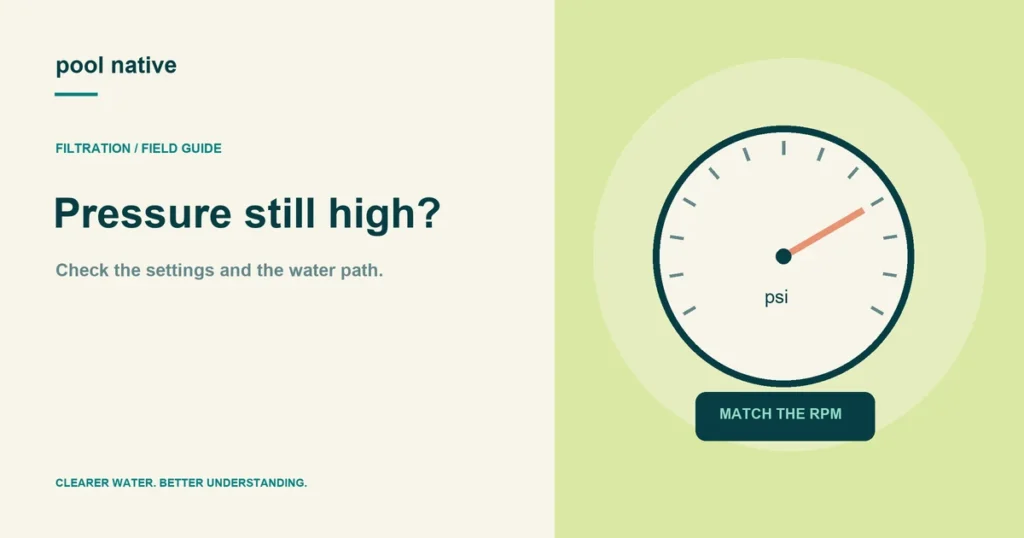
Pool filter pressure that stays high after backwashing doesn’t automatically mean the sand or cartridges need replacing. First compare the same pump setting and operating mode. Then check whether pressure never recovered or recovered briefly before rising again.
Those are different clues. An immediate high reading can reflect a remaining restriction or a changed setup. A later rise can mean the filter is collecting another load of debris.
Pool filter pressure high after backwashing: check the comparison
Find the last confirmed clean pressure and its pump setting. Match that operating condition before judging the new reading. Pool mode, spa mode, and cleaning overrides may not be comparable.
If there is no trustworthy clean record, don’t borrow a normal psi range from another pool. Check the model guidance and have abnormal operation assessed. Keep the new observations in a pressure and equipment log.
Never continue running beyond a component’s pressure limit. Stop for a leaking closure, distorted tank, or unsafe startup behavior. Do not loosen or tighten pressure equipment while it runs.
Use the timing to choose the next check
| Pattern | Check first | Don’t conclude yet |
|---|---|---|
| Higher only at a faster pump setting | Compare the original setting | The filter is dirty |
| High immediately after cleaning | Valve mode, downstream restrictions, cleaning completeness, and gauge condition | The media has reached a certain age |
| Normal briefly, then climbs | Continuing debris load, water condition, and effective cleaning | The cleaning did nothing |
| High since a pump or plumbing change | Flow and equipment compatibility | The filter suddenly wore out |
| Gauge remains implausibly fixed | Proper gauge assessment with the system made safe | The displayed number is reliable |
Rule out a gauge problem safely
A gauge can stick or fail. Observe whether it behaves normally through the manufacturer’s shutdown and pressure release procedure. Do not remove it while the system is pressurized.
A reading above zero after proper depressurization can warrant gauge assessment. But zero alone doesn’t prove all pressure has escaped. Use the designated relief procedure, not the gauge as a substitute.
If the gauge or relief device can’t be trusted, arrange service before opening the filter. Don’t keep cleaning in response to an instrument that may be wrong.
Check the intended return path
Filter pressure can be affected by restriction after the filter. Confirm that the valve positions match the known normal arrangement. A partly closed return valve can leave pressure high after the media is clean.
Note recent work on heaters, return fittings, water features, or plumbing. Smaller return openings and changed flow paths can alter resistance. Don’t remove fittings or operate unfamiliar valves to experiment.
Manufacturer troubleshooting lists both dirty media and return restrictions. That is why repeating a cleaning cycle isn’t always the next step. A technician can assess the flow path and pump selection if the visible checks don’t resolve it.
Then check cleaning completeness by filter type
Sand
Review the valve sequence, waste route, and cleaning flow. A kinked hose or unsuitable pump setting may prevent effective backwashing. Deposits can also remain after loose debris has left.
Follow the correct backwash procedure and the model’s approved deeper cleaning guidance. Don’t immediately replace media. Use the sand replacement decision once cleaning and other causes have been assessed.
Cartridge
Check whether all pleats were cleaned, not just the visible outside. Oils and minerals can remain after a quick rinse. Confirm the elements and manifolds were reinstalled correctly.
Use the cartridge cleaning workflow for deposits and assembly checks. Do not try to correct poor fit by tightening the lid harder. Replace damaged media only after identifying the correct part.
DE
Confirm the exact service and recharge instructions. A wrong quantity, incomplete cleaning, or an internal assembly problem can affect performance. Don’t add another scoop simply because pressure is high.
Some situations require opening and manually cleaning the elements. That work needs full isolation, pressure release, and model specific reassembly. Use qualified service if the procedure isn’t clear.
If pressure returns to normal and climbs again
Record how long the improvement lasts and what the water looks like. Recent storms, fine debris, or an active algae cleanup can keep loading the filter. Check water test results instead of treating the filter as an isolated appliance.
More frequent inspections may be needed during a cleanup. Use the manual’s service trigger and maintain safe operation. Don’t deliberately leave the filter overloaded to prove that the problem is recurring.
Short cycles without an obvious debris source deserve a closer look at cleaning effectiveness, media condition, and actual flow. Keep the before and after sequence. It helps separate cause from coincidence.
Don’t create a new baseline to hide the problem
If the old clean pressure was 12 psi and a matched reading now stays at 20, don’t simply rename 20 as normal. Those hypothetical numbers illustrate a lost reference, not recommended pressures. Record the discrepancy and resolve it.
A new baseline is appropriate after a confirmed system change or successful commissioning. It should have a reason attached. The filter cleaning frequency guide explains how to preserve that reference.
Once settings, instrument condition, cleaning, and the return path have been checked, unresolved pressure needs professional diagnosis. Send the model labels and your dated readings. That is more useful than a list of parts already replaced by guesswork.