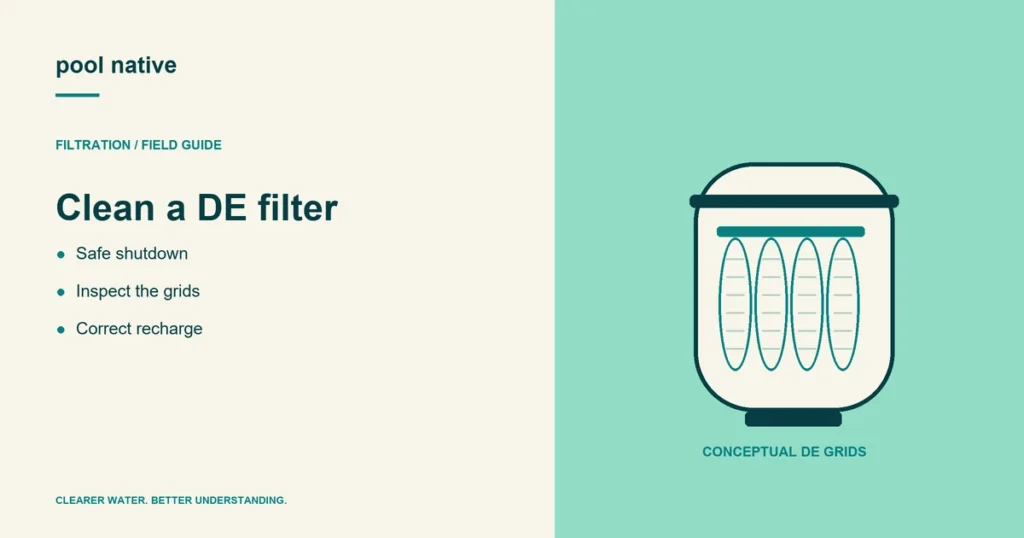
To clean a DE pool filter internally, you need the instructions for its exact tank, elements, and clamp. Backwashing removes accumulated material, but persistent pressure or dirty internals may require disassembly and washing. The critical work includes safe opening, inspection, correct reassembly, and a fresh DE coating.
Pressure vessels can separate violently if opened or assembled incorrectly. Follow the manufacturer’s service restrictions; Pentair recommends professional filter maintenance, and the Hayward ProGrid manual specifies qualified service. This guide explains the job and its checkpoints without replacing those instructions.
How to clean a DE pool filter starts with identification
Photograph the tank label, clamp, and valve before arranging service. Confirm whether the filter uses curved grids, fingers, or cartridge shaped DE elements. An ordinary pleated cartridge filter doesn’t become a DE filter because the tank looks similar.
Even the same product family can have different clamp instructions. Pentair provides separate FNS Plus manuals for cast and spring clamp models. Don’t transfer a tightening method from a video unless the installed assembly matches.
Decide whether internal cleaning is needed
Compare pressure at the same pump speed and valve configuration as your clean baseline. A higher programmed speed can raise the reading without indicating a dirty filter. First rule out that changed operating state.
Internal cleaning becomes relevant when the prescribed backwash no longer restores normal performance, or the manual calls for seasonal service. Check the cleaning trigger for your filter. A fault elsewhere can also explain pressure that stays high after cleaning.
Prepare for the complete service sequence
- Plan disposal first. Identify where dirty water and spent DE may go. Lay out an approved collection arrangement before opening the tank.
- Prevent automatic startup. Isolate power and follow the exact shutdown and depressurization instructions. A zero gauge reading alone doesn’t establish safe access.
- Open only as directed. The clamp, drain, air relief, and isolation sequence depend on the model. Never loosen or tighten a clamp under pressure.
- Document the assembly. Record element positions and how the manifold connects before taking the assembly apart.
Our backwash disposal guide helps identify the right authority and waste stream. DE solids need explicit consideration, even when ordinary pool drainage is permitted.
Wash, then inspect what the dirt concealed
Use the washing method in the manual. For example, the Hayward ProGrid instructions call for a garden hose and prohibit pressure washing the element cluster. A powerful jet can turn a cleaning job into damaged fabric.
Once the coating is removed, inspect the fabric, seams, ribs, manifold, and sealing connections. Look for tears, cracks, distorted parts, and debris in the air bleed components. Record damage before ordering replacements.
Cleaning isn’t a repair for torn fabric or a cracked manifold. Likewise, a clean exterior doesn’t establish that every element is sound. Persistent DE returning through the jets needs a bypass or damage diagnosis.
For deposits that remain after hosing, use only the cleaning treatment approved for those elements. Don’t improvise an acid concentration or mix cleaning chemicals. Different residue types and materials require different handling.
Reassembly is part of the cleaning job
Return every element to its correct position and seat the manifold without forcing it. Follow the manual’s tightening instructions for the internal assembly. Excess force can crack components that looked sound before cleaning.
Clean the sealing surfaces and inspect the tank seal and clamp. Don’t assume every seal requires grease: the ProGrid manual specifically says not to lubricate its DEX2422Z2 tank seal. Use the rule for the actual part.
Complete the exact clamp and startup procedures before returning the filter to service. Stand clear during startup and stop immediately if the tank joint leaks. Never try to cure that leak by tightening a running filter.
Recharge and establish the new baseline
Add the required filter grade DE using the model’s coating procedure. Don’t run extended filtration with bare DE elements. Find the amount in the model and maintenance state charge guide.
Record pressure, pump speed, valve mode, and the amount added after normal circulation is restored. Check for leaks and media returning to the pool. If performance remains abnormal, preserve those observations for diagnosis instead of repeating cleaning indefinitely.