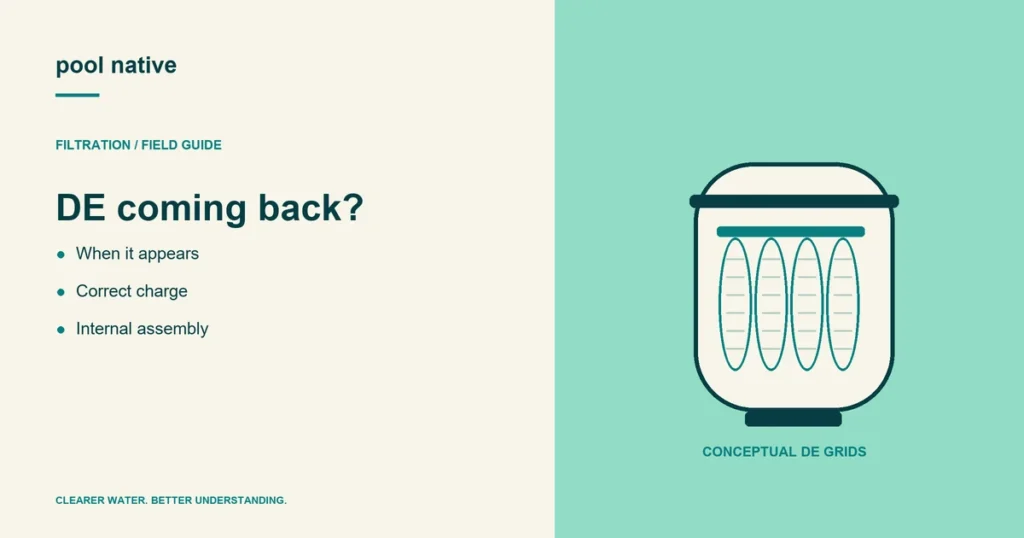
DE powder coming back into a pool needs a timing check before you replace the grids. A brief puff during coating, continuing discharge from the returns, and old powder stirred off the floor are different observations. Record which one actually happens.
Persistent new discharge can involve damaged elements, the manifold, seals, assembly, or the valve route. A fresh set of grids won’t repair a bypass elsewhere.
Trace DE powder coming back into the pool
Watch from outside the water and identify whether new material emerges directly from a return. Note whether it happens only while powder is added or continues afterward. Compare that with dust already lying on the floor.
| Timing | Useful next step |
|---|---|
| Only during initial coating | Check the exact manual’s coating instructions and any guidance about a precoat puff. |
| Continues during normal filtration | Investigate an internal leak or incorrect flow route. |
| Started after internal cleaning | Check element seating, manifold connection, and reassembly. |
| Persists after grid replacement | Inspect the remaining manifold, seals, air bleed components, and valve. |
| Appears only when brushing old floor deposits | Remove settled material and determine whether fresh discharge is still occurring. |
Confirm the material and the charge
Fine pale material isn’t always DE. Pollen, dead algae, and other debris can look similar from the deck. The relationship to a recent DE addition is evidence, not laboratory identification.
Record the product, amount, and maintenance performed before the symptom began. Verify the required DE charge for the actual model. Don’t add extra powder to compensate for material escaping.
Also confirm the system is routed through the filter. A bypass setting cannot provide normal filtration. Review the filter versus recirculate distinction where that valve is installed.
Inspect the complete filtering boundary
Internal inspection requires the full shutdown and pressure relief procedure. Use qualified service as specified by the manufacturer. Never open the tank while trying to watch the leak happen.
During service, check fabric and seams as well as the supporting structure. Then inspect the manifold, connections, seals, and air bleed arrangement for the exact model. A component can look acceptable from one angle while a hidden joint is misseated.
Recent reassembly deserves particular attention. Pentair warns that overtightening internal wing nuts can damage parts and allow DE into the pool. Correct seating matters more than added force.
Follow the internal cleaning and inspection sequence without borrowing another filter’s clamp method. Replace damaged parts with confirmed compatible components.
Why repeated backwashing may not solve it
Backwashing removes accumulated dirt and spent coating. It doesn’t close a tear or repair a cracked manifold. Repeated cycles can consume water and powder while leaving the escape path unchanged.
If the valve also sends water to waste during filtering, report that separate symptom. Use the backwash line leak guide to describe it. Don’t assume all powder problems originate inside the tank.
Verify the repair without confusing old and new debris
After correct reassembly and coating, check the returns for fresh material. Remove the old settled deposits using a compatible cleaning route. If vacuuming to waste is needed, confirm the equipment and disposal arrangement first.
Record clean pressure at a known speed and inspect for external leaks. Continued fresh discharge means the diagnosis isn’t complete. Preserve the timing and repair history rather than replacing another set of grids by guesswork.