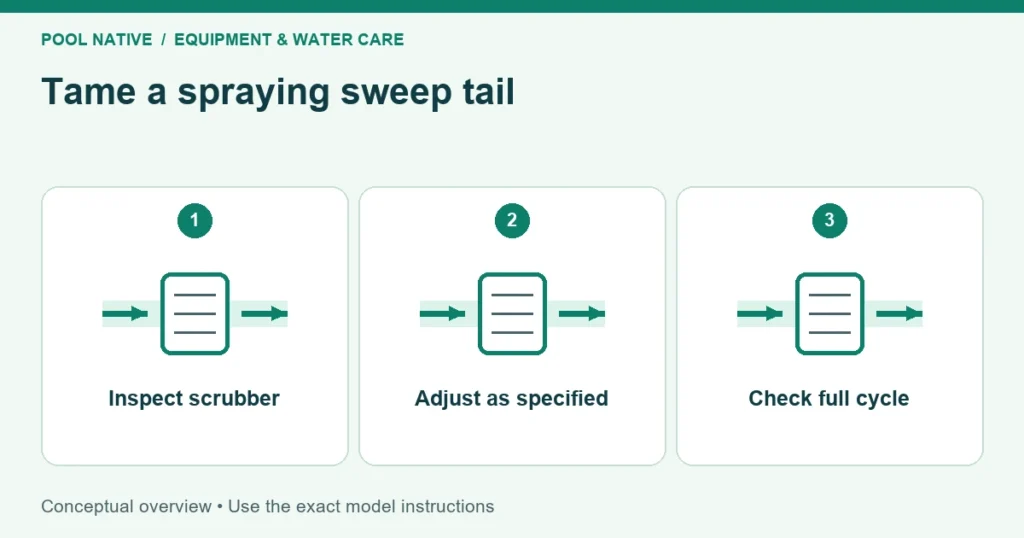
If your Polaris cleaner tail sprays outside the pool, check the tail scrubber and its own flow adjustment before changing the entire system. A missing scrubber or an overly active sweep hose can cause overspray even when the wheels turn correctly. Measure cleaner speed separately if its overall movement also looks excessive.
Turn off the booster pump before adjusting a booster driven cleaner’s tail. For other models, stop the pump that powers the cleaner. Keep people clear during the next observation run and remove the cleaner before swimming.
Confirm which outlet is spraying
The sweep hose is the flexible tail trailing behind the cleaner. It is different from the thrust jet on the body, the backup valve on the feed hose, and the relief outlet near the wall. Adjusting one because another is spraying can create a second problem.
| Where water comes from | What to investigate |
|---|---|
| Tail end repeatedly flicks above the surface | Scrubber condition and sweep motion |
| Wall connection discharges water | Relief flow versus a fitting leak |
| Valve on the feed hose jets intermittently | Normal backup cycle versus persistent backing up |
| Split along the tail hose | Damaged hose requiring a compatible replacement |
| Cleaner body rises or races as well | Whole cleaner flow and balance |
Watch whether the tail sprays only when the cleaner climbs or also during ordinary floor travel. That distinction helps separate a tail adjustment from excessive overall movement. A short video from the deck can make the pattern easier to compare.
Inspect the scrubber with the cleaner stopped
Look at the soft scrubber on the end of the sweep hose. Replace it if it is missing or worn out according to the model’s maintenance instructions. Do not assume the tail is complete because the hose itself remains intact.
Check that the scrubber is installed in its intended position and leaves the outlet open. The cited Polaris 280 manual specifically warns that a blocked tail opening can cause the hose to enter the vacuum tube. An improvised plug is therefore not a suitable overspray fix.
Inspect the hose for splits, hardened areas, or a damaged connection. Water escaping through a split follows a different path from normal outlet flow. Replace a damaged component rather than tightening the sweep control until the leak appears smaller.
Use the correct scrubber and hose for the cleaner. Similar looking parts may have different dimensions or attachment details. Confirm compatibility against the complete model and its parts diagram before ordering.
Adjust the sweep hose gently
On the Polaris 280 covered by the cited manual, the adjustment screw controls sweep hose movement. Turn it clockwise to reduce the sweep action, with the booster pump off. Make a small change and observe before adjusting again.
The target is a gentle sweeping motion. The goal is not a completely motionless tail or maximum hose activity. A tail that no longer sweeps has lost part of its intended cleaning function.
Use the adjustment shown in your own manual if the model differs. Do not turn the rear thrust jet while looking for the tail screw. The thrust jet changes cleaner behavior and is a separate adjustment.
Record the starting position with a photograph or note. If the first change makes little difference, inspect the scrubber and actual hose condition again. Repeatedly tightening a control against its stop can damage it without solving the underlying issue.
Check wheel speed if the whole cleaner is overactive
If the cleaner races, lifts excessively, or has lost normal floor contact, measure wheel revolutions per minute. The cited Polaris 280 manual specifies 28 to 32 RPM. Hold the cleaner submerged as instructed and count the marked wheel for a full minute.
Do not infer RPM from the sound of the booster pump or the height of the tail spray. Those observations do not measure wheel speed. Use the wheel RPM measurement guide if you need help getting a reliable count.
For that 280, the manual describes blue and red restrictor disks and the pressure relief adjustment. It specifies adjusting the relief valve only with a restrictor installed. Follow that sequence rather than closing random equipment valves to calm the tail.
Changing the overall flow affects more than overspray. Recheck wheel speed, forward movement, and backup operation after any approved flow adjustment. If speed was already correct, return attention to the tail and balance rather than starving the cleaner.
Consider an approved accessory only after setup is right
The cited 280 troubleshooting instructions allow a model compatible sweep hose weight when needed. They also call for replacing a worn or missing scrubber before relying on extra weight. Use the specified accessory and position, not a fishing sinker or another improvised attachment.
An accessory should address the remaining symptom in a correctly operating cleaner. It should not hide a split hose, excessive RPM, or damaged float. Otherwise the spray may improve while cleaning performance continues to deteriorate.
If considering an overspray accessory, verify the exact cleaner compatibility and installation instructions. Do not assume a product fits every Polaris because the tail looks similar. A parts diagram or manufacturer confirmation is more reliable than a broad marketplace title.
Check cleaner balance and the route
A full debris bag can change the cleaner’s balance. Empty and refit it as directed, then check the head float and feed hose floats. Restore their model specific positions rather than moving them to force the tail downward.
Observe the area where spray is worst. A repeated approach to a shallow transition may bring the tail near the surface more often. Correct hose reach and routing before changing the entire cleaning pattern to avoid one window.
The pressure cleaner setup guide covers those wider checks. Keep this distinction clear: a tail that whips during normal travel needs different attention from a cleaner repeatedly lifting out of its intended position.
Verify the result over several passes
Start with a sound scrubber, the correct wheel speed, and a gentle sweep setting. Watch floor travel, wall approaches, and at least one backup cycle. Check both the overspray and the tail’s remaining ability to sweep.
For example, replacing a missing scrubber may stop most spray without changing a 30 RPM wheel count. If you also reduced system flow, you would not know which correction mattered. One change at a time preserves the useful baseline.
Stop and seek service if the adjustment is damaged, the hose cannot be fitted securely, or correct settings do not restore normal behavior. Provide the model, RPM result, and video showing where the spray begins. That is a better basis for repair than buying several tail accessories in succession.