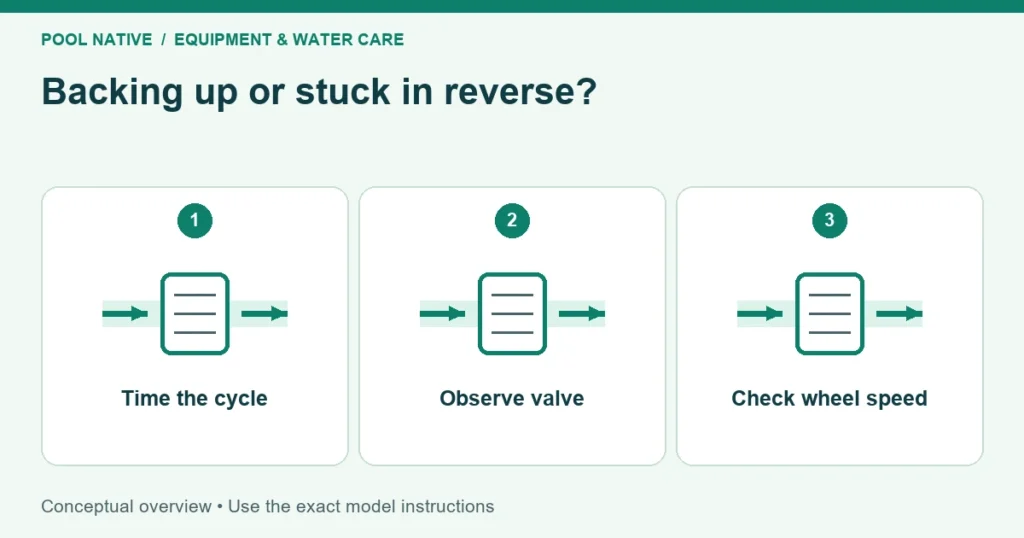
A Polaris that keeps moving backward may be in its normal backup cycle, have a valve that does not stop jetting, or be dragged by its hose. Watch a complete cycle before buying a backup valve. The important question is whether it returns to useful forward cleaning.
Model and manual revision matter. The cited Polaris 280 manual describes backup approximately every three minutes. Other models and older instructions can specify different timing, so use the document for your cleaner rather than a universal countdown.
Separate backing up from circling
Normal backup uses a jet from the valve on the feed hose to pull the cleaner away from obstacles. That differs from a cleaner turning in circles, tipping onto its side, or being pulled by a tangled hose. Record what the valve and cleaner do together.
| Observation | Next investigation |
|---|---|
| Valve jets, then stops, and forward cleaning resumes | Compare the full cycle with the model’s normal behavior |
| Valve continues jetting and useful forward travel never resumes | Valve cycling and correct water supply |
| Valve stops jetting but cleaner still barely moves | Wheel speed, debris path, drive, and hose condition |
| Cleaner circles while upright | Thrust direction, hose influence, and movement |
| Cleaner tips or runs on its side | Bag loading, head float, and hose floats |
A single photograph cannot show the timing. A short video spanning the transition from backup to forward operation is more useful. Note whether the problem occurs everywhere or only after a particular obstacle.
Observe the cycle without opening the system
Keep swimmers out and watch from the deck. Do not disconnect pressurized hose joints or open the backup valve while the cleaner runs. Follow the manufacturer’s specific observation method if the jet is difficult to see.
Write down when the backup jet starts, when it stops, and what the cleaner does afterward. Continue long enough to see a complete normal interval for that model. Stop if the system develops unstable flow, a significant leak, or an electrical problem.
Do not declare failure because the cleaner backs up at all. The feature is intended to free it from obstacles. Likewise, a jet that cycles does not prove the cleaner receives enough water during the forward portion.
Check the forward part of the cycle
Measure wheel RPM when the cleaner is in its normal forward operating state. The cited 280 range is 28 to 32 RPM. Keep the cleaner submerged and restart the measurement if backup interrupts the count.
The wheel RPM guide explains the method and why a full minute is preferable to a quick estimate. Low wheel speed can leave the cleaner nearly stationary between otherwise normal backup events. That can make normal reversing seem like its only movement.
With the equipment off, check accessible filter screens, baskets, and hose sections for restrictions. Service the main filter according to its own instructions. Inspect the feed hose and swivels for unintended leaks that reduce water reaching the cleaner.
Recheck RPM after correcting a restriction. Do not immediately remove a restrictor or change booster settings simply because forward movement is weak. Restore the clean, intact water path before following the model’s flow adjustment sequence.
Inspect the backup valve safely
Turn off the booster and any required supply pump, and let pressure dissipate before handling the assembly. Find the valve’s flow direction and part number in the model’s diagram. A replacement must match the intended hose and cleaner system.
Look for a cracked case, loose connection, or visible debris within owner accessible service areas. Follow the exact service instructions if the valve is designed for owner inspection. Do not force a sealed housing apart or lubricate its mechanism with an unapproved product.
For the cited 280, the parts list distinguishes the G52 valve assembly from its G53 mechanism. That distinction helps identify a service option; it does not establish that either part is faulty. Have compatibility confirmed before ordering an internal component.
Do not bypass or remove the valve to make the cleaner travel forward indefinitely. You would remove its escape function and change the approved hose arrangement. The resulting movement would not be a valid test of normal operation.
Check the hose and float arrangement
A twisted hose or poorly floating section can pull the cleaner away from its intended route. Check the specified length, leader section, swivel positions, and floats. Do not add extra hose as the first response to repeated backward movement.
Inspect the head float for the damage described in the manual. The 280 instructions also call for checking the bag and hose floats when the cleaner runs on its side. A heavy bag can change behavior even when the backup valve is functioning.
Empty the bag and restore the standard arrangement before changing the thrust jet. Record the existing jet position so an unsuccessful adjustment can be reversed. The cited 280 manual uses a straight back position as its starting reference.
If the cleaner only fails to escape one ladder or step, record that obstacle separately. A working backup cycle may still be unable to clear particular geometry. Ask about an approved obstacle solution rather than modifying a safety fitting or adding improvised weights.
Two situations that look similar
Imagine a 280 that backs up, stops jetting, and then has almost no forward movement. A low RPM measurement would direct attention toward flow or drive performance. Replacing a cycling valve might leave the same symptom unchanged.
Now imagine the backup jet never stops during an observation longer than the model’s expected cycle. That makes the valve’s cycling behavior a stronger concern. Correct supply and a sound hose still need confirmation before deciding which valve component to replace.
These examples explain why timing and forward speed belong in the same diagnosis. Neither a quick wheel check nor a glance at the backup jet tells the whole story. Together they reduce unnecessary parts swapping.
Confirm normal cleaning after the repair
Observe at least two transitions between forward travel and backup. Confirm the cleaner moves usefully between reversals and can recover from ordinary obstacles. Recheck wheel speed after changing a valve or correcting a leak.
Use the pressure cleaner setup checklist if several parts have been changed over time. Persistent failure with correct flow and assembly calls for a service diagnosis. Provide the cycle timings, RPM, model, and a video instead of describing the problem only as running backward.