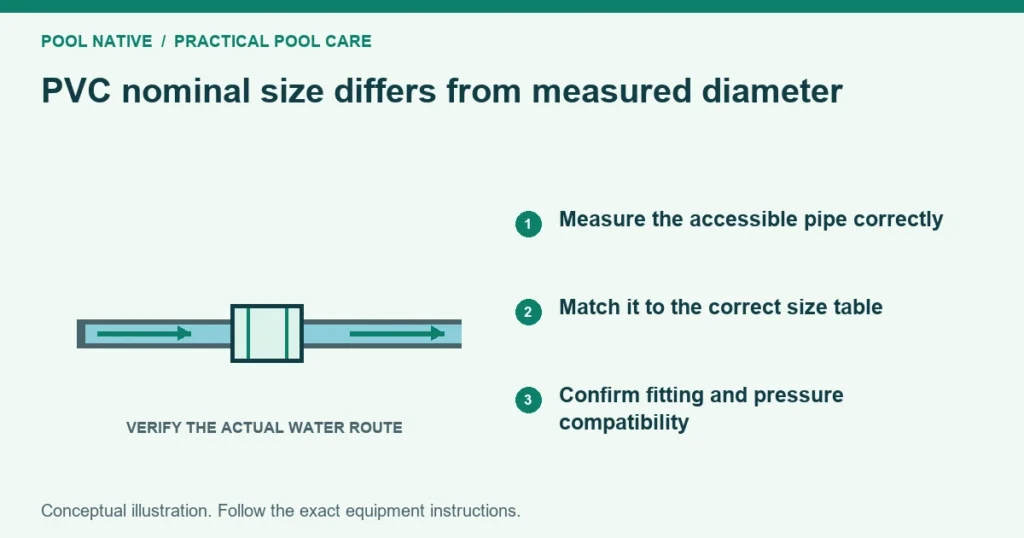
Measure the outside of a straight pipe section, then compare it with the correct pipe standard. For common US IPS PVC, the measured diameter is larger than the nominal size used to buy fittings. A pipe measuring about 2⅜ inches outside is normally sold as two inch IPS pipe.
Do not measure across the outside of a coupling and use that as the pipe size. The coupling has its own wall thickness. A union nut, threaded port or return eyeball creates the same identification trap.
Start with the printed markings
Look along an accessible straight section for the size, material and schedule or pressure class. Photograph the printing before cleaning anything aggressively. It can identify details that a ruler cannot.
Useful markings include PVC or CPVC, the nominal size, Schedule 40 or Schedule 80, and a product standard. Record the manufacturer when visible. Color alone is not a reliable substitute for those markings.
If paint or age hides the information, measure first and have the product identified before cutting. Do not use an aggressive solvent just to expose lettering. Damaging the pipe would defeat the purpose of the inspection.
Method one: measure outside diameter
Use calipers across a clean, straight section of the pipe barrel. Keep the jaws square to the pipe and avoid squeezing a flexible or damaged section. Read in inches or millimeters and record the unit.
With a ruler, look straight across the widest part of the pipe rather than an angled chord. A photo taken from an angle can make the measurement misleading. Calipers are more useful when two candidate sizes are close.
Measure away from a socket, raised lettering or a heavy paint ridge. If the pipe is visibly out of round, record measurements in two directions. Deformation is a reason to inspect its condition, not simply average the values and buy a fitting.
Common US IPS outside diameters
These are nominal size references for the listed US IPS PVC dimensions. They are not a universal chart for every hose, metric product or equipment thread. Verify the markings and application before ordering.
| Nominal IPS size | Outside diameter in inches | Outside diameter in millimeters, approximately |
|---|---|---|
| 1 inch | 1.315 | 33.40 |
| 1¼ inches | 1.660 | 42.16 |
| 1½ inches | 1.900 | 48.26 |
| 2 inches | 2.375 | 60.33 |
| 2½ inches | 2.875 | 73.03 |
| 3 inches | 3.500 | 88.90 |
For example, a measured outside diameter close to 1.900 inches points to nominal 1½ inch IPS pipe. It does not mean you need a 1.900 inch nominal coupling. Match the nominal size within the compatible pressure piping system.
The pool pipe and fitting identification guide covers connection types and equipment adapters. Measuring the pipe solves only one part of the purchase. The other end of the fitting still needs to match.
Method two: measure circumference
If you can reach around the pipe but cannot place calipers across it, use a narrow flexible tape. Wrap it once around the straight barrel, square to the pipe. Do not include a fitting, clamp or thick label.
Divide the measured circumference by pi, approximately 3.1416, to estimate the outside diameter. Keep the units unchanged through that calculation. Then compare the result with the appropriate standard.
A hypothetical circumference of 7.46 inches gives an outside diameter of about 2.37 inches. That is close to the 2.375 inch reference for nominal two inch IPS pipe. A loose or angled tape can introduce enough error to confuse a close match.
String can provide a rough estimate if you mark the overlap and measure it afterward. Avoid elastic cord and do not pull tightly enough to stretch it. Use a more accurate method or manufacturer identification before buying a critical connection.
Schedule changes the inside, not the nominal outside match
Within the same IPS size, Schedule 40 and Schedule 80 PVC share the reference outside diameter. Their wall thickness differs, so their internal diameter differs. An outside measurement alone cannot tell you the schedule.
That distinction matters for flow meters and hydraulic calculations. A meter calibrated for a particular internal diameter may not be accurate on another wall specification. Use the pool flow measurement guide when selecting or interpreting a meter.
Do not choose a replacement solely because its outside fits. Pressure, temperature, material and equipment requirements still apply. The complete system is limited by its applicable component ratings and installation conditions.
Be careful with metric names
Some metric pipe systems are designated by actual outside diameter. Other standards use nominal designations whose outside diameters are different. Converting an inch label into millimeters does not establish compatibility.
For an imported pump, heater or fitting, record the original standard and manufacturer’s adapter requirements. Do not force an apparently close metric socket onto IPS pipe. A small mismatch can prevent the proper fit needed for a sound solvent joint.
Ask for a specified transition fitting when two systems must connect. The adapter’s documentation should name both sides. Avoid a purchasing description that says only approximately two inches.
What if only a fitting is exposed?
Look for molded size markings and the equipment parts diagram. A valve may accept one size inside its socket and another through an external connection. The largest visible diameter may belong to neither nominal description you expected.
Do not loosen a pressurized union or remove an equipment fitting just to take a measurement. Shut down, secure, depressurize and isolate the system before any disassembly. If measurement would disturb a sealed or buried connection, have the part identified professionally.
A wall return also has separate connection and opening sizes. Use the return eyeball size guide for that assembly. The hole the water exits is not the size of the pipe behind it.
Save the measurement with its location
Write the result as a complete observation: straight pipe before filter, 2.375 inch outside diameter, marked two inch Schedule 40 PVC. That is more useful than a note saying large pipe. Include a photo showing where the measurement was taken.
If the measurement and markings disagree, stop and resolve the mismatch. You may be measuring a socket, sleeve or different dimensional system. The correct answer is a verified compatible part, not the closest number in a chart.