To determine what size pool pump you need, find the required flow at the system’s total dynamic head. Then choose a pump that can meet those conditions without exceeding any equipment limit. Pool volume and horsepower alone cannot establish a safe match.
The pump curve and the pool system must be considered together. Two pumps with the same horsepower can produce different flow. The same pump can also behave differently on two plumbing layouts.
What size pool pump do I need: collect these inputs
| Information | Why it belongs in the decision |
|---|---|
| Pool volume and intended use | Provides context for the circulation plan |
| Plumbing layout and pipe sizes | Affects resistance and the safe operating range |
| Required flow for each mode | Identifies the actual jobs the pump must perform |
| Total dynamic head at those flows | Allows a meaningful comparison with pump curves |
| Filter, heater, sanitizer, and cleaner limits | Defines the usable range through shared equipment |
| Electrical supply and controls | Determines installation and automation compatibility |
| Suction system protection | Requires a qualified safety and code assessment |
| Physical connections and service access | Determines whether the proposed installation is practical |
Ask an installer to document missing hydraulic information. Guessing resistance from pool gallons won’t fill that gap. A replacement project still needs these checks if the original design is unknown.
Understand flow and total dynamic head
Flow is the volume of water moved per unit of time, commonly gallons per minute in US pool specifications. Total dynamic head describes the energy requirement associated with moving that water through the system. Pump charts often express head in feet of water.
Pipes, elbows, valves, filters, and other equipment contribute resistance. The resistance changes with flow. This means the system doesn’t have one fixed head number that applies at every pump speed.
Static elevation can matter differently depending on the circuit. Don’t simply add the height of the equipment above the pool to an invented friction figure. Have the actual circuit assessed.
A filter pressure gauge by itself doesn’t provide total dynamic head. It doesn’t capture the entire suction and discharge condition. Appropriate measurements or a documented calculation are needed.
Read the pump curve at the required operating point
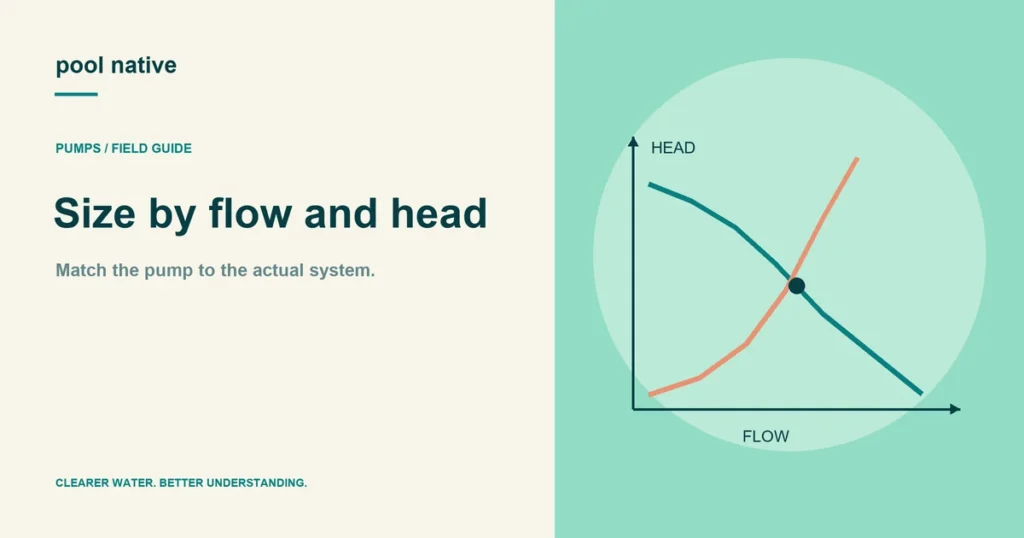
A typical curve plots flow horizontally and head vertically. For a variable speed pump, the chart may show several speeds. Locate the required flow and head, then check whether the relevant curve can provide them.
Read the exact model’s chart, including voltage and configuration notes. Don’t borrow a curve from a similar motor size. A maximum flow at very low head is not the flow you’ll necessarily get at home.
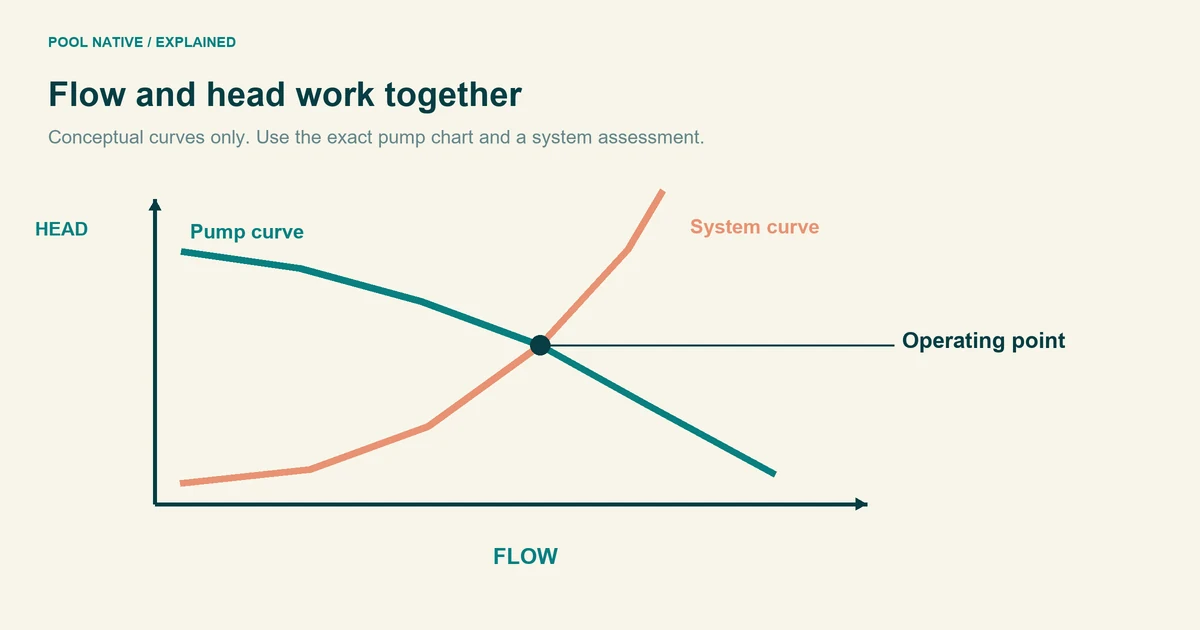
This conceptual diagram shows the relationship, not measured performance from a real pump. The operating point occurs where the pump and system characteristics meet. Your equipment requires its own published curve and system assessment.
A hypothetical sizing example
Suppose a documented design needs 45 GPM during ordinary circulation at an assessed 35 feet of head. It also needs a separate 65 GPM operating mode at its own assessed head. These are invented inputs, not recommendations for your pool.
A candidate pump must meet both relevant points within its supported operation. Now suppose one component in the shared path has a 60 GPM maximum. The 65 GPM mode cannot be accepted through that component.
A larger pump doesn’t solve this mismatch. The system design or operating requirement needs revision. That may involve a different approved component or a properly designed separate circuit.
| Check | Hypothetical result | Decision |
|---|---|---|
| Normal circulation point | Candidate curve can meet 45 GPM at 35 feet | Passes this requirement only |
| Faster required mode | Calls for 65 GPM | Check its separate head and equipment path |
| Limiting shared component | Maximum 60 GPM | Design conflict must be resolved |
Don’t turn a turnover calculation into a horsepower chart
Pool volume divided by operating minutes gives a simple volume throughput rate. For 18,000 gallons over 600 minutes, that rate is 30 GPM. The arithmetic doesn’t establish a complete operating schedule.
Water mixes as it circulates. Moving 18,000 gallons through equipment doesn’t prove every drop in an 18,000 gallon pool was filtered. It also doesn’t verify skimming, heater flow, or sanitation.
Use the volume calculation as context. Then check actual water care, circulation, and equipment requirements. Avoid charts that convert gallons directly into a single horsepower answer without those steps.
Match the filter and the fastest allowed program
Check the exact filter’s flow rating, not just its media area. More area can improve debris capacity without increasing its allowed flow. Our filter sizing guide includes a manufacturer example.
Include automatic cleaning overrides, spa mode, and priming behavior in the review. A low everyday setting doesn’t make an incompatible high program acceptable. Ask how commissioning limits will be set and preserved.
Backwashing can require a different flow from ordinary filtration. Confirm that the pump and system can provide the approved cleaning conditions without exceeding limits. A nominally larger filter still needs suitable maintenance flow.
Compare controls, electrical requirements, and installation work
Check the voltage and electrical requirements for the exact selected model. Confirm how it communicates with existing automation. A pump with its own controller may not integrate the way you expect.
Measure port locations, connection requirements, and service space. Include plumbing changes in the quote. Don’t assume matching pipe diameter makes the replacement a direct swap.
Use qualified installation for electrical work, bonding, grounding, and suction safety assessment. Don’t remove protective devices or bypass interlocks to make a candidate fit. Those constraints are part of selecting the right pump.
Ask for the settings and readings at handover
Keep the model, curve reference, documented operating requirements, and programmed modes. Ask the installer to show the normal schedule and temporary overrides. Record actual power and flow where appropriately measured.
Save clean filter pressure with its pump setting in the pool operating record. Those readings help distinguish later loading from an installation or schedule change.
For a broader explanation of pump types, energy use, and ordinary care, see the pool pump guide. The right size is the pump that meets the documented jobs within the system’s limits, with settings you can understand and maintain.