
Why Is Your Pool Pump Noisy?
A pool pump making noise needs more than a sound label to diagnose it. Grinding, rattling, humming, and a gravel like sound can overlap. Record when the noise starts and what the water and speed display are doing.
THE POOL NATIVE LIBRARY
Find your way around flow, priming and pump choices.
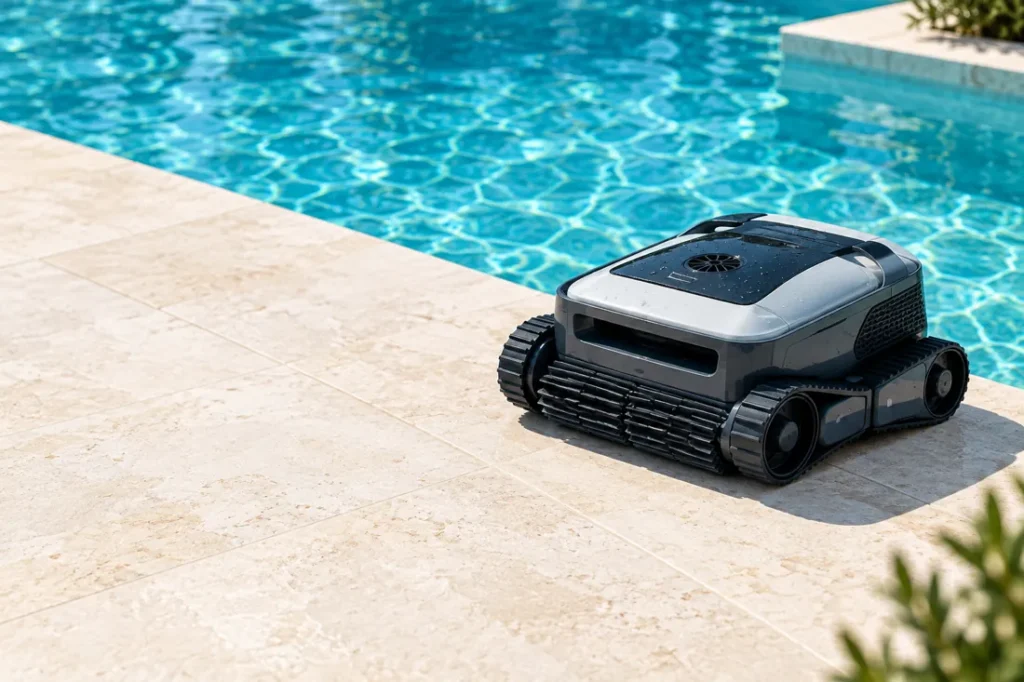
A pool pump making noise needs more than a sound label to diagnose it. Grinding, rattling, humming, and a gravel like sound can overlap. Record when the noise starts and what the water and speed display are doing.

If your pool pump trips the breaker or GFCI, keep it off until the fault is assessed. Repeatedly resetting protection can expose people and equipment to the same unresolved problem. Do not fit a larger breaker or bypass the GFCI.

A pool pump surging can mean changing motor speed, pulsing water flow, or both. Watch the RPM display and water behavior together. A constant flow pump may deliberately change speed as resistance changes, which is different from losing its water supply.

Pool pump cavitation can sound like gravel moving through the wet end. The sound comes from unstable conditions within the water, not necessarily actual stones. Debris, admitted air, and mechanical faults can sound similar, so noise alone cannot confirm cavitation.
If a pool pump ran dry or overheated, switch it off and prevent automatic restart. Do not immediately open the lid or pour water into a hot strainer pot. Hot water or vapor may remain inside even when little water was visible.
A pool pump that will not turn off may still be receiving a valid run command. Check the active feature and controlling device before assuming a relay has failed. Freeze protection, a cleaning override, and an overlapping schedule can all change the expected stopping time.
A pool pump shaft seal leaking often leaves water near the junction between the motor and wet end. Water can also travel there from a lid, fitting, or housing seal. Find the first wet point before ordering a mechanical seal.
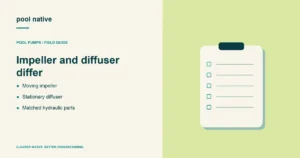
A pool pump impeller rotates; its diffuser stays stationary. The impeller transfers energy to the water. The diffuser surrounds or follows that flow in a design that helps guide it through the pump.

A pool pump replacement checklist should describe what the installation must do, not just name a horsepower. Ask the installer to quote a pump that meets the pool’s required operating flows and controls. Include commissioning in the job, so the settings are verified after installation.

Pool pump total horsepower is rated horsepower multiplied by service factor. A motor labeled 1 HP with a 1.65 service factor has 1.65 total horsepower. That number helps compare motor ratings, but it does not tell you the installed water flow.
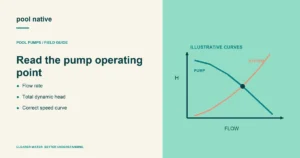
To read a pool pump curve, match a flow rate on one axis with total head on the other. Their intersection must lie on the curve for the exact pump and speed. That point describes a possible operating condition, not a guaranteed flow in your pool.

Knowing how to clean a pool pump impeller starts with confirming that a blockage is plausible. Low flow can also come from an emptying skimmer, dirty basket, air leak, or restricted line. Do those accessible checks before planning mechanical disassembly.