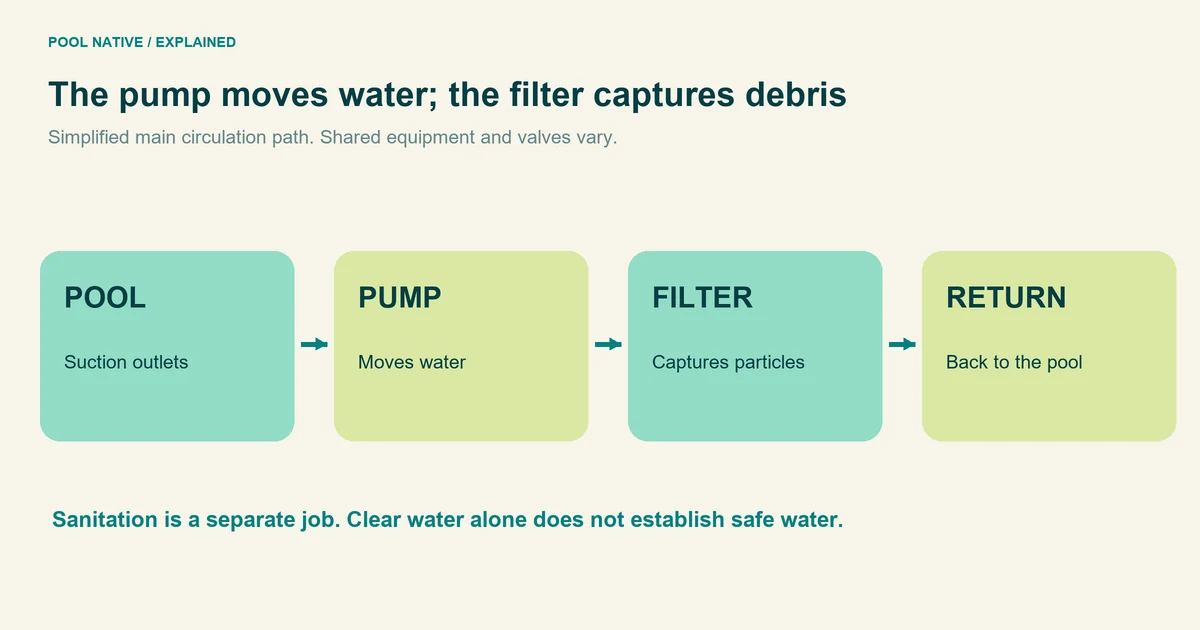
A pool pump moves water through the circulation system. It doesn’t filter or sanitize that water by itself. Understanding the job it performs makes pump choices, schedules, and warning signs much easier to assess.
Start with the installed model and the water path. A circulation pump, a cleaner booster pump, and a robotic cleaner’s motor do different work. Their size labels and schedules aren’t interchangeable.
What the pool pump actually does
The circulation pump draws water from the pool through the suction plumbing. Its impeller transfers energy to the water, which moves through the filter and the rest of the system. The return plumbing delivers that water back to the pool.
The strainer basket catches larger debris before it reaches the impeller. It isn’t the main filter. The filtration system has its own media and maintenance requirements.
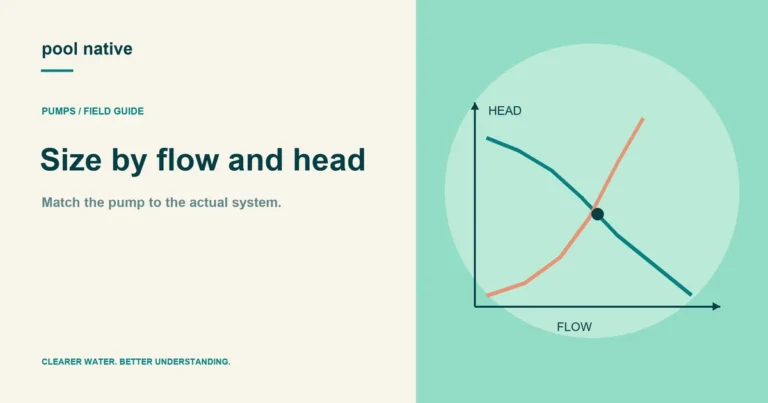
Pipework, valves, filters, heaters, and fittings resist flow. The amount of water moved depends on both the pump’s performance and that resistance. A horsepower label alone doesn’t tell you the actual flow at your pool.
Know which kind of pump you’re looking at
| Equipment | Main role | Selection or operating issue |
|---|---|---|
| Main circulation pump | Move pool water through the installed treatment system | Match flow, system resistance, equipment limits, and controls |
| Cleaner booster pump | Provide additional flow or pressure for a compatible cleaner | Follow the cleaner system’s dependency and schedule requirements |
| Dedicated feature pump | Supply a particular water feature or separate circuit | Evaluate that circuit rather than assuming main filter flow |
| Robotic cleaner motor | Drive an independent cleaner and its internal water collection | Follow the robot’s manual; it doesn’t set the main circulation schedule |
A pool can have more than one of these. Trace labels and known plumbing paths before changing a program. Don’t assume two pumps are duplicates.
Single speed, two speed, and variable speed
A single speed pump operates at one running speed. A two speed model provides two defined settings. A variable speed model can be programmed across its supported range.
Adjustable speed can help match different jobs without running one high setting all day. The actual benefit depends on the hydraulic system and schedule. Don’t apply an advertised savings percentage as a guaranteed result.
Some pumps control toward a flow target and vary speed to maintain it. Others primarily use programmed RPM. Record which mode the controller uses because it changes how you interpret readings.
Availability and efficiency rules vary by market and change over time. Check current local requirements when buying. An Australian energy label and a US certification describe different regional programs.
Match the pump to the system before choosing a model
Identify the flow required for ordinary circulation and for any shared equipment. Then evaluate the resistance at those flows. Check the candidate pump’s curve and the limits of every component in the path.
The pump sizing guide walks through those inputs. It includes a worked hypothetical example and a worksheet for discussing the installation. It doesn’t convert pool gallons directly into horsepower.
Check voltage, electrical requirements, controls, connection sizes, physical access, and the approved application. A pump intended for a permanent pool may not be approved for a storable pool. A visually similar replacement isn’t enough.
Have electrical installation and hydraulic compatibility checked by qualified professionals. That includes suction outlet protection and equipment flow limits. Don’t increase performance without reviewing what the rest of the system can safely handle.
Build a schedule around real jobs
Ordinary circulation, heating, skimming, and a pressure cleaner may need different operating conditions. Some equipment needs a minimum flow. Other components impose maximum limits.
A longer low speed period can be useful when it satisfies the system’s requirements. It isn’t automatically suitable for every cleaner or heater. Confirm actual operation instead of choosing the quietest setting and assuming the work is done.
Don’t calculate a schedule from one nominal turnover alone. Pool water mixes, so pumping the pool’s volume doesn’t mean every drop passed through the filter once. Water care and distribution still matter.
After programming, observe skimming, cleaner behavior, equipment alerts, and water results. Record changes one at a time. Avoid leaving a temporary cleaning override active indefinitely.
Estimate energy from power and time
Use measured electrical power where available, not the motor’s horsepower label. Energy in kilowatt hours equals power in kilowatts multiplied by running hours. Add separate operating periods to estimate a day’s total.
For a hypothetical schedule, 0.3 kW for 10 hours uses 3 kWh. Another 1.2 kW for one hour adds 1.2 kWh. The total is 4.2 kWh before applying the relevant electricity tariff.
Those invented power figures aren’t a forecast for your pump. Time based tariffs can also change the cost of different periods. Compare schedules that still perform the required pool jobs.
Learn your normal operating condition
Record the regular program, normal sounds, visible water behavior, and filter pressure at a known setting. Include measured flow if available. Keep this in the equipment operating log.
A pressure gauge is not a flow meter. Low pressure may accompany weak flow, while a higher reading can reflect downstream resistance. Matching the setting is essential when comparing readings.
Use the filter cleaning reference method to track filter loading. Don’t raise pump speed simply to conceal a growing restriction.
Recognize problems that need attention
- Loss of prime or unusual air: stop prolonged dry operation and follow the model’s diagnostic instructions.
- New noise or vibration: note when it occurs and whether settings changed; don’t assume it means more effective pumping.
- Weak returns: check the system as a whole, including supply, baskets, filtration, and valve mode.
- Leaks: identify the location without touching energized or pressurized equipment.
- Electrical trips or damage: stop use and arrange qualified assessment; don’t keep resetting a fault.
For a flow complaint that appears to involve the filter, use the symptom based diagnostic guide. Don’t open the motor drive or reach into the pump to investigate. Stored electrical energy and suction hazards remain serious concerns.
Keep maintenance specific to the installed model
Clean baskets using the required shutdown and pressure release procedure. Keep the equipment area accessible and ventilation unobstructed. Follow the manual for seals, lubrication, and winter preparation.
Never run a pump against a closed water path. Never operate a pool with damaged or missing suction covers. Do not use your hand or body to test suction strength.
A pump should be selected, programmed, and maintained as part of the whole pool. Keep the commissioning information with the manual. That turns the next repair or schedule adjustment into a measured decision.