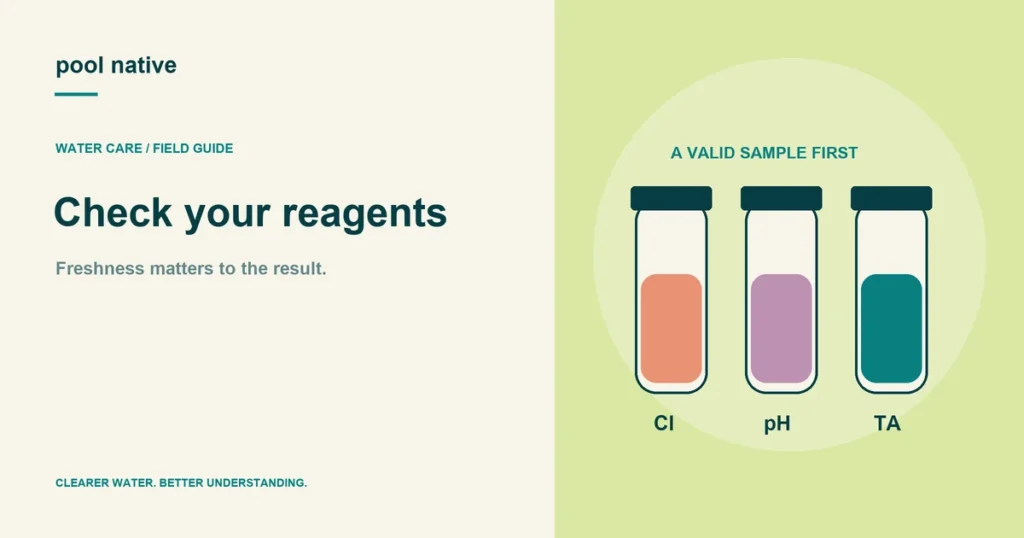
Pool test reagents do expire, and poor storage can shorten their useful life before the printed date. Heat, sunlight, moisture, and contaminated droppers all matter. A bottle looking full or the test producing a color does not prove the reagent still performs correctly.
Use the manufacturer’s date and storage guidance for the exact reagent. Liquids, powders, tablets, and strips do not necessarily age at the same rate. Replace a suspect component instead of assuming the whole kit has one universal lifespan.
Check the date and the storage history
Look for an expiration date, lot code, or replacement recommendation. If the code is unclear, ask the manufacturer rather than borrowing a decoding chart for another brand. Record when you opened the reagent and when it first entered service.
A kit stored in a hot car or outdoor equipment box deserves closer scrutiny. Freezing, repeated heat exposure, or moisture in a powder container may undermine reliability. The printed date assumes appropriate handling rather than every possible storage condition.
Taylor’s reagent guidance emphasizes storage and recommends regular replacement rather than relying on appearance alone. Follow its current guidance for Taylor products and the equivalent instructions for another brand. Don’t extend a date merely because the bottle was expensive.
Inspect without inventing a home chemistry test
Look for leaking containers, unreadable labels, clogged tips, moisture damage, or unusual changes identified by the maker. Some reagents naturally have color, so discoloration needs product specific interpretation. Don’t compare unrelated bottles and infer which is fresh.
Never taste or smell reagents deliberately to judge strength. Don’t mix old and new stock. Keep caps on their original bottles to reduce cross contamination.
Verify an unexpected result
Repeat the test with a fresh sample and correct technique. If the result still conflicts with reliable evidence, compare with fresh compatible reagent or an appropriate reference standard. The standard must suit the measurement and procedure.
A result that agrees with your expectation isn’t proof of accuracy either. Use the testing workflow and retain records so unusual changes stand out. Disagreement between methods may involve sampling or interference rather than age alone.
Buy replacements that match the system
Use the exact reagent code, strength, and size intended for the test. Different concentrations can change drop factors or comparator performance. A bottle labeled pH indicator is not automatically compatible with every pH block.
Check whether a refill includes all needed components. For FAS-DPD, powder and titrant have separate roles. Replacing only one suspect component may leave another expired reagent in use.
Make storage part of the routine
Keep supplies within the specified temperature range, out of direct sun, and away from pool chemical storage. Close bottles promptly and keep the case dry. Don’t leave used strips or spilled reagents in the kit.
Write replacement dates in the pool maintenance log. Small regular purchases are easier to plan than discovering that your only chlorine test is unreliable during a water problem.