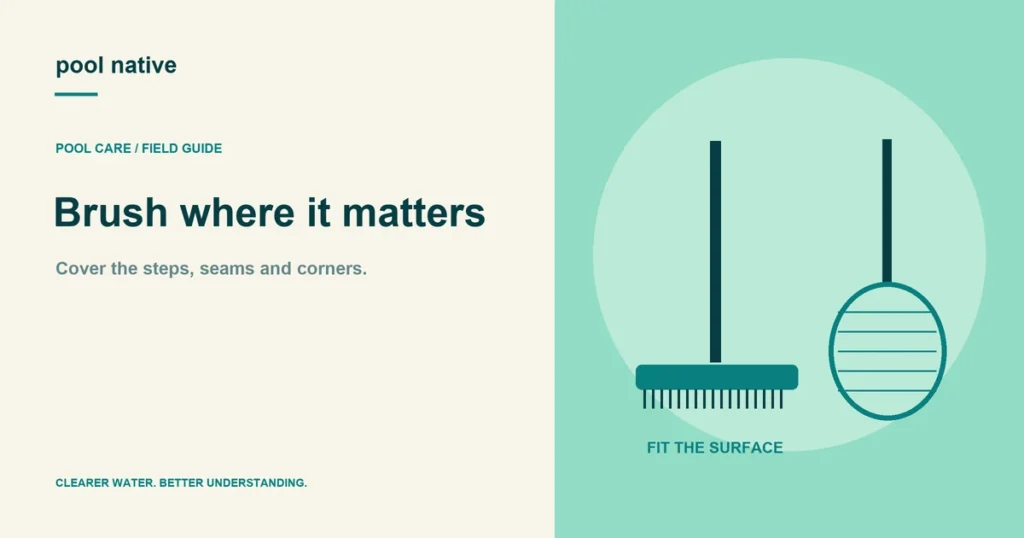
Brush a pool often enough to prevent persistent buildup and reach the areas that circulation or a cleaner misses. The right frequency depends on the finish, debris, use, and any active treatment. A new plaster startup can require a different routine from an established vinyl pool.
Use the finish provider’s instructions as the starting point. A weekly maintenance review can help you inspect the need, but it isn’t a universal promise that weekly brushing is enough. Heavy debris, developing growth, or a specific treatment can require more attention.
Identify the areas that need deliberate contact
Check steps, benches, corners, seams, ladder areas, and the waterline. Note which places your cleaner consistently misses. A robot’s completed cycle doesn’t prove every surface was brushed.
Look for visible deposits, slippery areas, or recurring dirt. Don’t diagnose the material by feel alone or enter unsafe water to inspect it. Algae identification helps distinguish a biological problem from other deposits.
Match the brush to the surface
Use brush compatibility guidance before increasing pressure or switching to stiffer bristles. Stainless steel can damage finishes that require gentler tools. A worn brush with an exposed backing can scratch even if the original bristles were suitable.
Check the pole lock and use a length you can control. Work from a stable position without overreaching. Keep the pole clear of electrical hazards and do not use it for tasks outside its design.
Set a routine you can adjust
| Condition | Brushing approach |
|---|---|
| Ordinary established pool | Follow finish guidance and inspect during routine care |
| Heavy dust, pollen, or debris | Increase attention where material settles, with removal and filtration |
| Active algae treatment | Follow the labeled treatment and finish compatible cleaning plan |
| New or resurfaced pool | Follow the finish provider’s commissioning schedule exactly |
Record problem areas rather than brushing every part with identical effort. A shaded step that repeatedly develops deposits may need a circulation or sanitation review as well. Brushing more often cannot compensate for inadequate sanitizer indefinitely.
Remove what brushing releases
Brush in a controlled pattern and use compatible vacuuming or filtration to remove loosened material. Follow equipment and treatment instructions for circulation. Don’t assume stirred up dirt has disappeared simply because it is no longer on the wall.
Check the filter according to its actual service trigger. Filter cleaning frequency depends on operating conditions and the manual, not just the number of brushing sessions. Heavy cleanup can increase the load quickly.
Reassess persistent buildup
If a deposit returns promptly, record its location, appearance, test results, and recent treatment. Pollen versus mustard algae illustrates why recurrence alone doesn’t identify the cause. A stain or finish defect will not be solved by progressively harsher brushing.
Keep the useful pattern in your maintenance log. The aim is a repeatable routine that keeps surfaces clean without unnecessary wear, not a fixed number of passes performed regardless of conditions.