A pool skimmer flap that won’t open may be jammed, incorrectly fitted, or sitting above the usable water level. The flap, called a weir, must move freely as water enters. Start with the water level and visible debris before ordering a replacement.
If the skimmer chamber is emptying or the pump is drawing air, shut the pump down. Prevent automatic restart before reaching near the flap or basket. Don’t hold the flap down while the pump runs to keep a failing setup operating.
Work out what isn’t moving
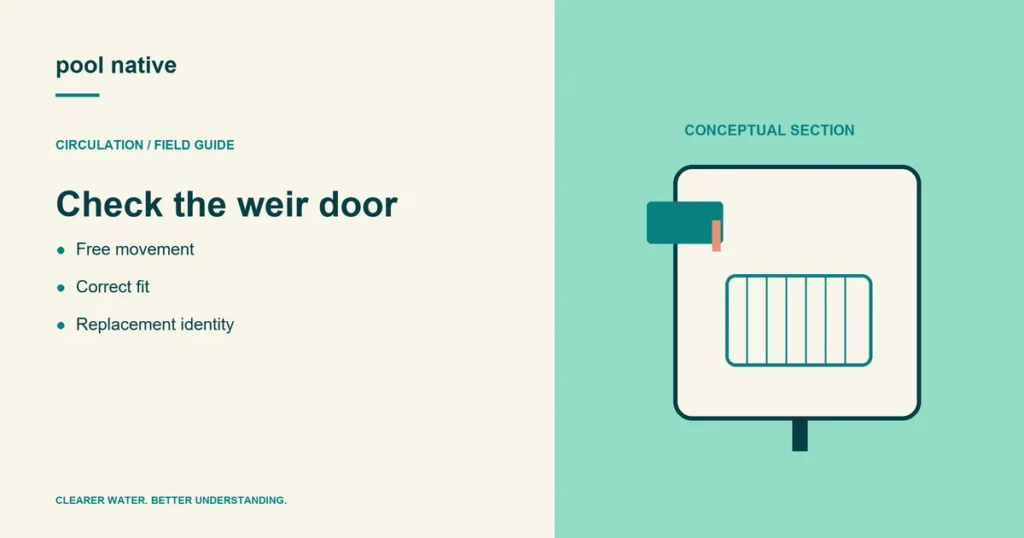
The weir is the hinged or floating gate at the mouth of the skimmer. A float valve beneath the basket is a separate part. A weir problem concerns water entering the mouth, not the lower valve closing.
Water should pass over the weir during normal skimming. It does not need to lie completely flat to work. Judge whether water enters freely, not whether the gate reaches an angle seen in another pool.
| Observation | First check |
|---|---|
| Gate catches at one point | Debris, a displaced hinge, or contact with the frame |
| Gate seems too tall or wide | Replacement model and installation orientation |
| Gate moves freely but little water enters | Water level and circulation flow |
| Gate sinks or stays flat after shutdown | Damage or lost buoyancy in a design intended to float |
Check the water against the opening
Restore the water to the operating range specified for the skimmer. If it is too low, a mechanically sound weir cannot supply normal skimming flow. Waves may briefly send water over it and disguise the problem.
Also look for leaves packed against the mouth. Remove accessible loose debris with the system safely off. Keep fingers away from pinch points and sharp broken plastic.
Inspect movement without forcing the hinge
Follow the model’s instructions for checking free movement. Look for a twig at the pivot, a crooked gate, or a hinge pin outside its socket. A recently installed part that binds is especially suspicious.
Some designs use spring pins; others attach differently. Do not pry the gate out based on a generic video. Breaking the housing’s mounting points can turn a small parts job into a larger repair.
With loose debris removed, the gate should complete its intended travel without scraping or sticking. Do not sand a replacement smaller or bend its mounts to make it fit. Recheck the correct part and orientation.
Decide whether cleaning or replacement fits
Replace a cracked, worn, or damaged weir with the specified assembly. For designs that depend on buoyancy, investigate a waterlogged or missing flotation component. Gluing random foam to the gate does not establish the right weight or movement.
Use the housing model and parts diagram when buying. Width is only one compatibility check; hinge spacing, height, and mounting style matter too. A listing described as universal still needs those details verified.
Recheck collection after reassembly
Secure the basket and lid, restore the normal operating arrangement, and restart as the equipment instructions require. Watch from outside the opening. Water should enter without repeatedly draining the chamber or drawing air.
If the gate moves correctly but leaves miss the mouth, investigate surface debris collection. If little water moves anywhere, use the skimmer flow checks. A new flap cannot correct a blocked basket or a circulation problem elsewhere.
The skimmer parts overview can help identify an unfamiliar assembly. Keep the correct weir installed during normal operation rather than removing it as a permanent workaround.