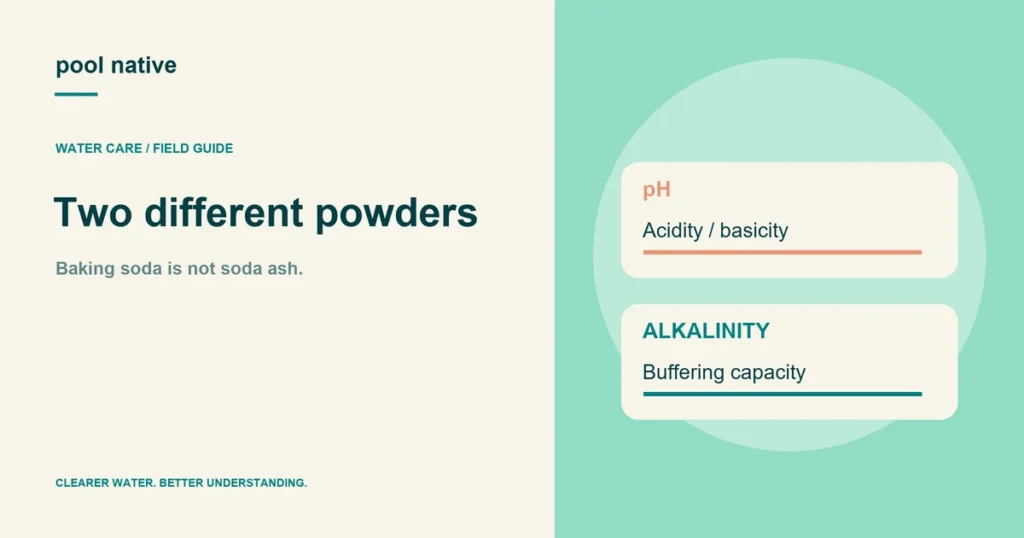
Baking soda is sodium bicarbonate; soda ash is sodium carbonate. Both can raise pool alkalinity, but soda ash has a stronger pH raising effect. Choose the compound by the correction you need rather than treating their names as interchangeable.
Neither product disinfects the pool. Neither should be added simply because water looks cloudy. Start with valid pH and alkalinity results and the requirements of the pool’s treatment system.
Compare the useful roles
| Question | Sodium bicarbonate | Sodium carbonate |
|---|---|---|
| Common pool role | Raise total alkalinity | Raise pH while also increasing alkalinity |
| Effect on pH | Generally more modest, depending on starting chemistry | Stronger upward effect |
| Risk of a blind large dose | Excess alkalinity and a harder pH management problem | pH overshoot and possible calcium precipitation |
| Can doses be swapped one for one? | No | No |
The exact response depends on the starting water, not just the product name. A chemical’s behavior in a pool can’t be reduced to its pH in a separate concentrated solution. Use measured pool results to guide the choice.
Choose bicarbonate when alkalinity needs increasing
If alkalinity is genuinely deficient, a suitable bicarbonate product is commonly used to restore buffering. Follow the label and calculate from actual volume and required increase. Monitor pH afterward rather than assuming it remains unchanged.
Use the alkalinity raising procedure for that task. Don’t add more because pH is still low without reviewing both readings. You may need a different next step.
Choose soda ash only when its combined effect fits
Soda ash may fit a low pH correction when the resulting alkalinity increase is acceptable. If alkalinity is already adequate or high, another approach may be more suitable. Raising pool pH explains the role of controlled aeration in appropriate conditions.
A large soda ash addition can create locally high pH and encourage calcium carbonate cloudiness. This is not proof that the filter suddenly failed. Stop and investigate the chemistry before adding clarifier or more powder.
Read the actual product label
Household washing products may contain fragrances or other additives and are not automatic pool substitutes. Pool products also differ in purity, packaging, and instructions. Match the active ingredient and approved use, not just a familiar brand word.
Follow the stated application method and keep measuring tools separate from other chemicals. Never mix concentrates in a bucket. Dilute only when and how the label instructs.
Retest before choosing the next correction
Allow the specified circulation period and measure both pH and alkalinity. Record the amount and actual response. Don’t alternate bicarbonate, soda ash, and acid without understanding which reading each addition is meant to change.
Use the pH and alkalinity decision guide when both values are troublesome. A coordinated plan is usually more useful than repeatedly correcting the side effects of the last product.