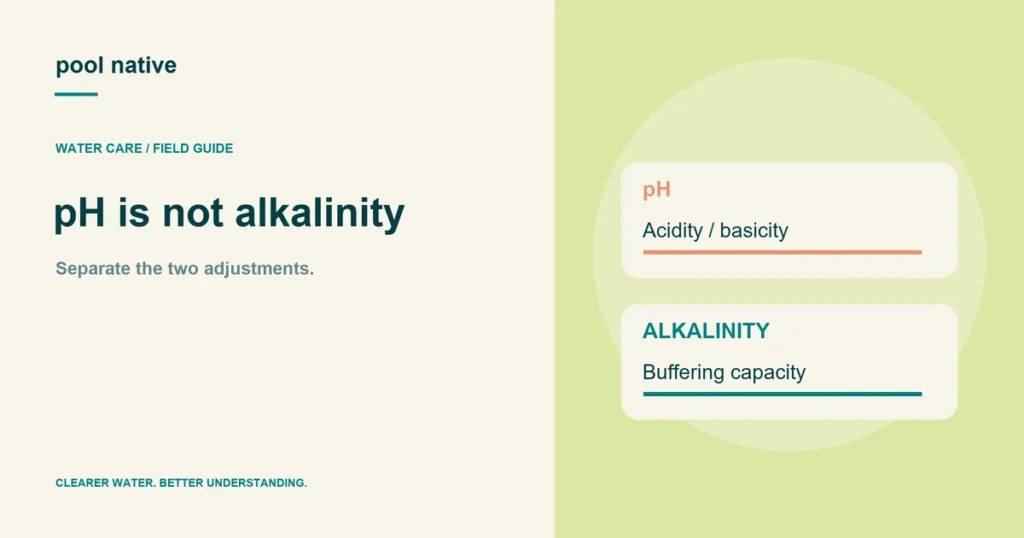
Pool pH and total alkalinity are related, but they aren’t the same measurement. pH describes how acidic or basic the water is. Alkalinity describes its capacity to neutralize acid and helps explain how strongly pH responds to a treatment.
Measure both before choosing a correction. The same pH can require different acid amounts in waters with different buffering. A single chart based only on pool gallons and pH misses that distinction.
Use the combination to choose a route
| Confirmed readings | Useful direction |
|---|---|
| High pH, alkalinity suitable | A measured pH reduction while monitoring alkalinity |
| High pH, high alkalinity | A coordinated acid and retesting plan |
| Low pH, suitable or high alkalinity | Investigate acid input and whether controlled aeration fits |
| Low pH, low alkalinity | Correct buffering and pH with appropriate measured additions |
| Suitable pH, low alkalinity | An alkalinity correction that accounts for the resulting pH change |
Suitable means appropriate to the treatment system, finish, and operating guidance. It does not mean a universal alkalinity target for every pool. CYA and other buffers can also contribute to total alkalinity readings.
Confirm the pH test is valid
Check sanitizer interference, reagent condition, sample volume, and reading time. A purple or off scale result needs pH test troubleshooting before treatment. Don’t calculate a dose from a guessed number beyond the comparator scale.
CDC’s residential guidance uses a pH range of 7.0 to 7.8. Your finish or equipment instructions may specify a narrower operating target. Meet all applicable conditions rather than choosing whichever range is easiest to satisfy.
Understand what each correction changes
Acid lowers pH and alkalinity. Sodium bicarbonate primarily serves as an alkalinity increaser, while sodium carbonate has a stronger pH raising effect and also increases alkalinity. Baking soda versus soda ash explains the practical choice.
Aeration encourages carbon dioxide to leave the water and can raise pH without adding alkalinity. Its effectiveness depends on the starting water chemistry and gas exchange. It isn’t a fixed dose equivalent or a guaranteed timed correction.
Repeated acid additions followed by repeated bicarbonate additions can create an expensive loop. Check why pH rises, including alkalinity, aeration, refill water, and equipment operation. Avoid correcting the side effect of yesterday’s unnecessary correction.
Work through one controlled adjustment
Choose an appropriate target and use actual pool volume and product strength. An acid demand test or suitable calculation can help determine quantity. Follow the label’s addition method, circulation interval, and retesting instructions.
Keep chemicals separate and never mix concentrates. Don’t pour acid in a stationary concentrated column to supposedly lower only alkalinity. Concentrated exposure can damage surfaces without providing a special selective treatment.
Use lowering pH, raising pH, lowering alkalinity, or raising alkalinity for the specific procedure. Each route needs its own follow up readings. Don’t make several unrelated corrections before allowing the first one to mix.
Include the rest of the water balance
Calcium hardness and temperature matter when assessing calcium carbonate balance, especially for cementitious finishes. A saturation index helps with that question but does not measure sanitation or every kind of corrosion. Keep the wider water chemistry picture in view.
Record starting readings, additions, and results. If pH repeatedly moves outside the intended range, investigate the pattern rather than increasing the routine dose from habit. A stable plan should explain both the measurements and the response.