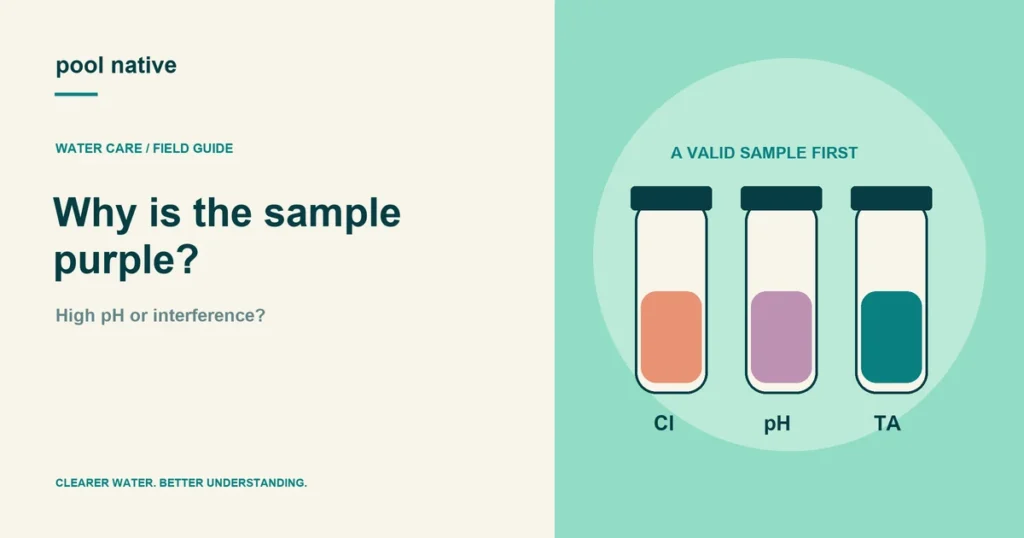
A purple or off scale pool pH test is not automatically proof that the water needs a large acid dose. The pH may be high, but sanitizer interference or the wrong reagent can also distort the color. Confirm that the test is valid before treating the result.
The exact colors and limits depend on the kit. A phenol red comparator and a strip pad can react differently. Use the instructions for the product in your hand.
Check chlorine and recent treatment
Record any recent shock or sanitizer addition and the measured chlorine level. High sanitizer can alter some pH indicators. If the kit’s interference limit is exceeded, the displayed color may no longer represent pH reliably.
Don’t convert a purple shade beyond the scale into an invented number. Don’t assume that a chlorine neutralizer can be added freely to any pH sample. Use only the manufacturer’s specified interference procedure, because an unsuitable addition can change the test itself.
If chlorine is also behaving strangely, use the clear chlorine test checks. Two unusual readings after the same chemical addition may share a testing cause. Treating both numbers independently can compound the mistake.
Repeat the pH test carefully
Use a fresh representative sample after the required mixing period. Confirm sample volume, correct reagent code, and the specified drop count. Compare in the recommended light and within the reading time.
Check for contaminated cells, mixed bottle caps, and old or overheated reagent. Rinse as directed. A sample collected next to an acid or chlorine addition may not represent the whole pool.
Don’t dilute pH as though it were chlorine
You cannot reliably divide or multiply pH readings after adding tap or distilled water. Dilution changes the sample’s chemistry, and pH is not a concentration expressed on a simple linear scale. Use an appropriate instrument or a manufacturer approved procedure instead.
A calibrated pH meter may help when suitable for the sample and expected conditions. It still needs correct buffers, electrode care, and operation. A cheap uncalibrated display is not automatically a better reference than a properly used kit.
If high pH is confirmed
Measure alkalinity and consider the system’s treatment target. Use the pH lowering procedure with the actual pool volume and acid strength. An off scale color alone cannot tell you how much acid to add.
Retest after the labeled circulation period and avoid stacking corrections. If pH repeatedly rises, investigate alkalinity, aeration, fill water, and the operating system. The pH and alkalinity overview helps separate those causes.
Keep swimming on hold if pH or sanitation cannot be established within the required conditions. Resolve the uncertainty with a suitable test rather than deciding from water appearance. Clear water can still have a problematic reading.