The liquid chlorine amount you need depends on pool volume, the desired increase in free chlorine, and the product’s actual strength. Start with a valid current reading and an appropriate target. A generic number of bottles cannot account for those inputs.
This calculation estimates the theoretical addition before ongoing chlorine demand. It does not choose the treatment target or authorize swimming. Follow the exact sanitizer label for permitted use, maximum additions, application, and reentry.
Calculate from your product label
Use the product label as the dosing reference
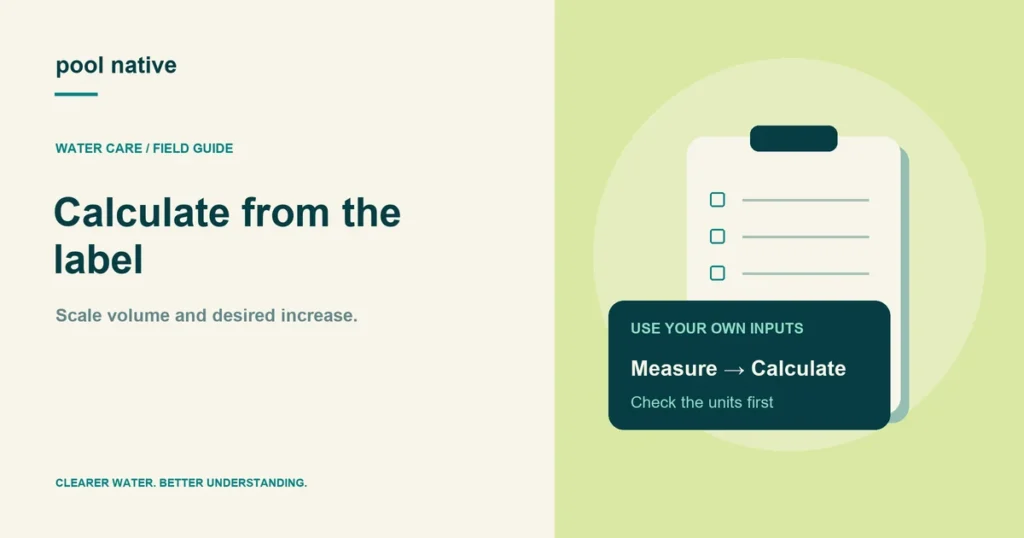
The most dependable owner calculation starts with a label statement relating a measured amount to a chlorine increase in a stated water volume. Keep all units consistent. Don’t confuse fluid ounces, ounces by weight, US gallons, and Imperial gallons.
Required amount = label reference amount × your pool volume ÷ label reference volume × desired increase ÷ label reference increase.
Desired increase is target free chlorine minus measured free chlorine. If the current result is already at or above the target, this calculation calls for no increase. Confirm that both readings and targets refer to free chlorine.
Worked label scaling example
Suppose a hypothetical label reference says 12.8 US fluid ounces raises 10,000 US gallons by 1 ppm. Your hypothetical pool holds 15,000 gallons and requires a 2 ppm increase. The calculation is 12.8 × 1.5 × 2 = 38.4 US fluid ounces.
That equals 1.2 US quarts, because one quart contains 32 fluid ounces. This is an arithmetic example, not a dose recommendation for an unidentified bottle. Use your own label’s reference values.
For a metric example, suppose a label reference states 100 mL per 10,000 liters for a 1 ppm increase. A 25,000 liter pool needing 2 ppm would require 500 mL by that reference. Again, the reference is hypothetical and must not replace the actual product instructions.
Why concentration labels need care
Percent sodium hypochlorite, percent available chlorine by weight, and trade percent are not interchangeable labels. Liquid density also matters when converting a weight concentration into a volume dose. Don’t insert whichever percentage looks familiar into an unexplained online formula.
Use a dosing reference supplied for the actual product or a calculator that explicitly matches its concentration convention. Confirm that the product is suitable for pool use. Fragranced or otherwise modified household bleach is not an automatic substitute.
Account for uncertainty before adding
Check the pool volume estimate, product age, and sample validity. Stored liquid chlorine can lose strength, but that is not a reason to guess a larger concentration correction. Use the shelf life guide when expected and observed results repeatedly differ.
A theoretical addition may not produce the full calculated increase because demand continues while the product mixes. Retest after the labeled interval. Don’t immediately add the calculated amount again without evaluating the first result.
Keep dosing and diagnosis separate
If chlorine seems to vanish rapidly, investigate demand, CYA, delivery, and testing. If the sample stays clear after a substantial addition, check possible test bleaching. The formula cannot distinguish low chlorine from a failed measurement.
Use chlorine level interpretation to choose the correct next action. Record the product, dose, and follow up result in the maintenance log. That creates a usable record of both the arithmetic and the pool’s actual response.