A pool chlorine reading only becomes useful when you know which chlorine was measured and what operating requirement applies. Free chlorine is the available residual used for routine sanitation decisions. Total chlorine includes free and combined chlorine, so the two numbers are not interchangeable.
Use the sanitizer label, system instructions, CYA context, and applicable guidance to choose your target. A generic ideal band on a test package is not a complete treatment plan. The goal is a reliable residual throughout use, not one reassuring reading after dosing.
Understand the three measurements
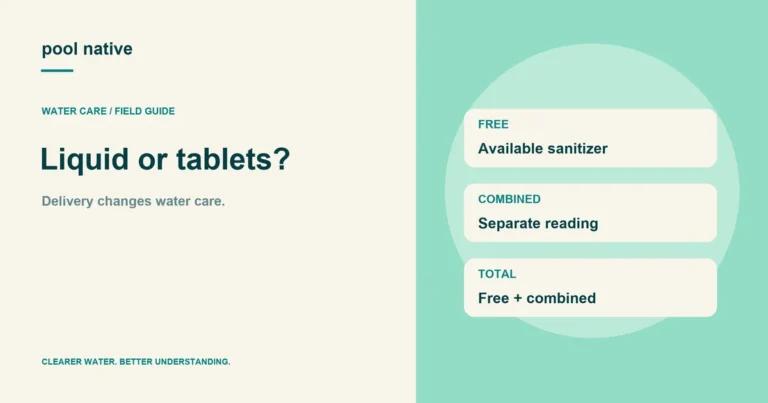
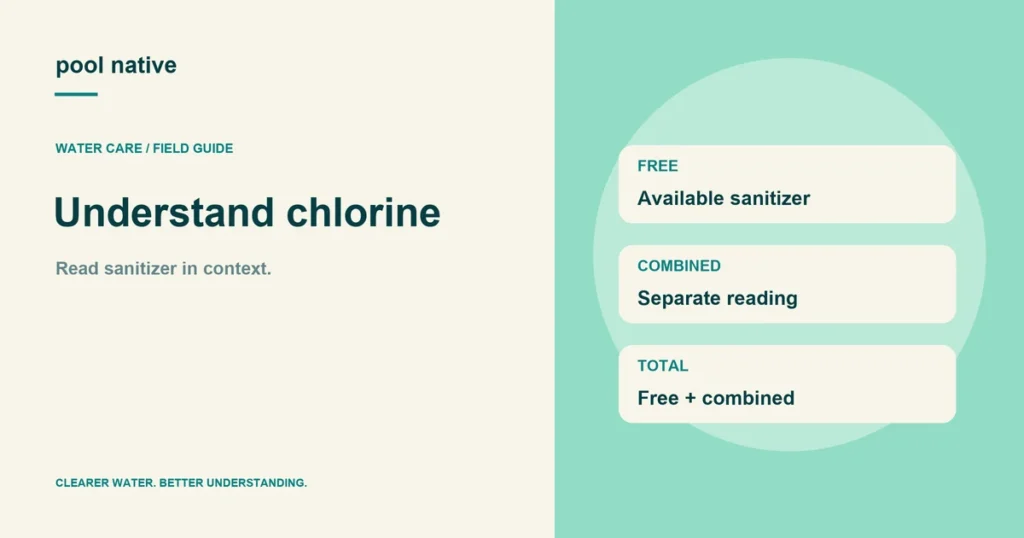
Free chlorine describes the free residual measured by the method. Combined chlorine represents chlorine combined with other substances detected by that procedure. Total chlorine is the sum of the two under a valid compatible measurement.
For example, total chlorine of 4 ppm and free chlorine of 3.5 ppm imply combined chlorine of 0.5 ppm. That calculation is hypothetical and only useful if both inputs are reliable. Subtracting rounded readings from different methods can exaggerate uncertainty.
Use free versus total versus combined chlorine for the measurement details. Don’t diagnose the water from odor alone. Smell can prompt investigation but cannot measure a residual.
Add the stabilizer context
CDC’s residential guidance recommends at least 1 ppm chlorine without CYA and at least 2 ppm when CYA is used. It also recommends pH from 7.0 to 7.8. These are public health minimums and boundaries, not a complete operating target for every pool.
Stabilizer affects chlorine management, and some chlorine products add it repeatedly. Use an appropriate CYA test rather than assuming last season’s level remains valid. Follow the actual treatment program when setting and maintaining the residual.
Interpret a low reading
Check the sample, test range, recent addition, and mixing time. If the reading is valid, investigate inadequate dosing, demand, feeder output, or product strength. Correct using the label rather than guessing from water color.
A clear DPD test after a large addition can be misleading at high chlorine. Use bleaching checks before adding more. A test problem and a real sanitizer shortage require opposite responses.
Interpret a high reading
Stop unnecessary sanitizer additions and confirm the result with a suitable method. Check automatic feeders or cell settings that may continue adding chlorine. Follow high chlorine correction and the product’s reentry limits.
Don’t neutralize a reading you haven’t verified. An excessive neutralizer dose can remove the residual you need. Keep the next measurement part of the treatment plan.
Interpret persistent combined chlorine
Confirm that free and total results are comparable and check for oxidizer interference. Investigate ongoing contamination and treatment history. High total with low free chlorine provides a diagnostic route.
Do not calculate a shock dose simply by multiplying any combined chlorine result by ten. Treatment chemistry, test interferences, and the labeled procedure matter. A simplified slogan cannot identify the actual oxidant requirement.
Test through the operating cycle
Test at the frequency required for residential guidance and use, including periods of heavier demand. Record whether a result came before or after dosing. For salt systems, include cell output and circulation hours when reviewing trends.
Keep results in the maintenance log. If the residual repeatedly falls short, change the supply or treatment plan based on evidence. Adding the same inadequate dose each day is not a stable routine.