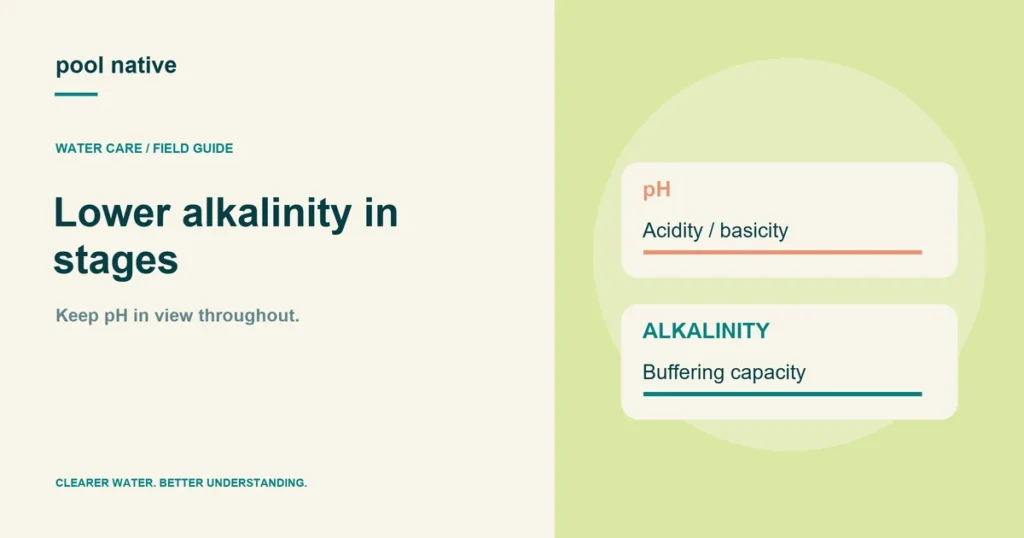
Lowering pool alkalinity requires acid, but acid also lowers pH. The practical challenge is reducing excess alkalinity without driving pH too low. A controlled sequence of acid adjustment, circulation, measurement, and appropriate aeration can manage those connected changes.
Do not pour a large acid dose into one stationary spot to lower only alkalinity. Concentrating acid doesn’t give it a selective job. It can expose the finish to damaging local conditions.
Confirm the target belongs to your pool
Measure pH and alkalinity with reliable tests. Consider sanitizer type, finish requirements, calcium hardness, temperature, and other buffers. A generic alkalinity band is not the right target for every pool.
CYA contributes to total alkalinity and can matter when assessing carbonate alkalinity and calcium balance. Don’t lower total alkalinity simply to match a number without understanding that context. The pH and alkalinity guide explains the relationship.
Plan the correction in stages
Choose the target and determine acid quantity using an appropriate calculation or professional guidance that accounts for the starting water. Use the exact product strength. Don’t substitute a remembered dose from a different acid concentration.
If pH is already low, adding more acid is not the immediate answer. Restore suitable pH using a method that fits the chemistry before continuing. Keep swimmers out while treatment or readings make the water unsuitable.
Lower, mix, and measure
Apply the acid according to the label’s safety, addition, and circulation instructions. Keep it separated from chlorine and other chemicals. Avoid exceeding the instructed dose or pushing pH below the treatment plan’s permitted boundary.
After the required mixing period, retest pH and alkalinity. Acid has reduced both. Record the observed change rather than assuming the calculation perfectly predicted the result.
Use aeration for the pH recovery step when appropriate
Aeration encourages carbon dioxide to leave the water and can raise pH without increasing alkalinity. Suitable return agitation or a water feature may provide that gas exchange. The equipment must still operate within its normal limits.
Monitor the response and stop or adjust according to the plan. Do not assume a universal aeration time or deliberately aerosolize unsafe treated water. Large or uncertain corrections are a good reason to use a competent pool professional.
Adding sodium bicarbonate to recover pH can undo the alkalinity reduction you wanted. Soda ash also raises alkalinity. Understand the chemical differences before choosing the recovery method.
Finish by checking stability
Repeat only if measurements justify another stage and the treatment instructions allow it. Recheck calcium balance and sanitizer after the water settles. A successful correction should meet the full operating requirements, not merely one target number.
If alkalinity rises again, investigate fill water, additions, and test interpretation. Keep a record of every stage in the maintenance log. Don’t turn a one time correction into an automatic weekly acid routine without evidence.