Cloudy pool water is a symptom, not a diagnosis. Suspended dirt, inadequate sanitation, calcium precipitation, or poor filtration can all make water hazy. The fastest useful response is to check the timing, water tests, and circulation before adding a clarifier.
Keep swimmers out if you cannot clearly see the bottom and drains or other required reference points. Visibility is a safety requirement as well as a cosmetic concern. Clearer water also does not prove that sanitizer is adequate.
Ask what happened before the cloudiness
Cloudiness after a storm points toward a different investigation from cloudiness immediately after adding soda ash. Haze during an algae cleanup has a different context from milky water after a refill. Record that sequence before the next treatment obscures it.
| Timing or appearance | Check first |
|---|---|
| After heavy use or neglected testing | Valid sanitizer and pH readings, visible growth, and treatment history |
| After pH or calcium adjustment | Product amount, mixing, pH, hardness, and calcium balance |
| After a storm or landscaping work | Debris, sediment, baskets, and filtration |
| After filter service | Assembly, media escape, valve setting, and normal flow |
| Green or brown tint after oxidizer | Metals and chemical compatibility as well as algae |
These are starting points, not color based proof. More than one problem can exist at the same time. Poor filtration can prolong cloudiness even after the original chemistry problem is corrected.
Confirm the water readings
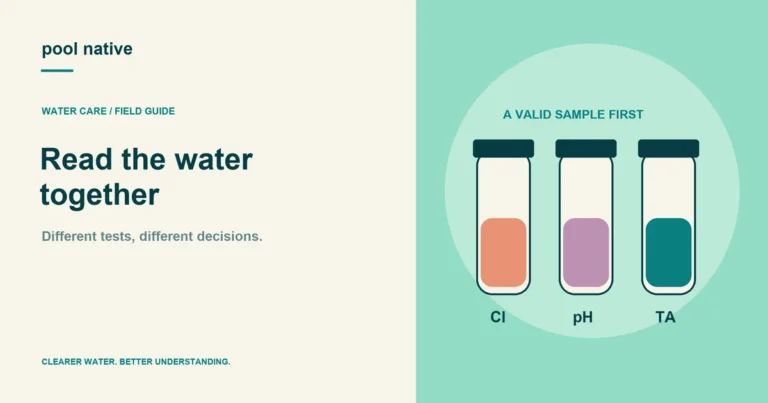
Measure free chlorine, pH, and the other factors needed by your system, including CYA when used. Verify any result that conflicts with a recent addition or falls outside the test’s range. Use the testing disagreement checks before treating questionable numbers.
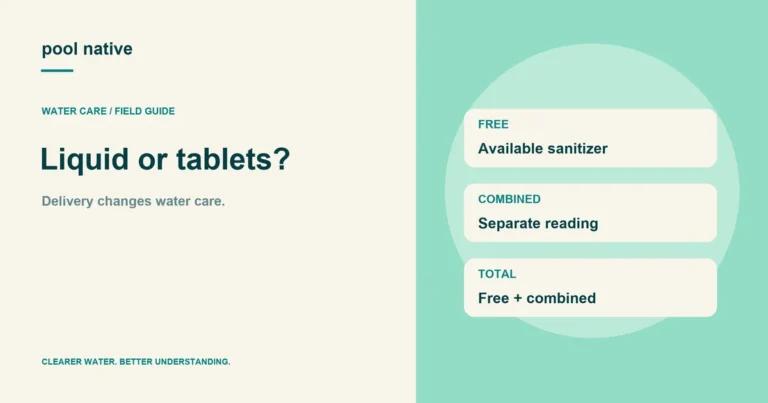
Don’t assume a strip’s ideal colors rule out a sanitation problem. Don’t assume high total chlorine means enough free chlorine. Chlorine interpretation explains that distinction.
Check whether the filter is actually receiving useful flow
Observe pump operation, return flow, baskets, and comparable filter pressure. Confirm the operating mode isn’t bypassing filtration. A motor can run while circulation is inadequate.
Clean the filter only when its condition and instructions call for it. Repeatedly backwashing because the water remains cloudy can waste water without addressing the cause. Use filter troubleshooting to distinguish restricted flow from escaping media or incorrect assembly.
Choose the treatment that fits the cause
If algae is supported by evidence, use a labeled treatment program and physical cleaning suitable for the surface. If a recent chemical addition triggered white cloudiness, investigate precipitation and water balance. If debris is the main issue, remove it and verify filtration.
Clarifiers and flocculants have different operating requirements. A product may require specific filtration, vacuuming, or waste handling and may be unsuitable for some systems. Don’t add one before confirming that you can complete its instructions.
Avoid stacking products because the first one didn’t make the water clear immediately. You may create interactions, overload the filter, or lose the ability to identify the cause. Green water after shock is a good example of a problem that can worsen with the wrong next addition.
Track progress with comparable observations
Record water clarity from the same viewpoint, the actual test results, and the filter’s operating conditions. Note the material removed by brushing, vacuuming, or filtration. A changing observation can help confirm whether the chosen route is working.
There is no dependable promise that every cloudy pool clears in 24 hours. Persistent cloudiness after correct treatment warrants another diagnosis, not an automatic second bottle. Get qualified help when sanitation remains uncertain, filtration fails, or metals and finish damage are suspected.