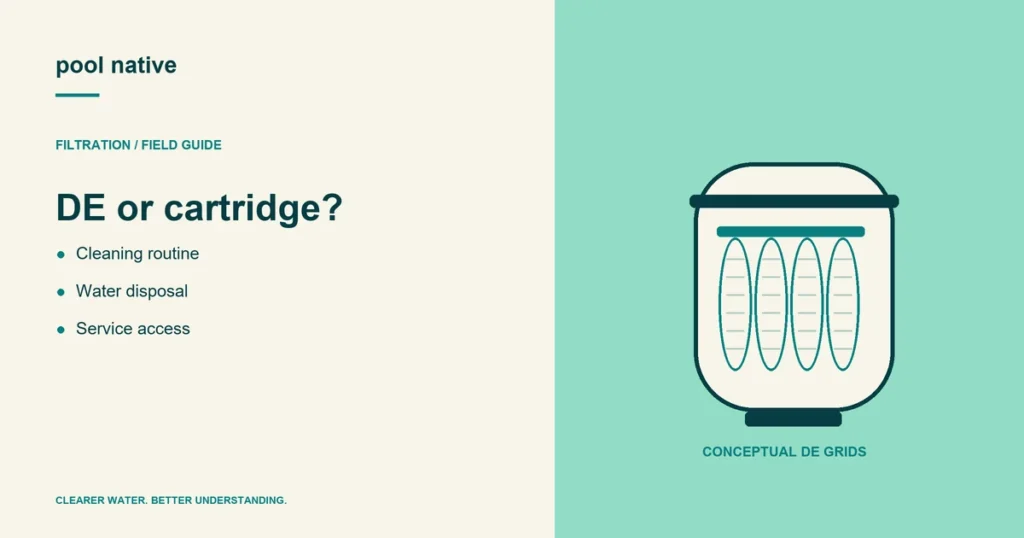
The DE filter vs cartridge filter decision comes down to the cleaning work you can sustain. DE can capture very fine particles, but its powder coating needs correct renewal. A cartridge filter avoids that powder and routine backwashing, while still requiring hands on cleaning.
Both can serve a residential pool well when properly sized and maintained. Neither replaces sanitizer, brushing, or a circulation system that actually moves water through the filter.
DE filter vs cartridge filter: the practical differences
| Decision | DE filter | Cartridge filter |
|---|---|---|
| What traps dirt? | A DE coating supported by grids or other elements | Pleated filter media |
| Ordinary cleaning | Depends on design; many systems backwash and need fresh DE | Remove elements and wash them as directed |
| Disposal planning | Dirty water and spent DE need an approved route | Dirty cartridge wash water also needs suitable disposal |
| Recurring supplies | Filter grade DE, plus eventual internal parts and seals | Replacement elements, plus seals and approved cleaning products |
| Service access | Room to open the tank and handle the internal assembly | Room to lift out and clean every cartridge |
Don’t compare a large DE filter against an undersized cartridge filter and blame every difference on the media. Filter area, flow, dirt load, and cleaning condition also affect results. Start with the same pool requirements when requesting quotes.
Understand what “finer filtration” can tell you
DE provides a filtering layer over its supporting elements. That layer is part of the operating system, not an optional additive. A grid filter run without its required coating isn’t a fair test of DE performance.
A cartridge captures debris in its own pleated media. Don’t add DE to an ordinary cartridge filter to improve it. Unicel specifically advises against that practice.
Broad micron comparisons describe a general difference between technologies. They don’t promise identical results across models or guarantee safe swimming. Persistent cloudy water still needs a diagnosis that includes water chemistry.
Compare the full cleaning job
Many DE filters allow routine debris removal by backwashing. That doesn’t eliminate periodic internal cleaning or inspection. Powder measurement, recharge, and disposal remain part of the job.
Cartridge maintenance moves the dirt removal work outside the tank. You need access to the elements, a suitable washing area, and time to clean between the pleats. A large set may feel quite different to handle than a small single element.
Ask the installer to show you the required clearance and the complete cleaning process. “Easy to clean” means little if a pipe blocks the lid or you cannot lift the assembly. Where a manufacturer specifies professional service, include that service in your budget.
Use our DE internal cleaning guide or cartridge cleaning guide for the relevant task. The methods aren’t interchangeable.
Build an ownership estimate from actual quotes
Compare the installed filter, required valves, plumbing changes, and access work first. Then list the supplies and service each option needs over your chosen ownership period. Keep assumptions visible rather than accepting one unexplained “annual cost.”
- For DE, price the correct powder, expected recharge workload, and approved disposal arrangement.
- For cartridges, price the complete replacement set rather than one element from a larger set.
- For both, include cleaning labor, water, seals, and any required professional maintenance.
- Ask which failures are covered by the warranty and which maintenance items you pay for.
There isn’t one replacement interval that makes this comparison accurate for every pool. Use condition and service evidence. Our filter lifespan guide separates the tank from replaceable components.
Which setup fits your pool?
DE is worth considering when fine particle capture is a priority and you have a workable powder and disposal routine. It’s a poor fit if nobody will measure the charge or maintain the internals. Existing sound DE equipment may also be cheaper to service than replace without a clear reason.
A cartridge system deserves a close look when routine backwash discharge is inconvenient and element washing is practical. It’s a poor fit if the installation leaves no safe cleaning access. Avoid assuming that buying the smallest compatible tank will minimize ownership work.
Have the installer verify filter size and system flow before choosing either option. Also identify how you would vacuum to waste if that task matters. A cartridge tank alone doesn’t create a bypass route.