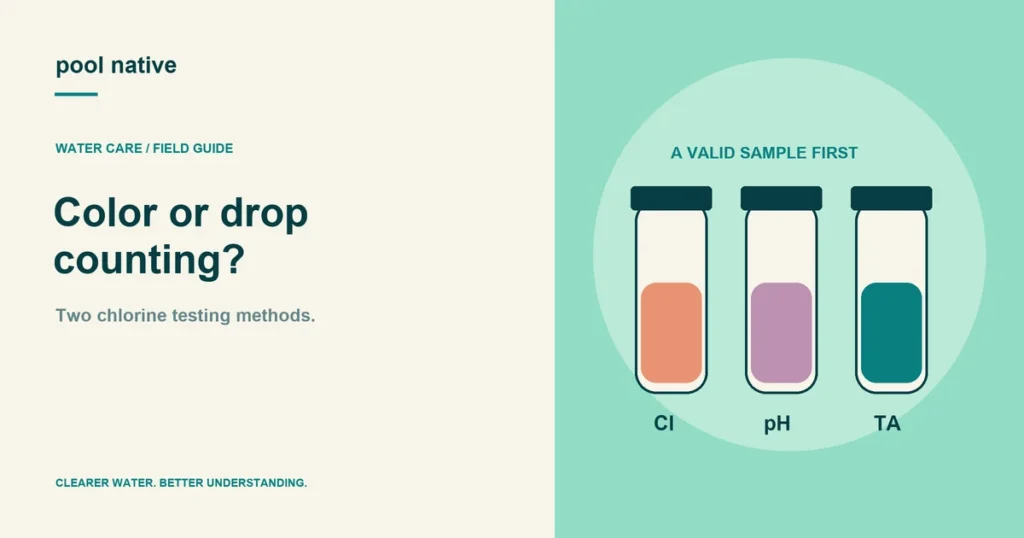
DPD color comparison and FAS-DPD titration both use DPD chemistry, but you read them differently. A conventional DPD kit compares a developed color with a scale. FAS-DPD adds a titration step: you count drops until the specified endpoint, then apply the sample factor.
For owners who need clearer separation of free and combined chlorine, FAS-DPD can be especially useful. It doesn’t make sampling, reagent care, or correct timing optional. Choose the exact kit by its documented range and procedure.
What changes during the test
In a DPD color test, chlorine produces a color whose intensity is compared visually or read by a photometer. The scale has an upper limit. A darker sample isn’t permission to estimate indefinitely beyond that limit.
In a FAS-DPD test, the initial reaction develops color and a titrating reagent removes it. The counted drops determine concentration using the factor for the selected sample volume. Some procedures then add another reagent to determine combined chlorine.
Taylor’s commonly used FAS-DPD procedures provide different factors for different sample sizes. The larger sample can provide finer increments but consumes more reagent. Read the instructions rather than using a remembered multiplier from another test.
Compare the practical tradeoffs
| Question | DPD color comparison | FAS-DPD titration |
|---|---|---|
| How is chlorine read? | Match color intensity to a scale | Count titrant drops to the endpoint |
| What can be difficult? | Similar colors, lighting, and off scale samples | Endpoint timing, counting, and correct drop factor |
| What should you check? | Measurement range and interference instructions | Sample volume, reagent condition, and procedure limits |
| Does it test all pool chemistry? | Only if the complete kit includes other tests | Only if the complete kit includes other tests |
Neither method means that pH, CYA, hardness, and alkalinity are all measured by the same procedure. Those tests may still use color comparison, turbidity, or another titration. A kit advertised for easier chlorine reading isn’t necessarily free of every visual judgment.
High chlorine needs special attention
Some DPD reactions can bleach at high chlorine and produce a falsely low or clear result. The remedy depends on the method. Follow its documented reagent or dilution procedure, or use a test suitable for the expected range.
Don’t assume every clear sample means no chlorine. Use the clear chlorine test checks when the result conflicts with recent additions. Don’t dilute a pH sample by analogy with a chlorine dilution.
Choose by the decisions you make
A routine color comparator may be sufficient within its intended range when you can read it consistently. FAS-DPD is worth considering when color matching is difficult or you need its chlorine measurement capability. Neither choice removes the need to measure stabilizer where it is used.
Check local reagent availability and replacement cost before buying. An excellent kit with unavailable refills can become an expensive empty case. Keep the full testing workflow consistent so the method’s benefits survive everyday use.