As an Amazon Associate, Pool Native earns from qualifying purchases.
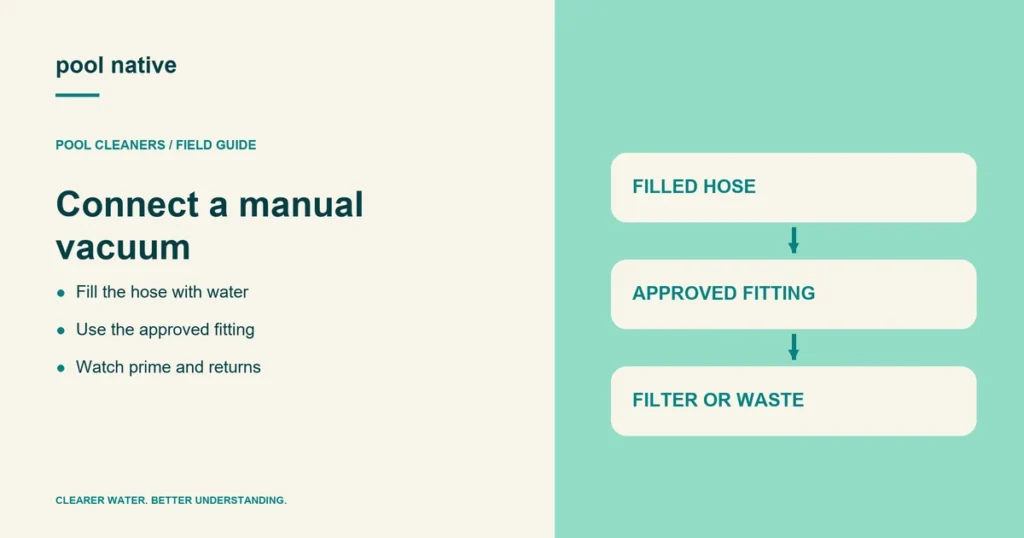
To connect a manual pool vacuum, attach a suitable head and hose, fill the hose completely with water, and connect it to the pool’s approved vacuum point. Keep the pump off while making the connection. An air filled hose can make the pump lose prime before cleaning begins.
You also need to know where the collected dirt will go. Normal filter mode sends it through the filtration system. Waste mode, where available and permitted, sends water out of the pool.
Check the head, hose, and connection
Use a vacuum head suitable for the pool surface and a pole that reaches comfortably. Match the hose diameter and cuffs to both the head and the connection. A hose that nearly fits can admit air under suction.
At a skimmer, a compatible vacuum plate may sit over the basket. Other approved arrangements connect differently. Follow your skimmer’s instructions, and do not remove a required basket or improvise a connection over an unfamiliar suction opening.
If the fittings do not match, use vacuum hose sizing and skimmer vacuum plate compatibility before starting. Keep swimmers out while vacuum equipment is connected.
Fill and connect the hose without trapping air
- Turn off the pool pump and prevent an automatic restart while you connect the equipment.
- Attach the vacuum head to the pole and the correct hose cuff to the head. For the Poolmaster hose discussed below, the swivel cuff connects to the head.
- Lower the head into the pool. Feed the hose vertically into the water, section by section, so water displaces the air.
- Keep the filled free end submerged as you bring it to the approved connection.
- Connect the hose securely using the manufacturer’s vacuum plate or fitting arrangement.
- Confirm the intended circulation path is open, then restart the pump and observe prime and return flow.
If the pump loses prime or large bubbles persist, stop and correct the connection. Do not continue vacuuming with an unfilled strainer pot. Use no suction at the vacuum to separate a hose problem from a pump supply problem.
Vacuum slowly and watch the equipment
Move the head in slow, overlapping passes. Fast movement can stir settled dirt into suspension before the intake collects it. Avoid lifting the head or hose connection out of the water while suction is active.
Watch filter pressure, return flow, and the pool level. Pause to clear loaded baskets or service the filter when needed, following the shutdown and pressure release procedure. Never open pressurized equipment just because suction at the vacuum has weakened.
Use waste only when the installation supports it
Turn the pump off before changing a multiport valve setting. Check that the disposal route is permitted and the discharge hose is secure. Waste can lower the pool level quickly, so stop before the suction supply draws air.
Some cartridge installations have no waste bypass. Do not assume that recirculate removes dirt from the pool; it normally returns water without filtration. See filter versus recirculate if the valve labels are confusing.
Handle a large patch without losing sight of the head
Start where you can clearly see the floor and work across the deposit in overlapping strips. Keep the head flat instead of pushing its edge into the sediment. If a pass raises a cloud, slow down and allow visibility to return before repeating it.
Work from the deck with a stable stance and a comfortable pole length. Reposition yourself instead of stretching across a wide section. A hose pulling against the head makes controlled movement harder, so leave enough slack for the area you are cleaning.
Stop to remove large leaves or objects that the head cannot accept. Forcing them through the opening can create a blockage farther along the hose. Bulk leaf removal and the final sediment pass can be separate jobs.
Use changes during the job to locate a problem
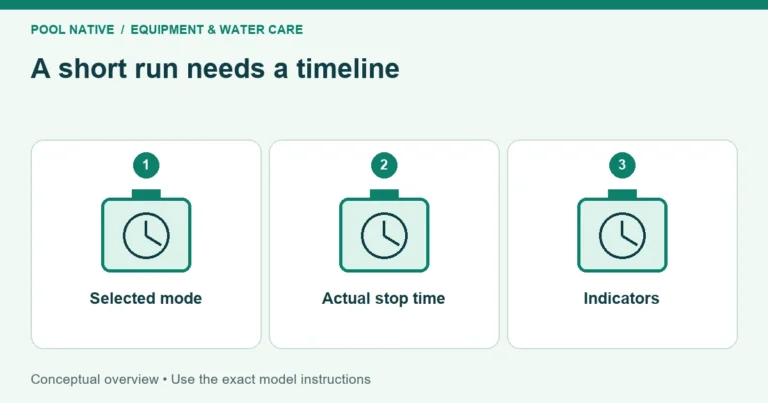
Suppose suction begins strongly, then weakens after several dirty passes. Check collection loading and the filter’s service condition before assuming the pump has failed. Stop and isolate equipment before opening baskets or disconnecting the hose.
If suction changes when you move into one corner, look for a kink, a strained cuff, or the head lifting. If bubbles begin as the water level falls, stop before the supply draws more air. These observations help distinguish a changing setup from a problem present at startup.
In waste mode, watch the discharge and pool level throughout the pass. Divide a large cleanup into manageable sessions if the available water level requires it. Do not leave the vacuum running while you walk away to refill or attend to another task.
When dirt comes back into the pool
A plume from a return while vacuuming suggests material is passing through or bypassing the collection path. Check the valve position, filter condition, and type of residue. A cloud around the vacuum head instead suggests disturbed sediment, though observation alone cannot identify every cause.
For treatment residue, follow the product’s removal method rather than repeatedly recirculating it. Finish by stopping the pump, disconnecting the vacuum, and restoring the normal baskets and valve positions. Restart normal circulation and confirm steady flow before leaving the equipment.
For a compatible manual setup, the Poolmaster 33435 hose on Amazon is a 35 foot option with 1.5 inch connections. Confirm the fittings and required reach before buying. It is a manual vacuum hose, not a substitute for an automatic cleaner’s specified hose.