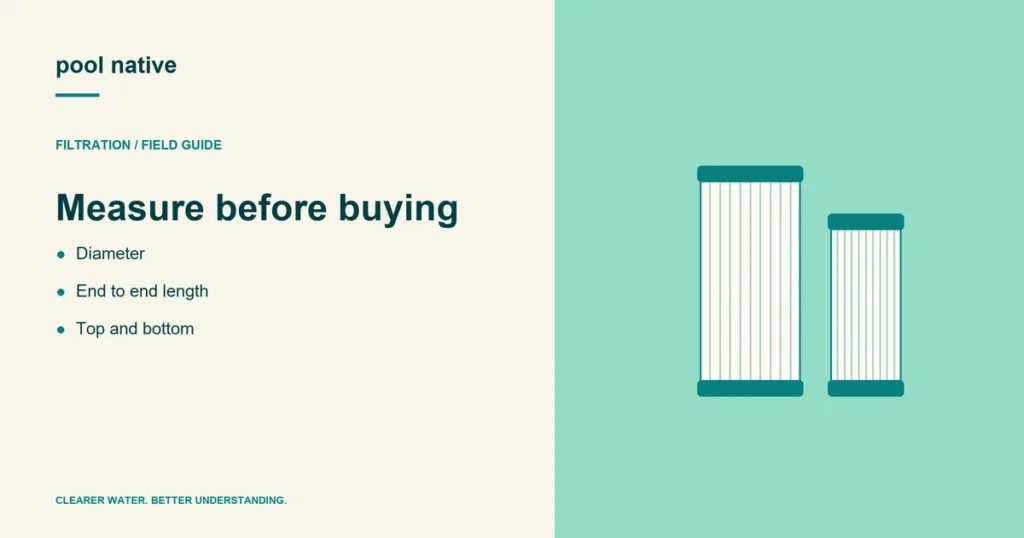
To measure a pool filter cartridge, record its outside diameter, length, and both end configurations. Include the end caps in the length, but exclude handles and other extensions. Then cross check the measurements against the housing model and replacement catalog.
Measurements narrow the search; they don’t prove compatibility by themselves. The sealing arrangement and intended filter model still matter.
How to measure a pool filter cartridge accurately
Remove the cartridge only through the equipment’s prescribed shutdown and service procedure. Clean away loose debris and place it on a stable surface. Don’t open a pressurized filter to make a quick measurement.
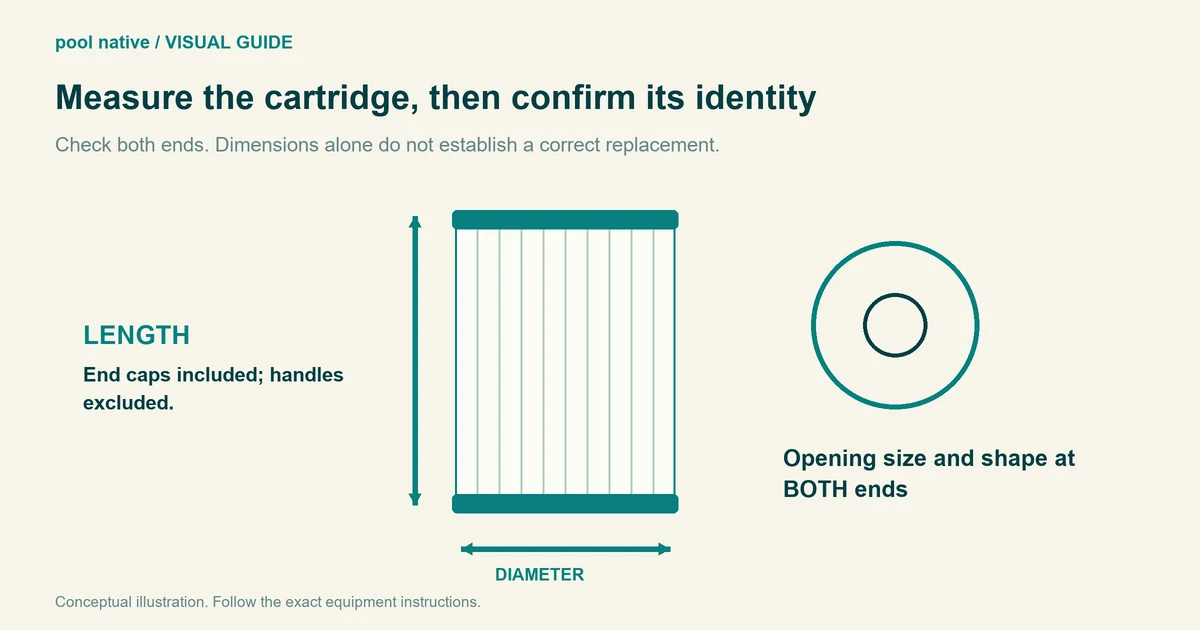
- Outside diameter: measure straight across the widest circular body, not around its circumference.
- Length: measure from end cap to end cap. Exclude handles, threaded necks, and other projections unless the catalog explicitly requests them.
- Top opening: record its inside diameter and whether it is open, closed, threaded, or shaped.
- Bottom opening: measure separately; don’t assume it matches the top.
- Other identifiers: record the part number, core arrangement, and housing model.
Unicel’s guide calls for diameter measurements within 1/32 inch and length within 1/16 inch. Those are measurement targets, not permission to install a cartridge that differs by that amount. Its catalog also uses end configuration and other identifiers.
Keep a compact measurement record
| Field | Record |
|---|---|
| Housing brand and model | Full label, including suffix |
| Existing cartridge number | All readable characters |
| Outside diameter | Dimension and unit |
| Length including end caps | Dimension and unit; extensions excluded |
| Top and bottom | Separate opening sizes and clear photographs |
| Set quantity | Number of elements inside the tank |
Use one unit system consistently. If a catalog requires inches and you measured millimeters, convert carefully rather than rounding to a nearby whole number. One inch equals 25.4 millimeters.
Avoid the common measurement traps
Don’t include a carrying handle in the main length. Don’t measure the pleated section alone and omit both caps. Either mistake can direct the search toward a different cartridge.
Check whether the old element is crushed, swollen, or distorted. A damaged part may no longer represent its intended dimensions. Use the equipment’s original specification to resolve that conflict.
Total tank area also differs from individual element area. For example, our Jandy CL lookup separates those values. A large number printed on the tank may describe a complete set.
Use the measurements to confirm a part
Find a documented cross reference that matches the equipment and the measurements. Compare both end photographs with the proposed product. The replacement identification guide puts the part number and dimensions together.
For small pool cartridges, don’t rely only on Type A or C labels. Those labels need a model match too. Never trim an end cap to force compatibility.
Once confirmed, save the replacement number so you won’t need to repeat the search. If you are measuring because performance has fallen, also check whether replacement is actually needed.