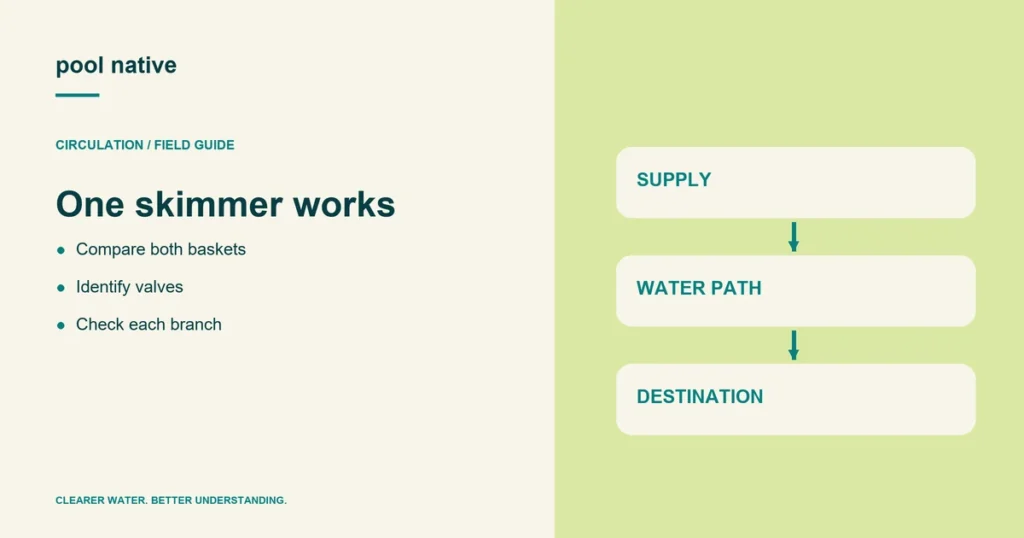
One pool skimmer not working does not always mean its pipe is blocked. The two skimmers may receive different amounts of debris or share plumbing that divides flow unevenly. Compare them under the same operating conditions before changing valves or replacing parts.
Call them skimmer A and skimmer B in your notes. Record what each actually does: water entering, air appearing, weir movement, and debris arriving. A nearly empty basket is only one observation.
Make a matched comparison
| Record for both skimmers | Why it matters |
|---|---|
| Same pump speed and mode | A schedule change can alter the entire comparison. |
| Water level and weir movement | A local restriction can limit entry. |
| Basket condition and seating | Debris or a poor fit can change operation. |
| Visible entry flow and air | Distinguishes capture differences from a circulation symptom. |
| Wind and debris route | One side may receive most floating material even with adequate flow through both. |
Observe from outside the pool. Do not cover a suction hole or remove protective fittings to compare pull. Shut down and prevent automatic restart before opening a skimmer for inspection.
Resolve the accessible differences first
Clean both baskets using the same safe procedure. Check that each basket is the correct part and seats fully. A basket that looks clean can still be distorted or incorrectly fitted.
Compare the weirs for free movement and damage. If one is stuck, follow the weir repair checks. Do not assume identical looking skimmer mouths have identical replacement parts.
If either has a float valve beneath the basket, identify its intended arrangement. Check the model’s reset and maintenance procedure rather than removing it to increase suction. The lower components may differ because the plumbing differs.
Determine how the branches connect
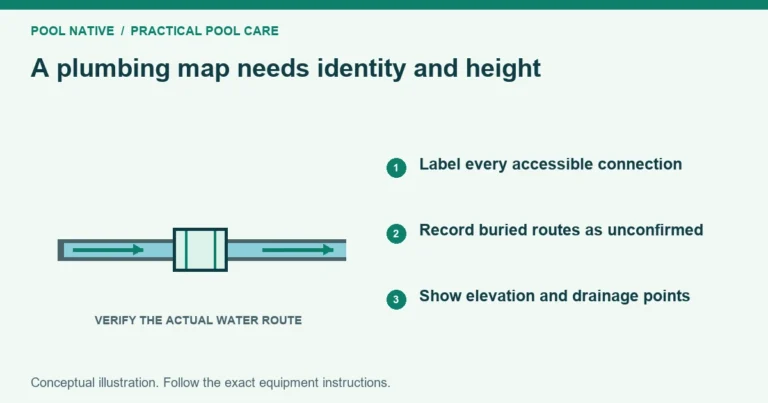
Look for labeled skimmer lines at the equipment area and compare them with the installation record. Separate visible valves can allow branch adjustment, while a shared underground tee may not. Two skimmers do not guarantee two independently controlled pipes.
Different pipe lengths and restrictions can divide flow unequally. The goal is suitable operation within system limits, not necessarily identical basket loads or an equal handle angle. A valve halfway through its travel does not guarantee half the water.
Use the valve identification guide before making a documented adjustment. Do not close every other suction source to force all flow through the weak branch. Have unknown piping identified professionally.
If the weaker branch brings air into the pump
Note whether opening that branch coincides with air accumulation or loss of prime. That is useful evidence of a branch related problem, but does not locate the defect. Stop if normal circulation cannot be maintained.
Follow the air in the pump basket checks and give the technician your matched observations. A line leak, local low water condition, or another fault may need testing. Do not pressure test an unknown line yourself.
If both move water but one catches fewer leaves
Watch how wind and return currents distribute floating debris. One skimmer may simply sit outside the main surface route. Use the surface capture checks before treating the difference as a blockage.
Save the final settings and repeat the comparison if performance changes. Include the date, weather, and any recent maintenance. That record turns “one never works” into evidence a service professional can use.