A pool autofill adds replacement water when the level falls below its setting. That can reduce the need to refill by hand. It does not eliminate the need to check the pool’s actual level or find out why water is being replaced.
A pool can look perfectly full while an autofill continuously compensates for a leak. It can also waste water by filling above an overflow opening. Understanding the sensing point, water supply and shutoff method makes those problems easier to spot.
What an autofill does
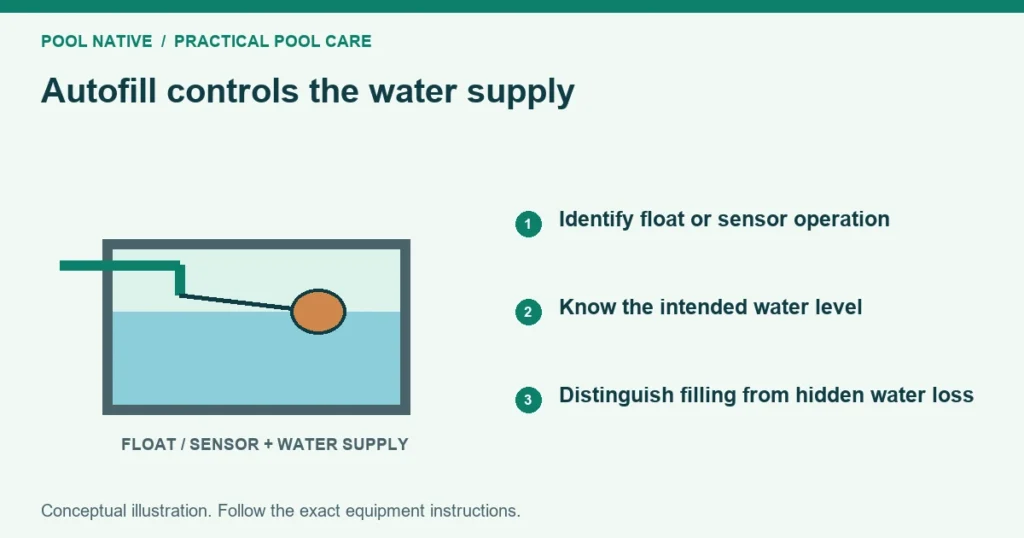
An autofill responds to a water level signal and controls incoming replacement water. The signal may come from a mechanical float or an electronic sensor. The system opens the fill valve when water is needed and closes it according to its control design.
It does not measure sanitizer, balance the water or prove the pool is leak free. Added water can change chemistry, depending on the source and how much is added. Continue normal water testing even when the level stays steady.
A manually opened fill line is different. Unless another device closes it automatically, it keeps adding water until someone shuts it off. Identify which arrangement you have before leaving it unattended.
Common system types
| Type | How it senses the level | What to identify |
|---|---|---|
| Mechanical chamber filler | A float rises and falls in a chamber connected to the pool | Float valve model, connection to pool and overflow |
| Portable pool leveler | A float responds near the pool water surface | Approved mounting, hose connection and stability |
| Electronic autofill | A sensor reports level to a controller and fill valve | Sensor, controller, valve and status indicators |
| Specialized feature or edge system | Controls water in a particular pool or balance arrangement | Which water body is being maintained and its operating sequence |
Pentair’s mechanical fillers use float mechanisms without electronic controls. A wireless system such as LevelSmart instead uses a sensor, controller and electrically operated valve. Their adjustment and troubleshooting procedures are different.
Do not apply a toilet valve procedure to every pool filler. Mounting, supply pressure, flow capacity and approved parts can differ. A familiar looking float is only the beginning of identification.
Follow four separate functions
Water supply
The replacement water comes through a supply route with an identified shutoff. Know where that shutoff is and what else it serves. A label and photo are useful when filling needs to be stopped promptly.
Level sensing
The sensor or float must represent the pool level the system is intended to maintain. A mechanical chamber depends on its connection to the pool. An electronic sensor depends on correct placement, calibration and communication.
Fill valve closure
The valve must actually stop incoming water when demand ends. A controller light changing state is useful information, but it is not proof that water stopped. A mechanical float reaching its target is similarly only part of the check.
Overflow
An overflow removes excess water where the pool design provides one. It has a separate function from normal fill control. If the fill target is above the overflow’s effective level, the system can add and discharge water continuously.
Set a level the pool can use
Choose the target from the pool and skimmer requirements. It must maintain reliable skimming and water supply without defeating the overflow arrangement. Do not select it solely for the appearance of the tile line.
Observe the level under the operating condition specified for that system. Pumps, features and waves can affect what a float or sensor sees. Specialized systems may require a particular pump state for their sensing arrangement to work.
Use the pool autofill adjustment guide for the adjustment process. If the correct pool level cannot coexist with the overflow position, investigate the installation. Raising the float again is not a solution to incompatible elevations.
Plan the installation around service access
A new system needs access to the supply shutoff, sensing components and any serviceable valve. The installer should identify the equalizing or sensing route and the overflow destination. Buried connections should be documented before they are covered.
The drinking water connection also needs the protection required by the local authority. EPA guidance explains that backflow protection depends on the hazard and applicable requirements. Have the water supplier or qualified installer confirm the approved arrangement.
Do not remove a backflow device to make an autofill operate differently. An ordinary pool circulation check valve is not automatically a substitute for drinking water protection. Device selection and any required testing belong in the installation plan.
Electrical components must use the approved power supply, enclosure and wiring arrangement. Match replacement valves and sensors to the controller. A physically similar valve may have an incompatible electrical requirement.
Check operation after installation or repair
Ask the installer to demonstrate a normal demand for water and the completed shutoff. Verify the actual pool level at both points. On an electronic system, compare the displayed status with visible evidence of filling.
For a mechanical chamber, confirm that its water level tracks the pool as the design requires. A chamber that fills while the pool stays low needs further investigation. The fill valve may be working while the connecting route is not.
Keep a commissioning record with the model numbers, target level, shutoff location and approved settings. Include the overflow route and any seasonal procedure. This makes later changes easier to evaluate.
Monitor use, not just pool level
Look for an unexpected increase in filling time or frequency. A supply meter or controller history can help when it actually measures that circuit. A household water meter includes other water use unless those uses are accounted for.
There is no single normal daily refill amount for every pool. Weather, covers, splash, maintenance and water features change losses. Compare similar conditions and investigate a persistent change.
If the system keeps running, use the autofill that will not shut off guide. If the pool falls below its target without filling, use the autofill not filling guide. Those symptoms need different checks.
Maintenance that remains necessary
Keep the accessible chamber free of loose debris and confirm the float is not obstructed. Follow the exact instructions before cleaning a supply screen or opening a valve. Shut off the water supply before disassembling pressurized fill components.
Inspect sensor mounting and visible cables where applicable. A sensor that moves can change what the controller believes the level is. Do not recalibrate immediately without first checking whether it is still correctly installed.
Follow the system’s winterization instructions in freezing climates. An inactive valve or pipe can still contain water that freezes. Leaving an autofill powered or supplied is not a universal freeze protection method.
Decide whether automation solves your problem
An autofill is useful when routine water replacement is the task. If the pool is losing an unexplained amount of water, investigate that loss first. Automatic filling can conceal the evidence without fixing it.
Choose a system whose operation you can inspect and whose service requirements you can support. The best handoff includes a demonstrated shutoff and a clear record. Convenience works better when you still know what the system is doing.